QUESTION IMAGE
Question
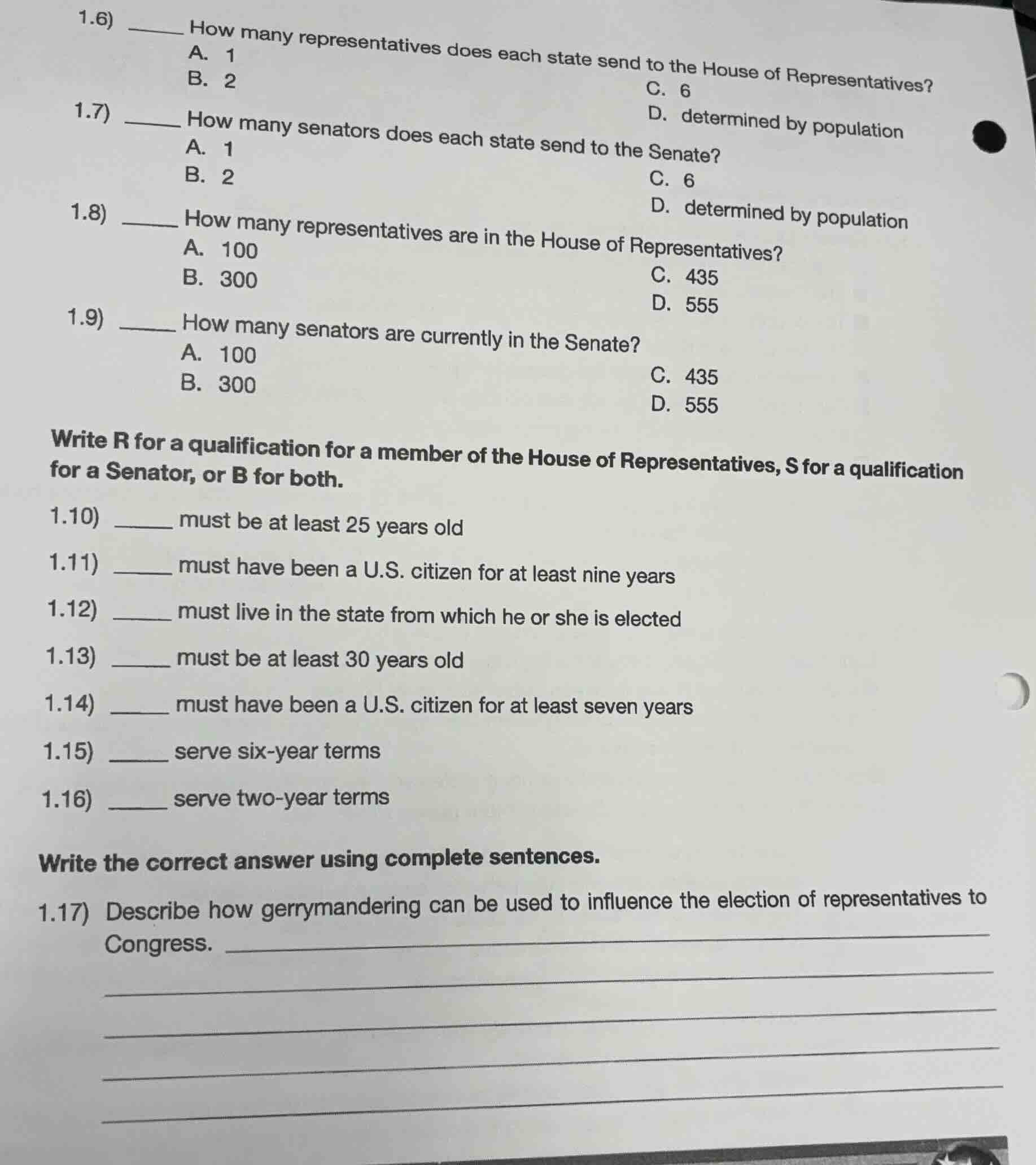
1.6) ______ how many representatives does each state send to the house of representatives?
a. 1
b. 2
c. 6
d. determined by population
1.7) ______ how many senators does each state send to the senate?
a. 1
b. 2
c. 6
d. determined by population
1.8) ______ how many representatives are in the house of representatives?
a. 100
b. 300
c. 435
d. 555
1.9) ______ how many senators are currently in the senate?
a. 100
b. 300
c. 435
d. 555
write r for a qualification for a member of the house of representatives, s for a qualification for a senator, or b for both.
1.10) ______ must be at least 25 years old
1.11) ______ must have been a u.s. citizen for at least nine years
1.12) ______ must live in the state from which he or she is elected
1.13) ______ must be at least 30 years old
1.14) ______ must have been a u.s. citizen for at least seven years
1.15) ______ serve six - year terms
1.16) ______ serve two - year terms
write the correct answer using complete sentences.
1.17) describe how gerrymandering can be used to influence the election of representatives to congress. ____________________________________________________________________________________________________________________________________________________________________________________________________
1.6) Under the U.S. Constitution, House representation is based on each state's population, updated via census.
1.7) The U.S. Constitution mandates exactly 2 senators per state.
1.8) Federal law sets the total number of U.S. House representatives at 435.
1.9) With 50 states sending 2 senators each, the total is 100.
1.10) Only House members need to be at least 25.
1.11) Only Senate members need 9+ years of U.S. citizenship.
1.12) Both House and Senate members must reside in their elected state.
1.13) Only Senate members need to be at least 30.
1.14) Only House members need 7+ years of U.S. citizenship.
1.15) Senate terms are 6 years long.
1.16) House terms are 2 years long.
1.17) Gerrymandering manipulates district boundaries to favor a political group, concentrating or splitting opposing voters.

Snap & solve any problem in the app
Get step-by-step solutions on Sovi AI
Photo-based solutions with guided steps
Explore more problems and detailed explanations
1.6) D. determined by population
1.7) B. 2
1.8) C. 435
1.9) A. 100
1.10) R
1.11) S
1.12) B
1.13) S
1.14) R
1.15) S
1.16) R
1.17) Gerrymandering is the intentional manipulation of congressional district boundaries by a political group to gain an unfair advantage in elections. For example, a party may pack voters from the opposing party into a small number of districts to waste their voting power, or they may crack opposing voters across multiple districts to dilute their influence, ensuring that the favored party wins a greater number of House seats than their overall share of the vote would otherwise warrant.