QUESTION IMAGE
Question
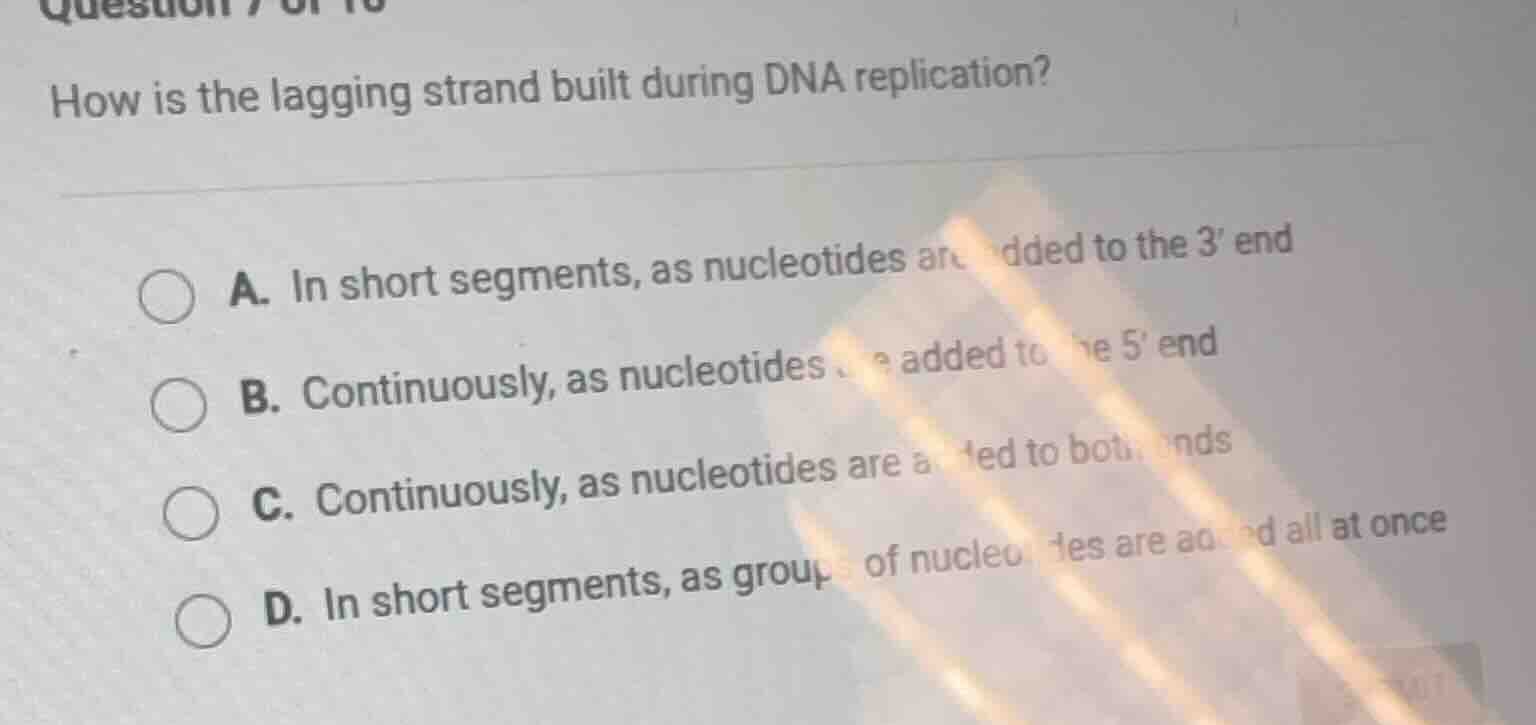
how is the lagging strand built during dna replication?
a. in short segments, as nucleotides are added to the 3 end
b. continuously, as nucleotides are added to the 5 end
c. continuously, as nucleotides are added to both ends
d. in short segments, as groups of nucleotides are added all at once
<pre_analysis>
{
"quality": "clear",
"question_count": 1,
"skills_matched": [
"direct_cot",
"multiple_choice_formatter",
"explain_then_answer",
"tutor"
],
"needs_drawing": false,
"concepts_used": [
"DNA Replication Stages"
],
"new_concepts": [
"Lagging Strand Synthesis",
"Okazaki Fragments"
],
"current_concepts": [
"DNA Replication Stages",
"Lagging Strand Synthesis",
"Okazaki Fragments"
]
}
</pre_analysis>
<reasoning>
Analyze the direction of DNA synthesis
DNA polymerase can only synthesize a new DNA strand in the \(5'\) to \(3'\) direction. This means that nucleotides are always added to the \(3'\) hydroxyl (\(-\text{OH}\)) end of the growing strand. This is a fundamental rule of DNA Replication Stages.
Compare leading and lagging strands
Because the two parental DNA strands are antiparallel, only one strand (the leading strand) can be synthesized continuously in the direction of the replication fork movement. The other strand (the lagging strand) must be synthesized in the opposite direction, away from the replication fork.
Determine lagging strand mechanism
To replicate the lagging strand, DNA polymerase synthesizes short segments called Okazaki fragments. Each short segment is built in the standard \(5'\) to \(3'\) direction, meaning nucleotides are added to the \(3'\) end of each growing fragment.
Evaluate the given options
- A. In short segments, as nucleotides are added to the 3' end: This correctly describes discontinuous synthesis (short segments) and the correct direction of nucleotide addition (to the \(3'\) end).
- B. Continuously, as nucleotides are added to the 5' end: Incorrect, because the lagging strand is synthesized discontinuously, and nucleotides cannot be added to the \(5'\) end.
- C. Continuously, as nucleotides are added to both ends: Incorrect, synthesis is discontinuous and only occurs at the \(3'\) end.
- D. In short segments, as groups of nucleotides are added all at once: Incorrect, because nucleotides are added individually by DNA polymerase, not as pre-assembled groups all at once.
</reasoning>
<answer>
<mcq-correct>A. In short segments, as nucleotides are added to the 3' end</mcq-correct>
<mcq-option>B. Continuously, as nucleotides are added to the 5' end</mcq-option>
<mcq-option>C. Continuously, as nucleotides are added to both ends</mcq-option>
<mcq-option>D. In short segments, as groups of nucleotides are added all at once</mcq-option>
</answer>
<post_analysis>
{
"subject": "Natural Science",
"question_type": "Multiple Choice",
"knowledge_point": [
"Natural Science",
"Biology",
"DNA Replication"
]
}
</post_analysis>
Snap & solve any problem in the app
Get step-by-step solutions on Sovi AI
Photo-based solutions with guided steps
Explore more problems and detailed explanations
<pre_analysis>
{
"quality": "clear",
"question_count": 1,
"skills_matched": [
"direct_cot",
"multiple_choice_formatter",
"explain_then_answer",
"tutor"
],
"needs_drawing": false,
"concepts_used": [
"DNA Replication Stages"
],
"new_concepts": [
"Lagging Strand Synthesis",
"Okazaki Fragments"
],
"current_concepts": [
"DNA Replication Stages",
"Lagging Strand Synthesis",
"Okazaki Fragments"
]
}
</pre_analysis>
<reasoning>
Analyze the direction of DNA synthesis
DNA polymerase can only synthesize a new DNA strand in the \(5'\) to \(3'\) direction. This means that nucleotides are always added to the \(3'\) hydroxyl (\(-\text{OH}\)) end of the growing strand. This is a fundamental rule of DNA Replication Stages.
Compare leading and lagging strands
Because the two parental DNA strands are antiparallel, only one strand (the leading strand) can be synthesized continuously in the direction of the replication fork movement. The other strand (the lagging strand) must be synthesized in the opposite direction, away from the replication fork.
Determine lagging strand mechanism
To replicate the lagging strand, DNA polymerase synthesizes short segments called Okazaki fragments. Each short segment is built in the standard \(5'\) to \(3'\) direction, meaning nucleotides are added to the \(3'\) end of each growing fragment.
Evaluate the given options
- A. In short segments, as nucleotides are added to the 3' end: This correctly describes discontinuous synthesis (short segments) and the correct direction of nucleotide addition (to the \(3'\) end).
- B. Continuously, as nucleotides are added to the 5' end: Incorrect, because the lagging strand is synthesized discontinuously, and nucleotides cannot be added to the \(5'\) end.
- C. Continuously, as nucleotides are added to both ends: Incorrect, synthesis is discontinuous and only occurs at the \(3'\) end.
- D. In short segments, as groups of nucleotides are added all at once: Incorrect, because nucleotides are added individually by DNA polymerase, not as pre-assembled groups all at once.
</reasoning>
<answer>
<mcq-correct>A. In short segments, as nucleotides are added to the 3' end</mcq-correct>
<mcq-option>B. Continuously, as nucleotides are added to the 5' end</mcq-option>
<mcq-option>C. Continuously, as nucleotides are added to both ends</mcq-option>
<mcq-option>D. In short segments, as groups of nucleotides are added all at once</mcq-option>
</answer>
<post_analysis>
{
"subject": "Natural Science",
"question_type": "Multiple Choice",
"knowledge_point": [
"Natural Science",
"Biology",
"DNA Replication"
]
}
</post_analysis>