QUESTION IMAGE
Question
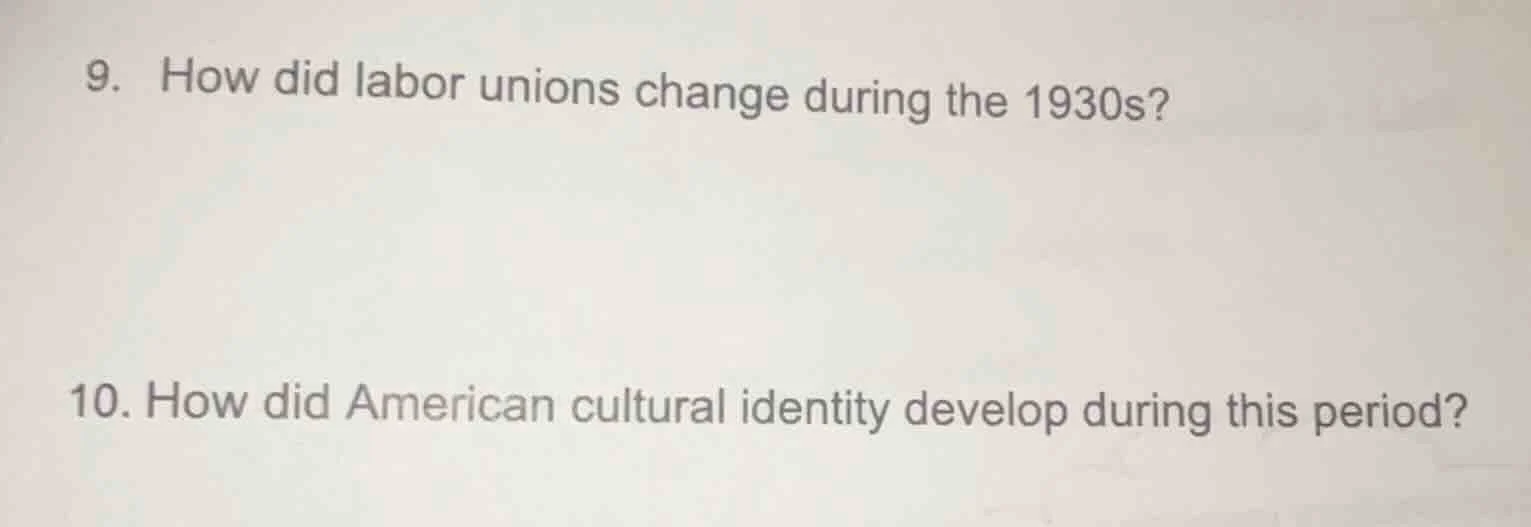
- how did labor unions change during the 1930s?
- how did american cultural identity develop during this period?
For question 9: The 1930s brought pro-labor federal legislation, expanded union scope, and shifted tactics. The Wagner Act (1935) legalized collective bargaining, allowing unions to organize freely. Unions moved beyond skilled craft workers to include industrial (unskilled/semi-skilled) workers, led by groups like the CIO. They shifted from small, isolated strikes to large, coordinated industrial actions, and gained significant membership growth.
For question 10: The 1930s (Great Depression era) saw American cultural identity tied to resilience and community. Federal New Deal programs funded art, music, and writing that celebrated working-class and regional American experiences, creating a shared narrative of struggle and unity. Popular culture (radio, film) offered escapism and reinforced values of hard work and neighborliness, while the era's hardships fostered a collective identity rooted in overcoming adversity.

Snap & solve any problem in the app
Get step-by-step solutions on Sovi AI
Photo-based solutions with guided steps
Explore more problems and detailed explanations
- Labor unions in the 1930s:
- Gained legal protection via the Wagner Act (1935) that enshrined collective bargaining rights.
- Expanded membership to include unskilled/semi-skilled industrial workers, through groups like the Congress of Industrial Organizations (CIO).
- Shifted to large-scale, coordinated industrial strikes instead of small, craft-focused actions, leading to major wins in industries like auto and steel.
- Saw massive growth in total membership, rising from under 3 million in 1933 to over 8 million by 1940.
- American cultural identity in the 1930s:
- Became tied to themes of resilience, community, and collective survival amid the Great Depression.
- Was shaped by New Deal-funded art, literature, and music (e.g., the WPA's Federal Art Project) that centered working-class, rural, and regional American stories, creating a shared narrative of struggle.
- Reinforced by popular culture (radio, Hollywood films) that offered escapism while promoting traditional values of hard work, neighborliness, and national unity.
- Emphasized a "common man" identity, moving away from the excess-focused culture of the 1920s to one rooted in humility and mutual support.