QUESTION IMAGE
Question
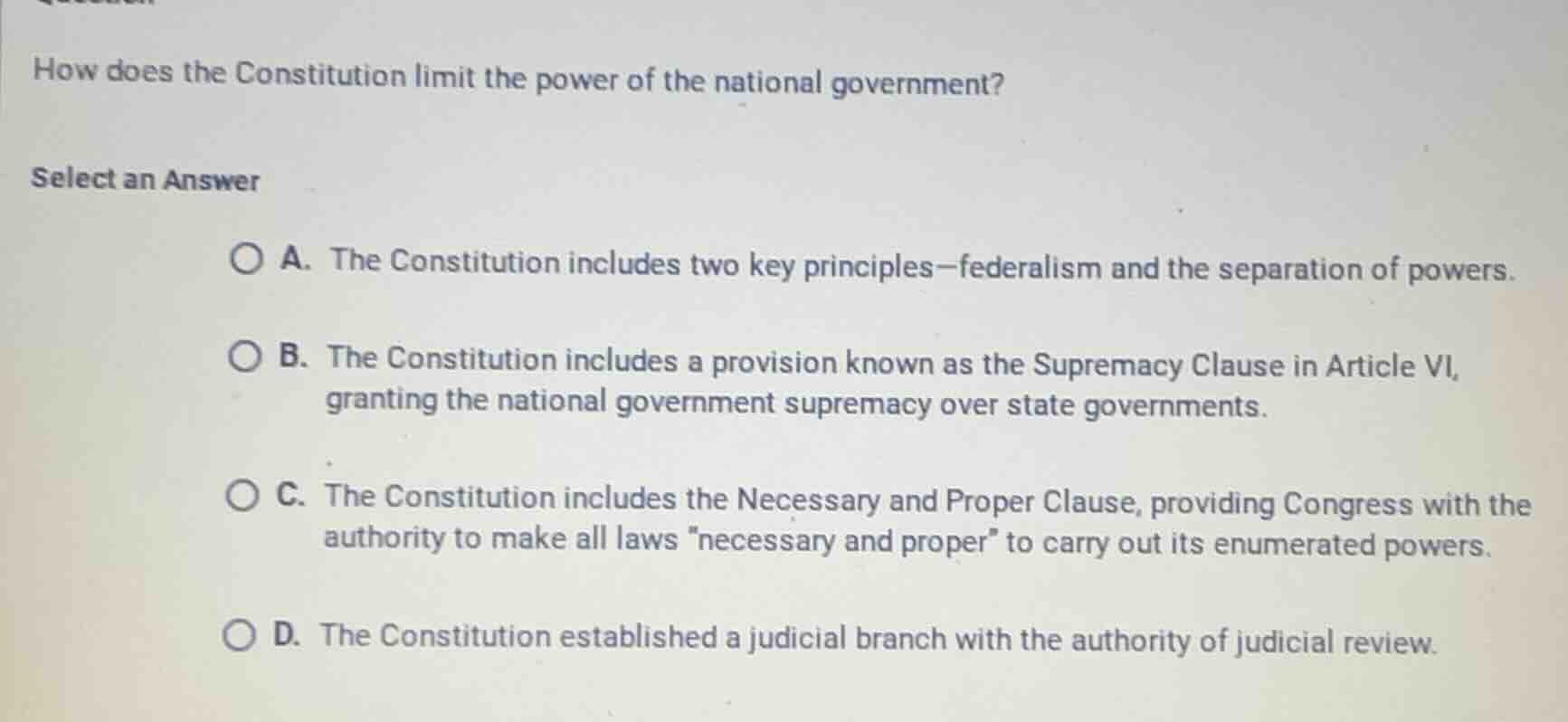
how does the constitution limit the power of the national government?
select an answer
a. the constitution includes two key principles-federalism and the separation of powers.
b. the constitution includes a provision known as the supremacy clause in article vi, granting the national government supremacy over state governments.
c. the constitution includes the necessary and proper clause, providing congress with the authority to make all laws
ecessary and proper\ to carry out its enumerated powers.
d. the constitution established a judicial branch with the authority of judicial review.
Analyze the question prompt
The question asks how the Constitution limits the power of the national government.
Evaluate the options
- Option A: Federalism divides power between the national and state governments, while the separation of powers divides national power among three distinct branches. Both are fundamental structural mechanisms designed specifically to limit the power of the national government.
- Option B: The Supremacy Clause establishes the supremacy of federal law over state law, which expands or reinforces national power rather than limiting it.
- Option C: The Necessary and Proper Clause (Elastic Clause) grants Congress implied powers to carry out its duties, which expands federal authority rather than limiting it.
- Option D: The Constitution of 1787 did not explicitly establish the power of judicial review; this authority was established later through judicial precedent in the landmark Supreme Court case Marbury v. Madison (1803).
Determine the correct answer
Option A is the only choice that describes constitutional mechanisms designed specifically to limit the power of the national government.

Snap & solve any problem in the app
Get step-by-step solutions on Sovi AI
Photo-based solutions with guided steps
Explore more problems and detailed explanations
- A. The Constitution includes two key principles-federalism and the separation of powers. (Correct answer)
- B. The Constitution includes a provision known as the Supremacy Clause in Article VI, granting the national government supremacy over state governments.
- C. The Constitution includes the Necessary and Proper Clause, providing Congress with the authority to make all laws "necessary and proper" to carry out its enumerated powers.
- D. The Constitution established a judicial branch with the authority of judicial review.