QUESTION IMAGE
Question
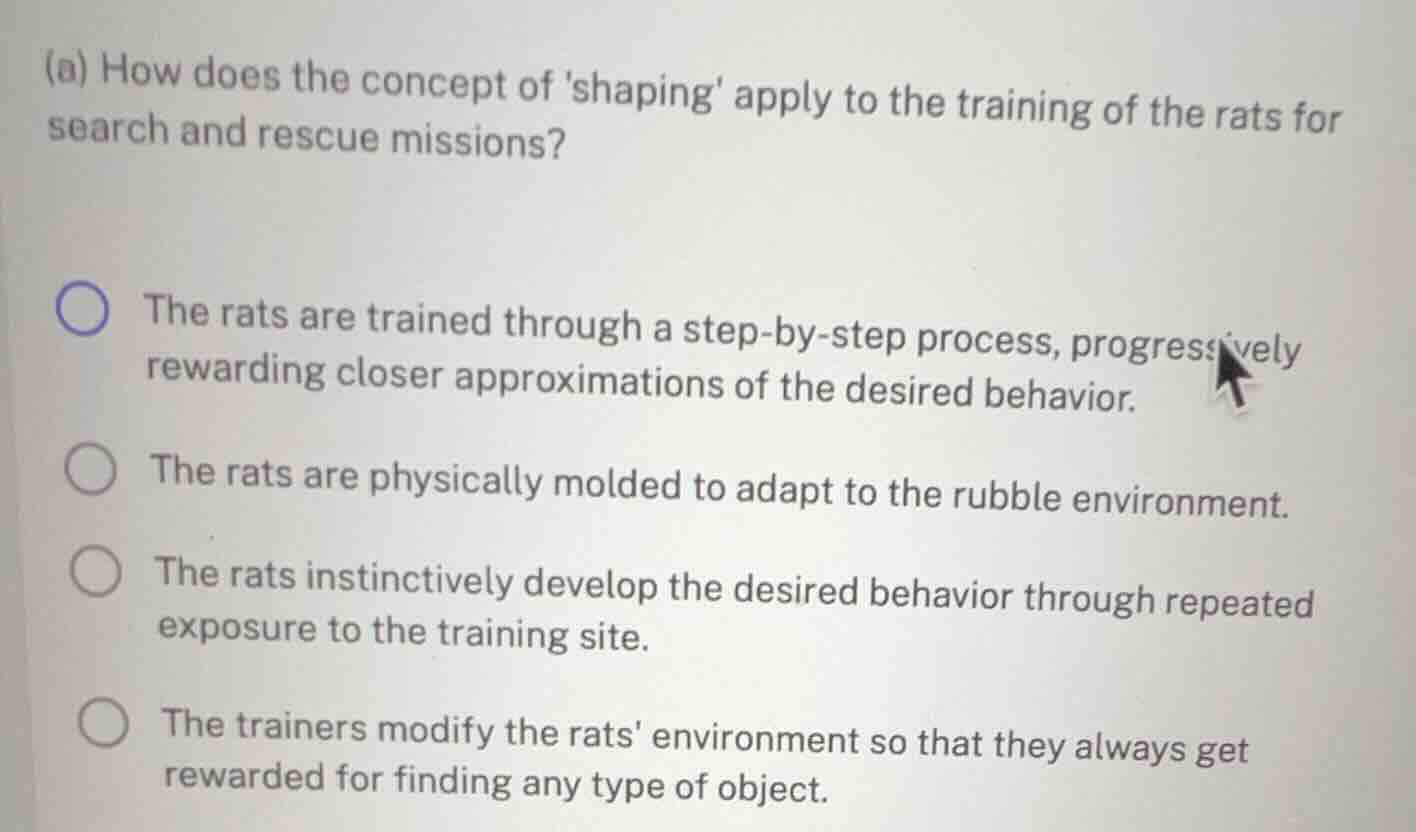
(a) how does the concept of shaping apply to the training of the rats for search and rescue missions?
- the rats are trained through a step-by-step process, progressively rewarding closer approximations of the desired behavior.
- the rats are physically molded to adapt to the rubble environment.
- the rats instinctively develop the desired behavior through repeated exposure to the training site.
- the trainers modify the rats environment so that they always get rewarded for finding any type of object.
<pre_analysis>
{
"quality": "clear",
"question_count": 1,
"skills_matched": [
"direct_cot",
"multiple_choice_formatter",
"explain_then_answer",
"tutor",
"mastery_adaptive_brevity"
],
"needs_drawing": false,
"concepts_used": [
"Operant Conditioning"
],
"new_concepts": [
"Shaping Behavior"
],
"current_concepts": [
"Operant Conditioning",
"Shaping Behavior"
]
}
</pre_analysis>
<reasoning>
Define the concept of shaping
Using the Operant Conditioning knowledge point
Shaping is an operant conditioning procedure in which reinforcement guides behavior toward closer and closer approximations of a desired goal.
Analyze the application to rat training
Training rats for complex search and rescue tasks cannot be done all at once. Trainers must reward simple behaviors first (like moving toward rubble), then reward intermediate behaviors (like entering crevices), and finally reward the target behavior (locating a survivor). This step-by-step reinforcement of successive approximations defines shaping.
Evaluate the given options
- Option 1 correctly describes shaping as a step-by-step process of rewarding closer approximations of the desired behavior.
- Option 2 describes physical manipulation, which is not shaping.
- Option 3 describes instinctual development, which contradicts learned operant behavior.
- Option 4 describes rewarding any behavior, which does not guide the animal toward a specific target behavior.
</reasoning>
<answer>
<mcq-correct>(A) The rats are trained through a step-by-step process, progressively rewarding closer approximations of the desired behavior.</mcq-correct>
<mcq-option>(B) The rats are physically molded to adapt to the rubble environment.</mcq-option>
<mcq-option>(C) The rats instinctively develop the desired behavior through repeated exposure to the training site.</mcq-option>
<mcq-option>(D) The trainers modify the rats' environment so that they always get rewarded for finding any type of object.</mcq-option>
</answer>
<post_analysis>
{
"subject": "Social Science",
"question_type": "Multiple Choice",
"knowledge_point": [
"Social Science",
"Psychology",
"Operant Conditioning"
]
}
</post_analysis>
Snap & solve any problem in the app
Get step-by-step solutions on Sovi AI
Photo-based solutions with guided steps
Explore more problems and detailed explanations
<pre_analysis>
{
"quality": "clear",
"question_count": 1,
"skills_matched": [
"direct_cot",
"multiple_choice_formatter",
"explain_then_answer",
"tutor",
"mastery_adaptive_brevity"
],
"needs_drawing": false,
"concepts_used": [
"Operant Conditioning"
],
"new_concepts": [
"Shaping Behavior"
],
"current_concepts": [
"Operant Conditioning",
"Shaping Behavior"
]
}
</pre_analysis>
<reasoning>
Define the concept of shaping
Using the Operant Conditioning knowledge point
Shaping is an operant conditioning procedure in which reinforcement guides behavior toward closer and closer approximations of a desired goal.
Analyze the application to rat training
Training rats for complex search and rescue tasks cannot be done all at once. Trainers must reward simple behaviors first (like moving toward rubble), then reward intermediate behaviors (like entering crevices), and finally reward the target behavior (locating a survivor). This step-by-step reinforcement of successive approximations defines shaping.
Evaluate the given options
- Option 1 correctly describes shaping as a step-by-step process of rewarding closer approximations of the desired behavior.
- Option 2 describes physical manipulation, which is not shaping.
- Option 3 describes instinctual development, which contradicts learned operant behavior.
- Option 4 describes rewarding any behavior, which does not guide the animal toward a specific target behavior.
</reasoning>
<answer>
<mcq-correct>(A) The rats are trained through a step-by-step process, progressively rewarding closer approximations of the desired behavior.</mcq-correct>
<mcq-option>(B) The rats are physically molded to adapt to the rubble environment.</mcq-option>
<mcq-option>(C) The rats instinctively develop the desired behavior through repeated exposure to the training site.</mcq-option>
<mcq-option>(D) The trainers modify the rats' environment so that they always get rewarded for finding any type of object.</mcq-option>
</answer>
<post_analysis>
{
"subject": "Social Science",
"question_type": "Multiple Choice",
"knowledge_point": [
"Social Science",
"Psychology",
"Operant Conditioning"
]
}
</post_analysis>