QUESTION IMAGE
Question
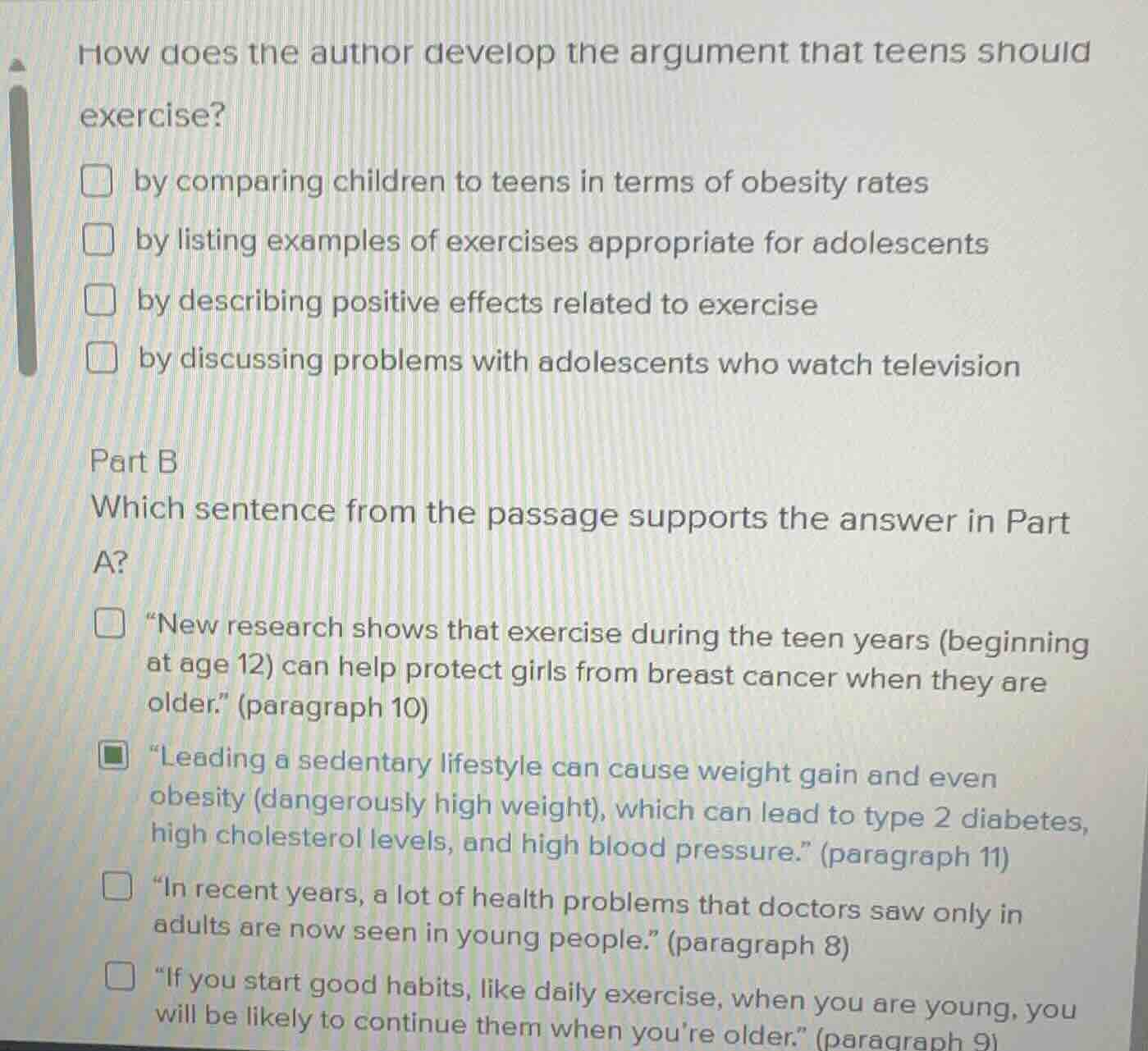
how does the author develop the argument that teens should exercise?
□ by comparing children to teens in terms of obesity rates
□ by listing examples of exercises appropriate for adolescents
□ by describing positive effects related to exercise
□ by discussing problems with adolescents who watch television
part b
which sentence from the passage supports the answer in part a?
□
ew research shows that exercise during the teen years (beginning at age 12) can help protect girls from breast cancer when they are older.\ (paragraph 10)
□ \leading a sedentary lifestyle can cause weight gain and even obesity (dangerously high weight), which can lead to type 2 diabetes, high cholesterol levels, and high blood pressure.\ (paragraph 11)
□ \in recent years, a lot of health problems that doctors saw only in adults are now seen in young people.\ (paragraph 8)
□ \if you start good habits, like daily exercise, when you are young, you will be likely to continue them when youre older.\ (paragraph 9)
Part A
To determine how the author develops the argument that teens should exercise, we analyze each option:
- Comparing children to teens' obesity rates (first option) doesn't directly argue for teens to exercise.
- Listing exercise examples (second option) focuses on exercises, not the argument for why teens should exercise.
- Describing positive effects of exercise (third option) gives reasons (like health benefits) for teens to exercise, which is a strong way to develop the argument.
- Discussing TV - watching problems (fourth option) is about a sedentary activity, not directly developing the exercise argument.
We need a sentence that supports the idea of describing positive effects of exercise (Part A's answer).
- The first sentence ("New research shows...") shows a positive effect (cancer protection) of teen exercise, supporting the argument.
- The second sentence is about negative effects of a sedentary lifestyle, not positive exercise effects.
- The third sentence is about health problems in young people, not exercise benefits.
- The fourth sentence is about habit formation, not exercise's positive effects.

Snap & solve any problem in the app
Get step-by-step solutions on Sovi AI
Photo-based solutions with guided steps
Explore more problems and detailed explanations
C. by describing positive effects related to exercise