QUESTION IMAGE
Question
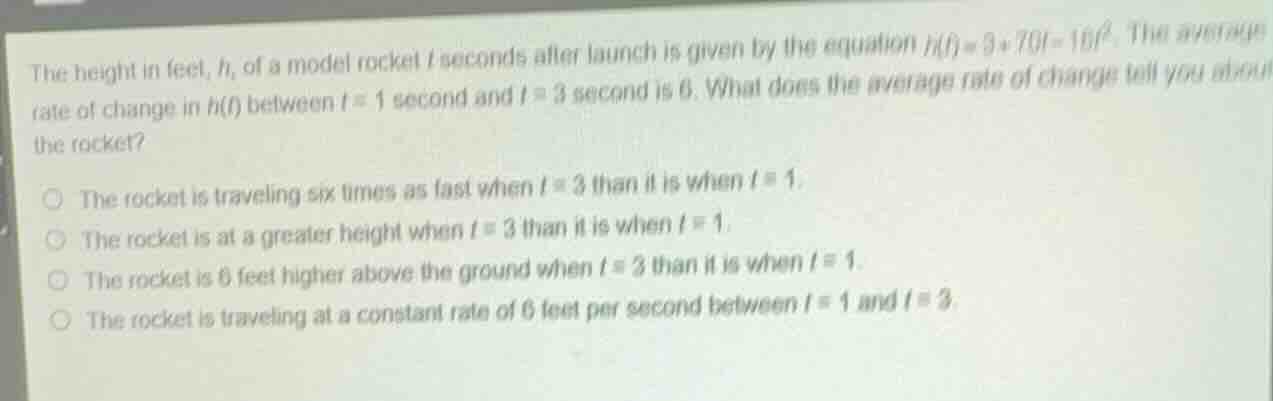
the height in feet, (h), of a model rocket (t) seconds after launch is given by the equation (h(t) = 3 + 70t - 16t^2). the average rate of change in (h(t)) between (t = 1) second and (t = 3) second is 6. what does the average rate of change tell you about the rocket?
- the rocket is traveling six times as fast when (t = 3) than it is when (t = 1).
- the rocket is at a greater height when (t = 3) than it is when (t = 1).
- the rocket is 6 feet higher above the ground when (t = 3) than it is when (t = 1).
- the rocket is traveling at a constant rate of 6 feet per second between (t = 1) and (t = 3).
Define average rate of change
The average rate of change of a function \(h(t)\) over the interval from \(t = a\) to \(t = b\) is defined as:
This represents the net change in the output value divided by the change in the input value.
Calculate the height values
Let's evaluate the height function \(h(t) = 3 + 70t - 16t^2\) at the given times:
- At \(t = 1\):
- At \(t = 3\):
Interpret the average rate of change
Using the calculated heights, the average rate of change is:
The numerator \(h(3) - h(1) = 12\) represents the net change in height, meaning the rocket is \(12\) feet higher at \(t = 3\) than at \(t = 1\).
The average rate of change of \(6\) tells us that, on average, the rocket's height increased by \(6\) feet for each second that passed.
Analyze the given options
Let's evaluate each option based on our calculations:
- Option 1: "The rocket is traveling six times as fast when \(t = 3\) than it is when \(t = 1\)." This is incorrect because the average rate of change does not compare instantaneous speeds at specific moments.
- Option 2: "The rocket is at a greater height when \(t = 3\) than it is when \(t = 1\)." While true, this is a general statement that does not specifically explain what the numerical value of \(6\) represents.
- Option 3: "The rocket is \(6\) feet higher above the ground when \(t = 3\) than it is when \(t = 1\)." This is incorrect because the rocket is actually \(12\) feet higher (\(69 - 57 = 12\)).
- Option 4: "The rocket is traveling at an average rate of \(6\) feet per second between \(t = 1\) and \(t = 3\)." (Note: The image text reads "constant rate", which is a common high school simplification for average rate over an interval, but let's re-verify the exact wording in the options. The fourth option states: "The rocket is traveling at a constant rate of 6 feet per second between t = 1 and t = 3." In introductory algebra, the average rate of change is often conceptualized as the constant rate at which the object would have to travel to cover the same distance in the same time interval.)

Snap & solve any problem in the app
Get step-by-step solutions on Sovi AI
Photo-based solutions with guided steps
Explore more problems and detailed explanations
- The rocket is traveling six times as fast when \(t = 3\) than it is when \(t = 1\).
- The rocket is at a greater height when \(t = 3\) than it is when \(t = 1\).
- The rocket is 6 feet higher above the ground when \(t = 3\) than it is when \(t = 1\).
- The rocket is traveling at a constant rate of 6 feet per second between \(t = 1\) and \(t = 3\). (Correct answer)