QUESTION IMAGE
Question
6.5 graphing and solving exponential functions quiz
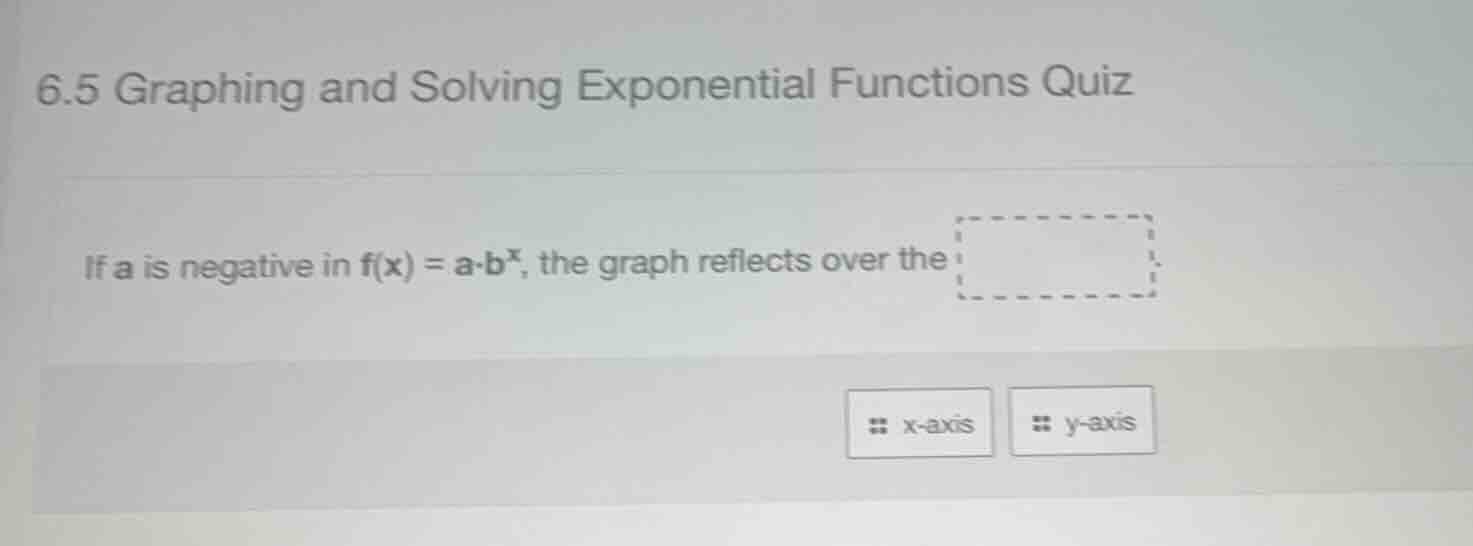
if a is negative in \\(f(x) = a \cdot b^x\\), the graph reflects over the
x-axis
y-axis
Analyze the parent function and transformation
We start with the standard exponential function \(y = b^x\), where \(b > 0\) and \(b
eq 1\). Multiplying the function by a constant \(a\) yields \(f(x) = a \cdot b^x\). This constant \(a\) acts as a vertical stretch, compression, and/or reflection.
Determine the effect of a negative coefficient
When the coefficient \(a\) is negative (\(a < 0\)), every output value \(f(x)\) changes its sign compared to when \(a\) is positive. Mathematically, this transformation is represented by \(g(x) = -f(x)\).
Identify the axis of reflection
A transformation of the form \(g(x) = -f(x)\) negates the \(y\)-coordinates of all points on the graph. This vertical negation reflects each point \((x, y)\) to \((x, -y)\), which is a reflection across the horizontal axis, known as the \(x\)-axis.

Snap & solve any problem in the app
Get step-by-step solutions on Sovi AI
Photo-based solutions with guided steps
Explore more problems and detailed explanations
If a is negative in \(f(x) = a \cdot b^x\), the graph reflects over the <blank>\(x\)-axis</blank>.