QUESTION IMAGE
Question
graphing asymptotes for a rational functions
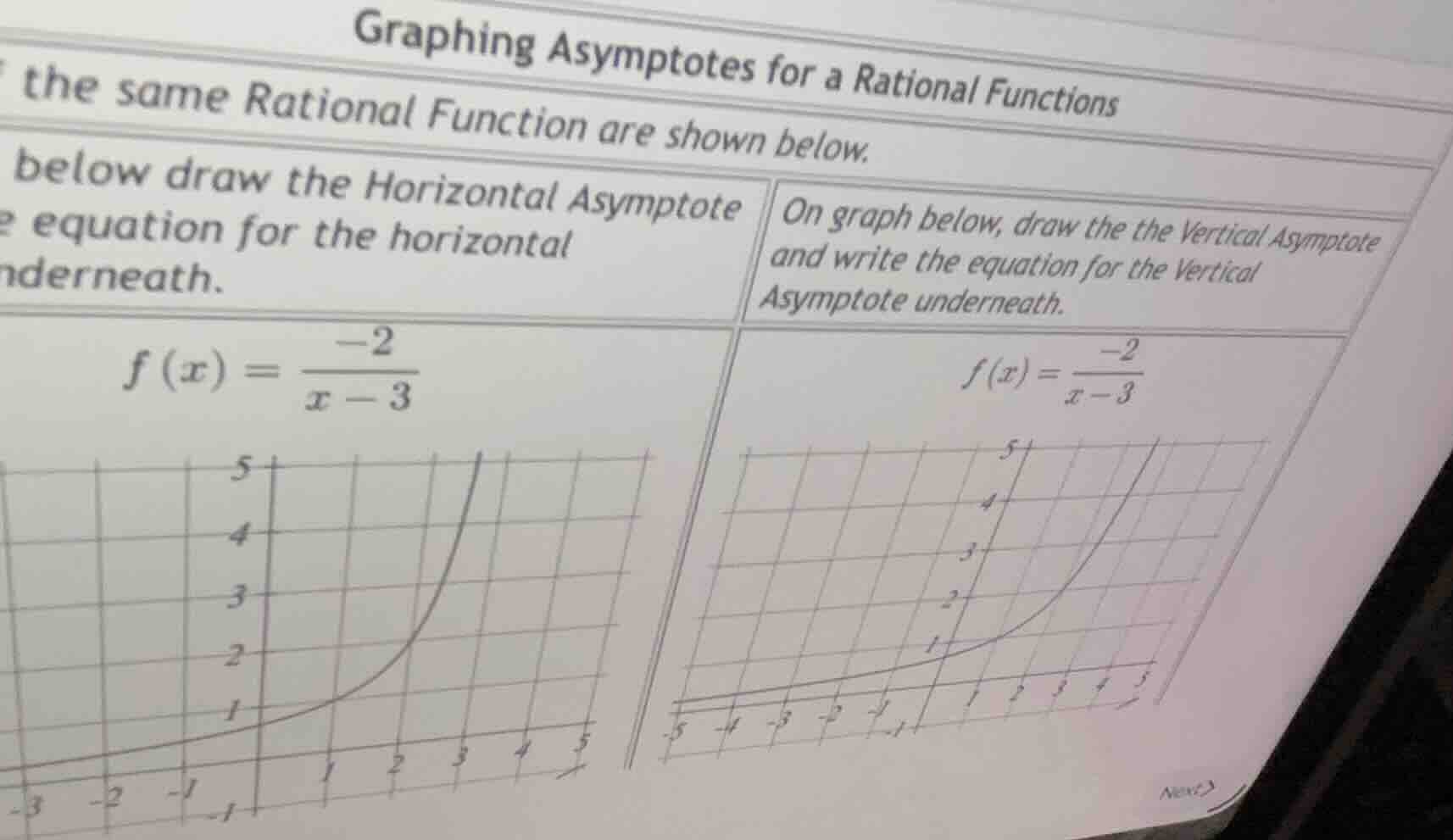
the same rational function are shown below.
on graph below draw the horizontal asymptote and write the equation for the horizontal asymptote underneath.
(f(x) = \frac{-2}{x - 3})
on graph below, draw the vertical asymptote and write the equation for the vertical asymptote underneath.
(f(x) = \frac{-2}{x - 3})
⚡ Using what you learned: Graphing Rational Functions
Step 1: Find the Horizontal Asymptote
For the rational function:
As \( x \to \infty \) or \( x \to -\infty \), the denominator becomes extremely large, causing the fraction to approach \( 0 \).
The equation of the horizontal asymptote is:
To draw this on the left graph, draw a dashed horizontal line along the x-axis (\( y = 0 \)).
Step 2: Find the Vertical Asymptote
The vertical asymptote occurs where the denominator is equal to zero and the numerator is non-zero:
The equation of the vertical asymptote is:
To draw this on the right graph, draw a dashed vertical line passing through \( 3 \) on the x-axis (\( x = 3 \)).

Snap & solve any problem in the app
Get step-by-step solutions on Sovi AI
Photo-based solutions with guided steps
Explore more problems and detailed explanations
- Left Graph (Horizontal Asymptote):
- Draw: A horizontal dashed line along the x-axis (\( y = 0 \)).
- Equation: \( y = 0 \)
- Right Graph (Vertical Asymptote):
- Draw: A vertical dashed line passing through \( x = 3 \).
- Equation: \( x = 3 \)