QUESTION IMAGE
Question
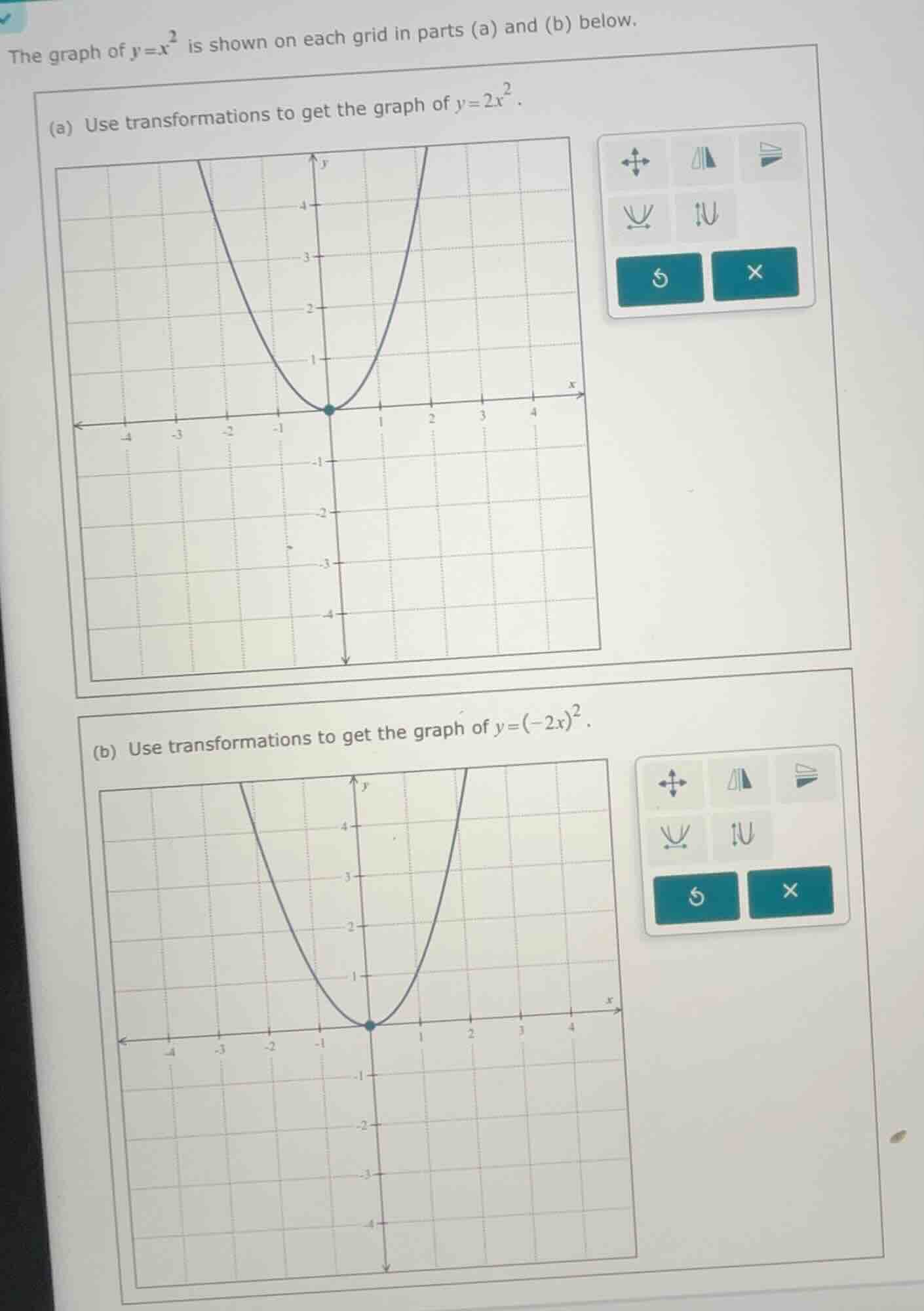
the graph of $y = x^2$ is shown on each grid in parts (a) and (b) below.
(a) use transformations to get the graph of $y = 2x^2$.
(b) use transformations to get the graph of $y = (-2x)^2$.
Part (a)
Step1: Recall Vertical Stretch Rule
For a function \( y = a f(x) \), if \( |a|>1 \), it's a vertical stretch by a factor of \( a \). Here, \( f(x)=x^{2} \), \( a = 2 \), so we vertically stretch \( y=x^{2} \) by factor 2.
Step2: Apply to Key Points
Take key points of \( y = x^{2} \), e.g., \( (0,0) \), \( (1,1) \), \( (- 1,1) \), \( (2,4) \), \( (-2,4) \). After stretching, \( (1,1)\to(1,2\times1)=(1,2) \), \( (-1,1)\to(-1,2) \), \( (2,4)\to(2,8) \) (but on the grid, we use the transformation: each \( y \)-value of \( y = x^{2} \) is multiplied by 2. So the parabola becomes narrower as it's stretched vertically.
Step1: Simplify the Function
First, simplify \( y=(-2x)^{2} \). Using exponent rules, \( (-2x)^{2}=(-2)^{2}x^{2}=4x^{2} \).
Step2: Recall Horizontal Compression Rule
For \( y = f(bx) \), if \( |b|>1 \), it's a horizontal compression by factor \( \frac{1}{|b|} \). Here, \( f(x)=x^{2} \), \( b = 2 \) (since \( 4x^{2}=(2x)^{2} \), or from \( y = (-2x)^{2}=4x^{2} \), we can also think of it as \( y = f(2x) \) with \( f(x)=x^{2} \), so horizontal compression by \( \frac{1}{2} \), or vertical stretch by 4. Alternatively, since \( (-2x)^{2}=4x^{2} \), we can also see it as a vertical stretch by 4. But let's use the horizontal transformation: \( y = (-2x)^{2}= (2x)^{2} \) (since square eliminates the negative), so for \( y=(2x)^{2} \), compared to \( y = x^{2} \), replace \( x \) with \( 2x \), so horizontal compression by \( \frac{1}{2} \).
Step3: Apply the Transformation
Take key points of \( y = x^{2} \): \( (0,0) \), \( (1,1) \), \( (-1,1) \), \( (2,4) \), \( (-2,4) \). For \( y=(2x)^{2} \), solve \( 2x = t \) (where \( t \) is the \( x \)-value in \( y = t^{2} \)), so \( x=\frac{t}{2} \). So the point \( (t,t^{2}) \) on \( y = t^{2} \) corresponds to \( (\frac{t}{2},t^{2}) \) on \( y=(2x)^{2} \). So \( (1,1) \) on \( y = x^{2} \) (where \( t = 1 \)) corresponds to \( (\frac{1}{2},1) \) on \( y=(2x)^{2} \), \( (-1,1) \) corresponds to \( (-\frac{1}{2},1) \), \( (2,4) \) corresponds to \( (1,4) \), \( (-2,4) \) corresponds to \( (-1,4) \). So it's a horizontal compression by \( \frac{1}{2} \) (or vertical stretch by 4, since \( (2x)^{2}=4x^{2} \)).

Snap & solve any problem in the app
Get step-by-step solutions on Sovi AI
Photo-based solutions with guided steps
Explore more problems and detailed explanations
Vertically stretch the graph of \( y = x^{2} \) by a factor of 2 to get \( y=2x^{2} \).