QUESTION IMAGE
Question
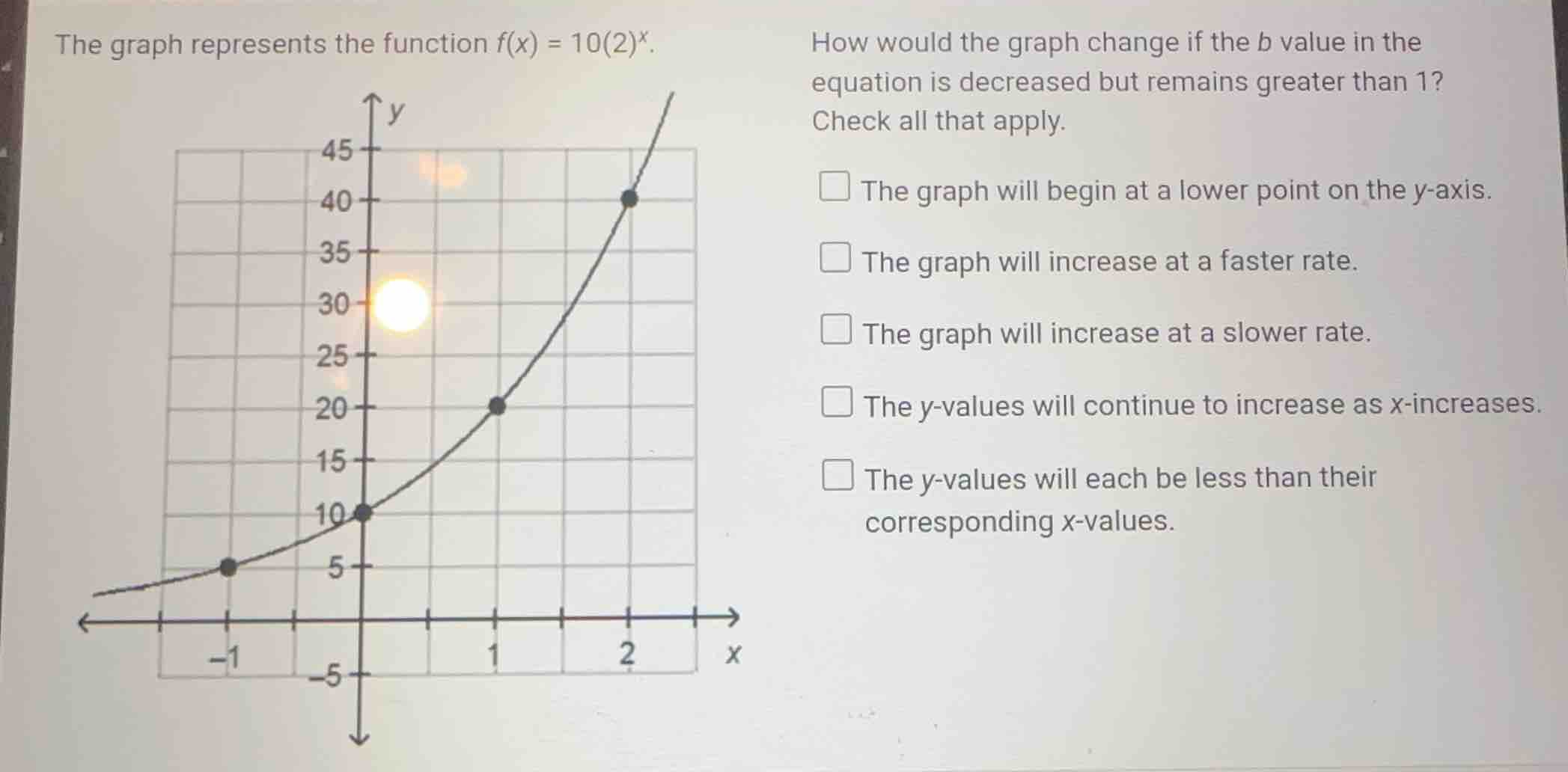
the graph represents the function \\(f(x) = 10(2)^x\\).
how would the graph change if the \\(b\\) value in the equation is decreased but remains greater than 1?
check all that apply.
the graph will begin at a lower point on the \\(y\\)-axis.
the graph will increase at a faster rate.
the graph will increase at a slower rate.
the \\(y\\)-values will continue to increase as \\(x\\)-increases.
the \\(y\\)-values will each be less than their corresponding \\(x\\)-values.
Identify the function parameters
Using the Exponential Growth Model knowledge point
Analyze the y-intercept
Using the Exponential Function Graphs knowledge point
The y-intercept depends only on \(a\), so it remains at \((0, 10)\).
Analyze the growth rate change
Using the Exponential Growth Model knowledge point
If \(b\) decreases but remains greater than \(1\) (e.g., \(b = 1.5\)):
For \(x > 0\), \(b^x < 2^x\), meaning the graph increases at a slower rate.
Analyze the behavior as x increases
Using the Exponential Function Graphs knowledge point
Since \(b > 1\), the function remains strictly increasing:
The y-values will continue to increase as x-increases.
Evaluate the final option
Using the Exponential Function Graphs knowledge point
For \(x = 1\), \(f(1) = 10 \cdot b > 10\).
Since \(10 \cdot b > 1\), the y-values are not less than their corresponding x-values.

Snap & solve any problem in the app
Get step-by-step solutions on Sovi AI
Photo-based solutions with guided steps
Explore more problems and detailed explanations
- The graph will begin at a lower point on the y-axis.
- The graph will increase at a faster rate.
- The graph will increase at a slower rate. (Correct answer)
- The y-values will continue to increase as x-increases. (Correct answer)
- The y-values will each be less than their corresponding x-values.