QUESTION IMAGE
Question
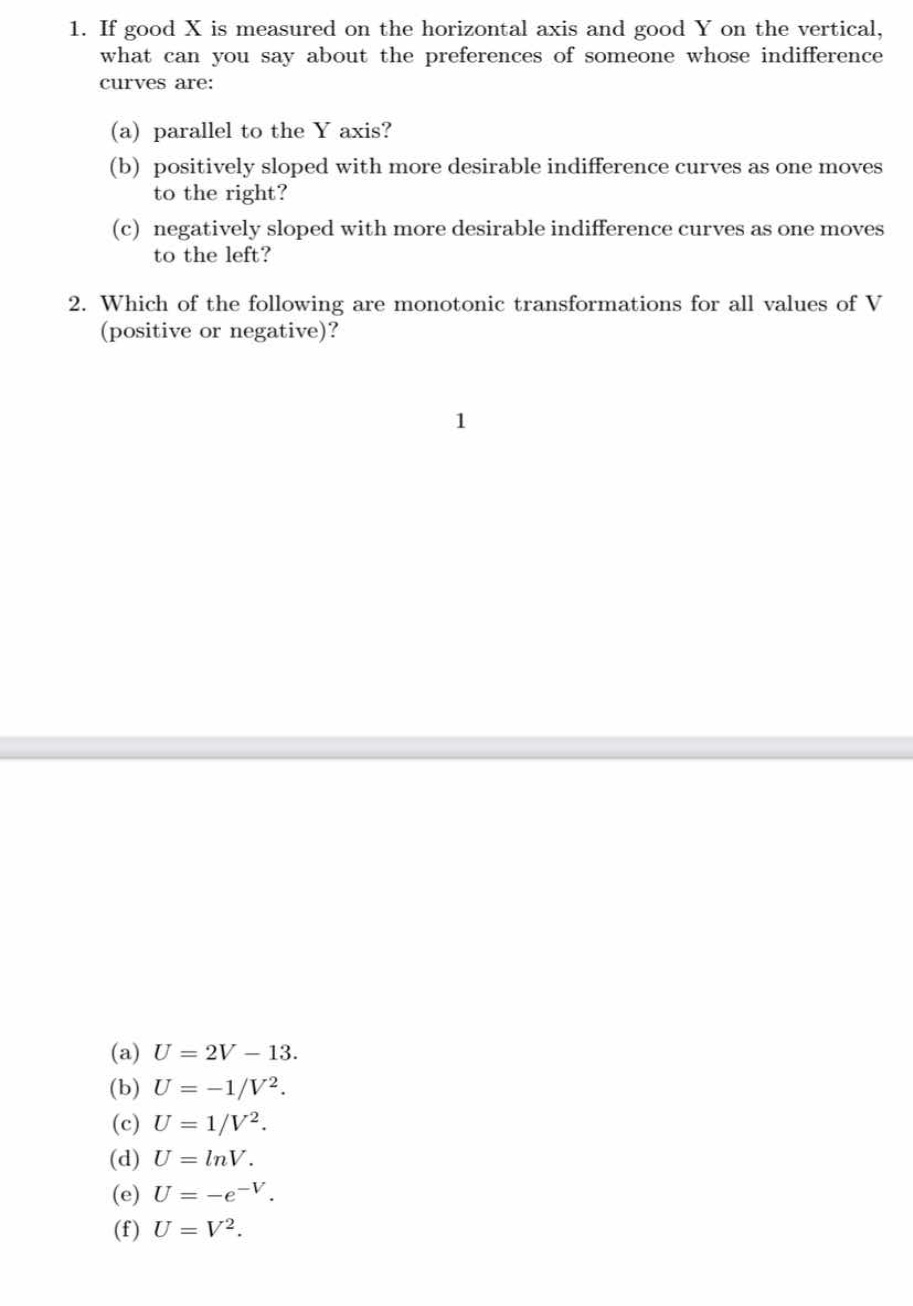
- if good x is measured on the horizontal axis and good y on the vertical, what can you say about the preferences of someone whose indifference curves are:
(a) parallel to the y axis?
(b) positively sloped with more desirable indifference curves as one moves to the right?
(c) negatively sloped with more desirable indifference curves as one moves to the left?
- which of the following are monotonic transformations for all values of v (positive or negative)?
(a) (u = 2v - 13).
(b) (u = -1/v^2).
(c) (u = 1/v^2).
(d) (u = \ln v).
(e) (u = -e^{-v}).
(f) (u = v^2).
Analyze vertical indifference curves
Using the Monotonic Transformation knowledge point, we evaluate how utility changes across indifference curves.
For 1(a), vertical indifference curves mean that any change in \(Y\) along a vertical line keeps utility constant. Thus, the consumer does not care about good \(Y\) (it is a neutral good). Since moving to the right (increasing \(X\)) typically increases utility, \(X\) is a good, and \(Y\) is neutral.
Analyze positively sloped indifference curves
For 1(b), the indifference curves are positively sloped, meaning to keep utility constant, an increase in \(X\) must be accompanied by an increase in \(Y\). This implies one of the goods is a "bad" (disutility) and the other is a "good". Since utility increases as we move to the right (increasing \(X\) while keeping \(Y\) constant), \(X\) is a good and \(Y\) is a bad.
Analyze negatively sloped curves with leftward preference
For 1(c), the indifference curves are negatively sloped, but utility increases as we move to the left (decreasing \(X\) while keeping \(Y\) constant). This means that less of \(X\) is preferred, so \(X\) is a bad. Since the curves are negatively sloped, to keep utility constant, a decrease in \(X\) (which increases utility) must be balanced by a decrease in \(Y\) (which must decrease utility), meaning \(Y\) is a good.
Evaluate monotonic transformations for all V
A function \(f(V)\) is a strictly monotonic transformation if its derivative with respect to \(V\) is strictly positive for all real values of \(V\) (both positive and negative).
- (a) \(U = 2V - 13\): \(\frac{dU}{dV} = 2 > 0\) everywhere. This is a monotonic transformation.
- (b) \(U = -1/V^2\): Undefined at \(V = 0\). Thus, not defined for all values of \(V\).
- (c) \(U = 1/V^2\): Undefined at \(V = 0\).
- (d) \(U = \ln V\): Undefined for \(V \le 0\).
- (e) \(U = -e^{-V}\): \(\frac{dU}{dV} = e^{-V} > 0\) for all \(V\). This is a monotonic transformation.
- (f) \(U = V^2\): \(\frac{dU}{dV} = 2V\), which is negative for \(V < 0\) and positive for \(V > 0\). Not monotonic.

Snap & solve any problem in the app
Get step-by-step solutions on Sovi AI
Photo-based solutions with guided steps
Explore more problems and detailed explanations
Question 1
(a) Good \(X\) is a normal good (preferred more), and Good \(Y\) is a neutral good (the consumer does not care about its quantity).
(b) Good \(X\) is a good (preferred more), and Good \(Y\) is a bad (preferred less).
(c) Good \(X\) is a bad (preferred less), and Good \(Y\) is a good (preferred more).
Question 2
The monotonic transformations for all values of \(V\) are:
(a) \(U = 2V - 13\)
(e) \(U = -e^{-V}\)