QUESTION IMAGE
Question
go
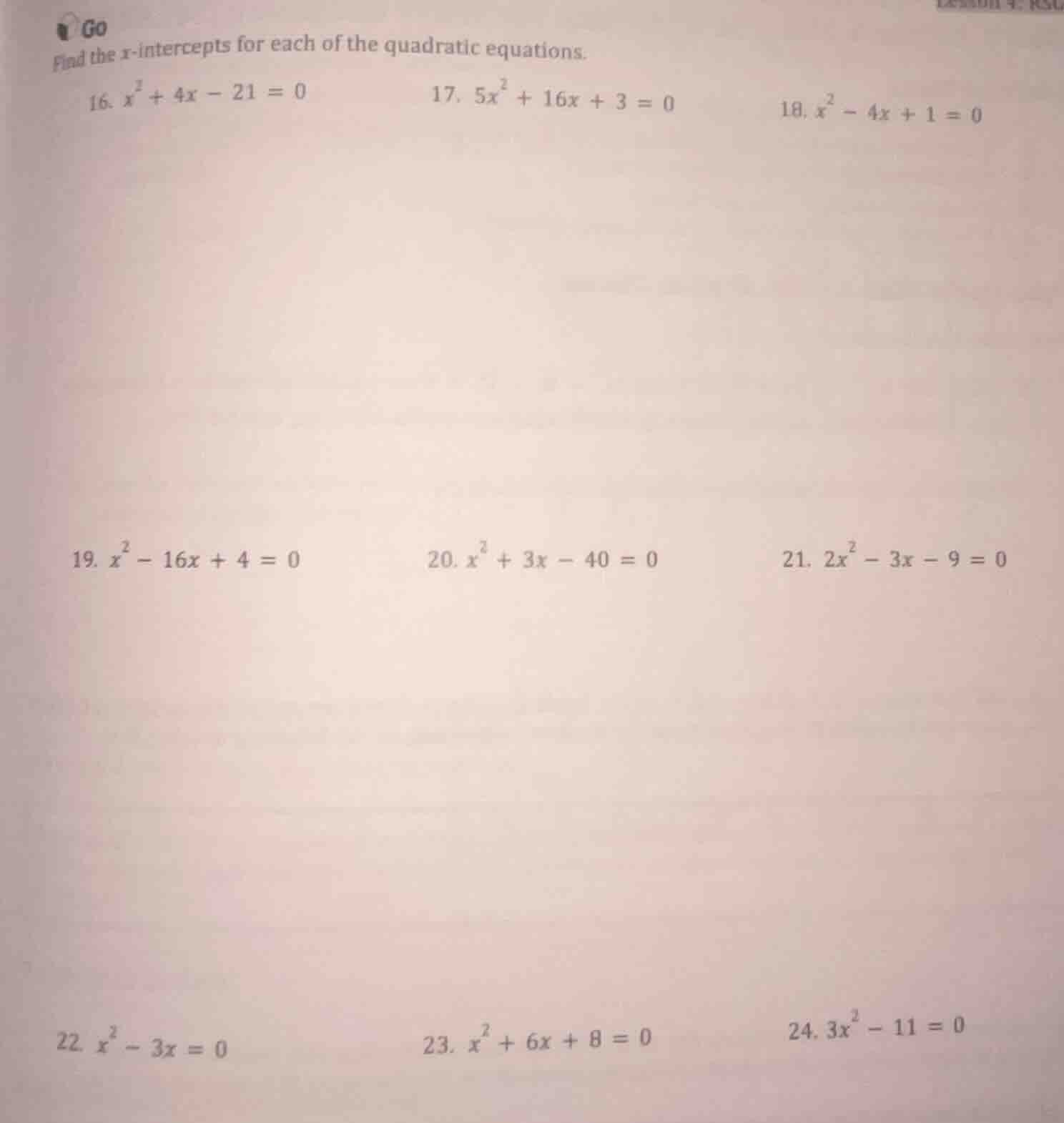
find the x-intercepts for each of the quadratic equations.
- $x^2 + 4x - 21 = 0$
- $5x^2 + 16x + 3 = 0$
- $x^2 - 4x + 1 = 0$
- $x^2 - 16x + 4 = 0$
- $x^2 + 3x - 40 = 0$
- $2x^2 - 3x - 9 = 0$
- $x^2 - 3x = 0$
- $x^2 + 6x + 8 = 0$
- $3x^2 - 11 = 0$
Problem 16: \( x^2 + 4x - 21 = 0 \)
Step1: Factor the quadratic equation
We need two numbers that multiply to \(-21\) and add up to \(4\). The numbers are \(7\) and \(-3\) since \(7\times(-3)=-21\) and \(7 + (-3)=4\). So we can factor the equation as:
\( (x + 7)(x - 3) = 0 \)
Step2: Solve for \(x\)
Set each factor equal to zero:
\( x + 7 = 0 \) or \( x - 3 = 0 \)
For \( x + 7 = 0 \), we get \( x = -7 \)
For \( x - 3 = 0 \), we get \( x = 3 \)
Step1: Factor the quadratic equation
We need two numbers that multiply to \(5\times3 = 15\) and add up to \(16\). The numbers are \(15\) and \(1\). So we rewrite the middle term:
\( 5x^2 + 15x + x + 3 = 0 \)
Factor by grouping:
\( 5x(x + 3) + 1(x + 3) = 0 \)
\( (5x + 1)(x + 3) = 0 \)
Step2: Solve for \(x\)
Set each factor equal to zero:
\( 5x + 1 = 0 \) or \( x + 3 = 0 \)
For \( 5x + 1 = 0 \), we get \( x = -\frac{1}{5} \)
For \( x + 3 = 0 \), we get \( x = -3 \)
Step1: Use the quadratic formula
The quadratic formula is \( x = \frac{-b \pm \sqrt{b^2 - 4ac}}{2a} \) for an equation \( ax^2 + bx + c = 0 \). Here, \( a = 1 \), \( b = -4 \), and \( c = 1 \)
Step2: Calculate the discriminant
\( \Delta = b^2 - 4ac = (-4)^2 - 4(1)(1) = 16 - 4 = 12 \)
Step3: Solve for \(x\)
\( x = \frac{4 \pm \sqrt{12}}{2} = \frac{4 \pm 2\sqrt{3}}{2} = 2 \pm \sqrt{3} \)

Snap & solve any problem in the app
Get step-by-step solutions on Sovi AI
Photo-based solutions with guided steps
Explore more problems and detailed explanations
\( x = -7 \) and \( x = 3 \)