QUESTION IMAGE
Question
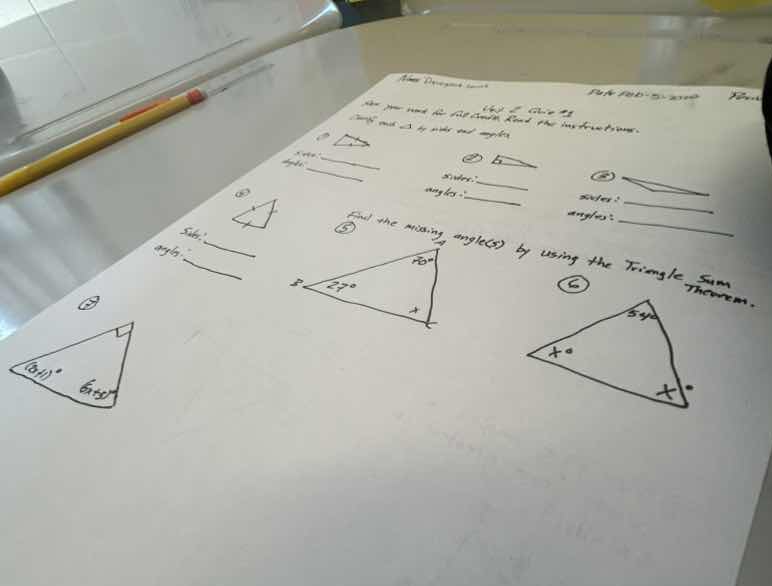
for the given triangles, find the indicated (sides and angles?)
①
sides:
angles:
②
sides:
angles:
③
sides:
angles:
④
sides:
angles:
find the missing angle(s) by using the triangle sum theorem.
⑤
triangle with angles 27°, 76°, and x°
⑥
triangle with angle 54° and two angles x°
⑦
triangle with angles (3x + 1)°, 6x + 5)°, and a right angle
Let's solve the triangle angle problems using the Triangle Sum Theorem (the sum of angles in a triangle is \(180^\circ\)).
Problem 5:
We have a triangle with angles \(76^\circ\), \(27^\circ\), and \(x\).
Step 1: Recall the Triangle Sum Theorem
The sum of the interior angles of a triangle is \(180^\circ\). So, we can write the equation:
Step 2: Simplify the left - hand side
First, add \(76^\circ\) and \(27^\circ\):
So the equation becomes:
Step 3: Solve for \(x\)
Subtract \(103^\circ\) from both sides of the equation:
Problem 6:
We have a triangle with one angle \(54^\circ\) and two equal angles \(x\) (since it's an isosceles triangle with two equal angles).
Step 1: Apply the Triangle Sum Theorem
The sum of the angles in a triangle is \(180^\circ\). So we can write the equation:
Step 2: Combine like terms
Combine the two \(x\) terms:
Step 3: Solve for \(x\)
Subtract \(54^\circ\) from both sides:
Then divide both sides by 2:
Problem 7:
Let the unknown angle be \(y\). We have two angles: \((3x + 1)^\circ\) and \(6x^\circ\) (assuming there is a typo and it's \(6x^\circ\) instead of \(6x0^\circ\)). Using the Triangle Sum Theorem:
But since we don't know the value of \(x\), we assume that maybe it's a right - angled triangle (the small square indicates a right angle, \(90^\circ\)). Let's assume the right angle is \(90^\circ\), and the other two angles are \((3x + 1)^\circ\) and \(6x^\circ\). Then:
Step 1: Apply the Triangle Sum Theorem for right - angled triangle
Step 2: Combine like terms
Step 3: Solve for \(x\)
Subtract 91 from both sides:
Then the two angles:
\(3x + 1=3\times\frac{89}{9}+1=\frac{89}{3}+1=\frac{92}{3}\approx30.67^\circ\)
\(6x = 6\times\frac{89}{9}=\frac{178}{3}\approx59.33^\circ\)
And the right angle is \(90^\circ\), and \(\frac{92}{3}+\frac{178}{3}+90=\frac{270}{3}+90 = 90 + 90=180^\circ\), which satisfies the Triangle Sum Theorem.

Snap & solve any problem in the app
Get step-by-step solutions on Sovi AI
Photo-based solutions with guided steps
Explore more problems and detailed explanations
s:
- For problem 5: \(x = 77^\circ\)
- For problem 6: \(x = 63^\circ\)
- For problem 7: If it's a right - angled triangle with angles \((3x + 1)^\circ\), \(6x^\circ\) and \(90^\circ\), \(x=\frac{89}{9}\approx9.89\), and the angles are approximately \(30.67^\circ\), \(59.33^\circ\) and \(90^\circ\)