QUESTION IMAGE
Question
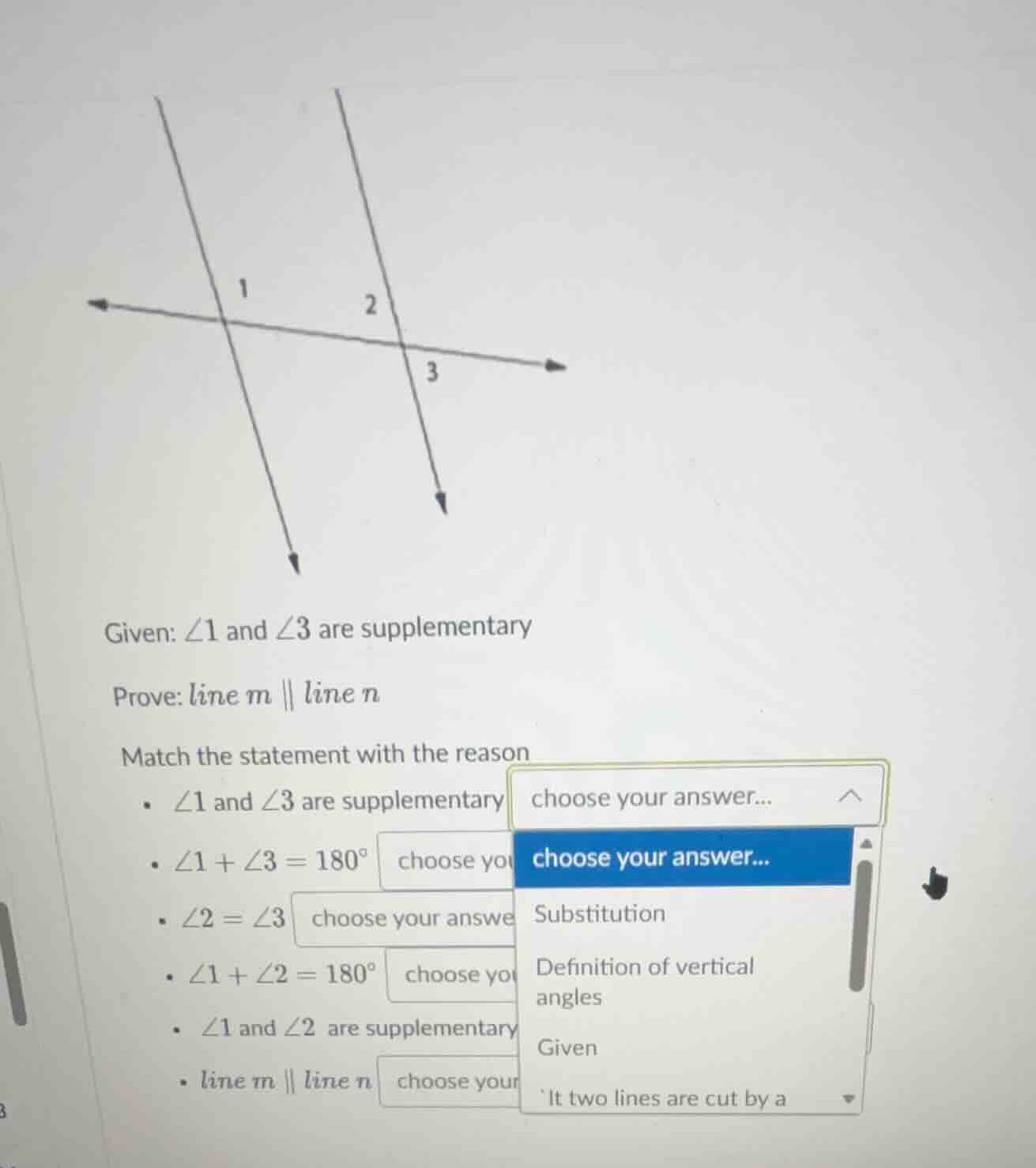
given: \\(\angle 1\\) and \\(\angle 3\\) are supplementary
prove: line \\(m \parallel\\) line \\(n\\)
match the statement with the reason
- \\(\angle 1\\) and \\(\angle 3\\) are supplementary
- \\(\angle 1 + \angle 3 = 180^\circ\\)
- \\(\angle 2 = \angle 3\\)
- \\(\angle 1 + \angle 2 = 180^\circ\\)
- \\(\angle 1\\) and \\(\angle 2\\) are supplementary
- line \\(m \parallel\\) line \\(n\\)
Identify the given information and goal
We are given that \(\angle 1\) and \(\angle 3\) are supplementary. We need to prove that line \(m \parallel \text{line } n\). We will match each statement in the proof with its corresponding geometric reason.
Analyze statements 1 and 2
The first statement is "\(\angle 1\) and \(\angle 3\) are supplementary", which is directly provided in the problem description. Thus, the reason is Given.
The second statement is "\(\angle 1 + \angle 3 = 180^\circ\)". This follows directly from the definition of supplementary angles. Thus, the reason is Definition of supplementary angles.
Analyze statements 3 and 4
The third statement is "\(\angle 2 = \angle 3\)". Looking at the diagram, \(\angle 2\) and \(\angle 3\) are vertical angles formed by the intersection of line \(n\) and the transversal. Using the Vertical Angles Theorem, we know they are equal.
The fourth statement is "\(\angle 1 + \angle 2 = 180^\circ\)". Since \(\angle 1 + \angle 3 = 180^\circ\) and \(\angle 2 = \angle 3\), we can replace \(\angle 3\) with \(\angle 2\) in the equation. Thus, the reason is Substitution.
Analyze statements 5 and 6
The fifth statement is "\(\angle 1\) and \(\angle 2\) are supplementary". Since their measures add up to \(180^\circ\), this is the Definition of supplementary angles.
The sixth statement is "line \(m \parallel \text{line } n\)". Since consecutive interior angles \(\angle 1\) and \(\angle 2\) are supplementary, the lines are parallel. Thus, the reason is If two lines are cut by a transversal so that consecutive interior angles are supplementary, then the lines are parallel (Consecutive Interior Angles Converse).

Snap & solve any problem in the app
Get step-by-step solutions on Sovi AI
Photo-based solutions with guided steps
Explore more problems and detailed explanations
- \(\angle 1\) and \(\angle 3\) are supplementary \(
ightarrow\) Given
- \(\angle 1 + \angle 3 = 180^\circ\) \(
ightarrow\) Definition of supplementary angles
- \(\angle 2 = \angle 3\) \(
ightarrow\) Vertical Angles Theorem (or Definition of vertical angles)
- \(\angle 1 + \angle 2 = 180^\circ\) \(
ightarrow\) Substitution
- \(\angle 1\) and \(\angle 2\) are supplementary \(
ightarrow\) Definition of supplementary angles
- line \(m \parallel \text{line } n\) \(
ightarrow\) If two lines are cut by a transversal so that consecutive interior angles are supplementary, then the lines are parallel