QUESTION IMAGE
Question
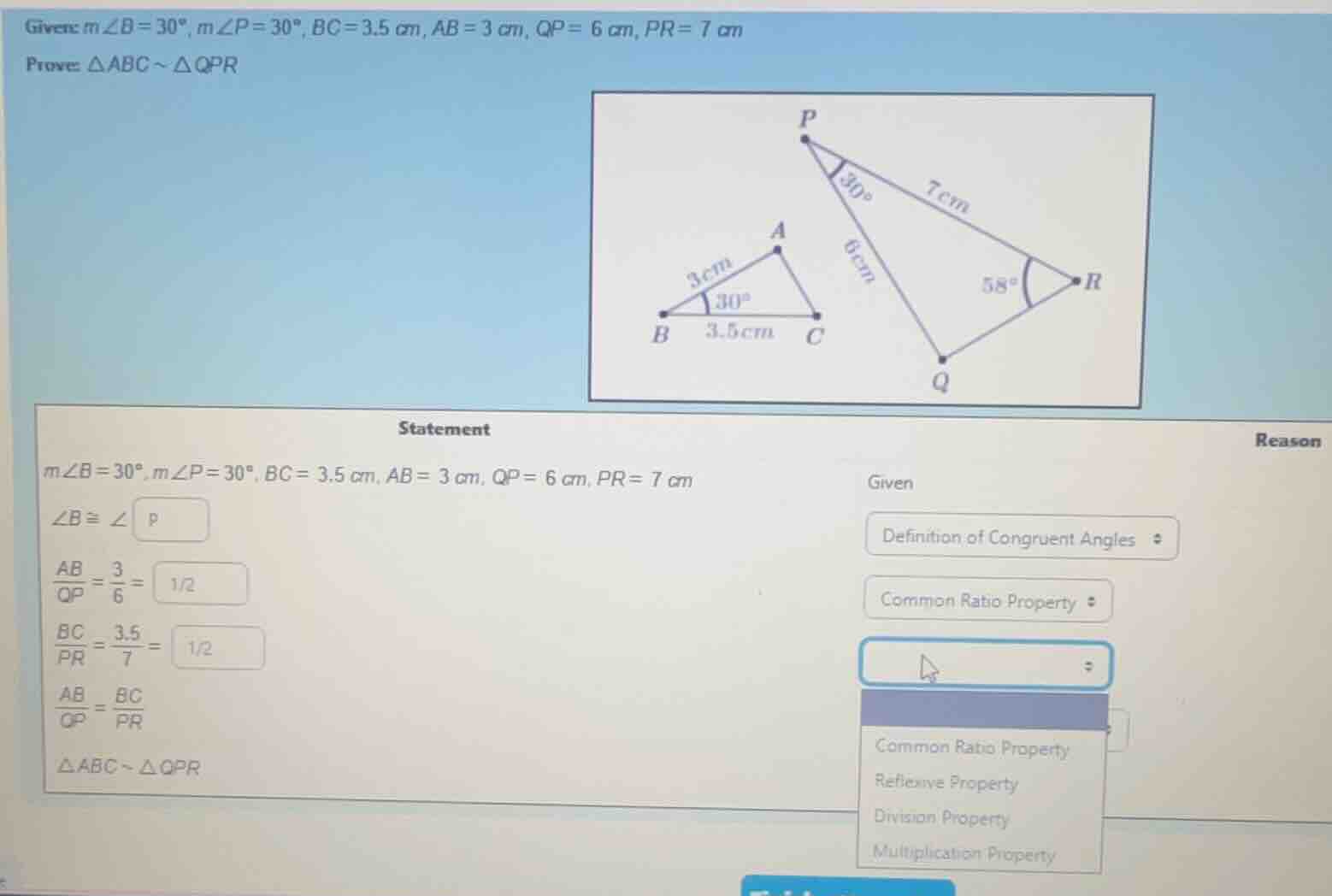
given: \\(m\angle b = 30^\circ\\), \\(m\angle p = 30^\circ\\), \\(bc = 3.5\text{ cm}\\), \\(ab = 3\text{ cm}\\), \\(qp = 6\text{ cm}\\), \\(pr = 7\text{ cm}\\)
prove: \\(\delta abc \sim \delta qpr\\)
statement | reason
--- | ---
\\(m\angle b = 30^\circ\\), \\(m\angle p = 30^\circ\\), \\(bc = 3.5\text{ cm}\\), \\(ab = 3\text{ cm}\\), \\(qp = 6\text{ cm}\\), \\(pr = 7\text{ cm}\\) | given
\\(\angle b \cong \angle p\\) | definition of congruent angles
\\(\frac{ab}{qp} = \frac{3}{6} = 1/2\\) | common ratio property
\\(\frac{bc}{pr} = \frac{3.5}{7} = 1/2\\) |
\\(\frac{ab}{qp} = \frac{bc}{pr}\\) |
\\(\delta abc \sim \delta qpr\\) |
Identify given information
We are given the following geometric values:
- \(m\angle B = 30^\circ\)
- \(m\angle P = 30^\circ\)
- \(BC = 3.5\text{ cm}\)
- \(AB = 3\text{ cm}\)
- \(QP = 6\text{ cm}\)
- \(PR = 7\text{ cm}\)
We need to complete the two-column proof showing that \(\triangle ABC \sim \triangle QPR\).
Analyze the proof steps
Let's examine each row of the proof:
- Statement: \(m\angle B = 30^\circ, m\angle P = 30^\circ, BC = 3.5\text{ cm}, AB = 3\text{ cm}, QP = 6\text{ cm}, PR = 7\text{ cm}\)
- Reason: Given
- Statement: \(\angle B \cong \angle P\)
- Reason: Definition of Congruent Angles (since their measures are equal)
- Statement: \(\frac{AB}{QP} = \frac{3}{6} = \frac{1}{2}\)
- Reason: Common Ratio Property (or substitution/simplification)
- Statement: \(\frac{BC}{PR} = \frac{3.5}{7} = \frac{1}{2}\)
- Reason: Common Ratio Property (or substitution/simplification)
- Statement: \(\frac{AB}{QP} = \frac{BC}{PR}\)
- Reason: We need to select the correct reason from the dropdown menu. Since both ratios are equal to \(\frac{1}{2}\), they are equal to each other. This is justified by the Transitive Property of Equality (or Substitution Property). Looking at the options in the dropdown:
- "Common Ratio Property"
- "Reflexive Property"
- "Division Property"
- "Multiplication Property"
- Note: If Transitive/Substitution is not listed, let's look at the visible dropdown options. The options shown are:
- "Common Ratio Property"
- "Reflexive Property"
- "Division Property"
- "Multiplication Property"
- Since \(\frac{AB}{QP} = \frac{1}{2}\) and \(\frac{BC}{PR} = \frac{1}{2}\), setting them equal to each other is a direct application of the Transitive Property or Substitution Property. If we scroll up in the dropdown (which is partially cut off), "Transitive Property" or "Substitution Property" would be the standard geometric reason. Let's identify the standard geometric reason for this step. Since \(a = c\) and \(b = c\) implies \(a = b\), this is the Transitive Property (or Substitution Property).
- Statement: \(\triangle ABC \sim \triangle QPR\)
- Reason: Since we have two pairs of proportional sides (\(\frac{AB}{QP} = \frac{BC}{PR}\)) and their included angles are congruent (\(\angle B \cong \angle P\)), the triangles are similar by the SAS Similarity Theorem (Side-Angle-Side Similarity).
Determine the missing values in the blanks
Let's fill in the interactive fields shown in the image:
- First blank (under Statement 2): \(\angle B \cong\) <blank>\(\angle P\)</blank>
- Second blank (under Statement 3): \(\frac{AB}{QP} = \frac{3}{6} =\) <blank>\(1/2\)</blank>
- Third blank (under Statement 4): \(\frac{BC}{PR} = \frac{3.5}{7} =\) <blank>\(1/2\)</blank>
- Fourth dropdown (under Reason 5): <blank>Transitive Property</blank> (or <blank>Substitution Property</blank>)
- Fifth dropdown (under Reason 6): <blank>SAS Similarity Theorem</blank>

Snap & solve any problem in the app
Get step-by-step solutions on Sovi AI
Photo-based solutions with guided steps
Explore more problems and detailed explanations
Statement 2
\(\angle B \cong\) <blank>\(\angle P\)</blank>
Statement 3
\(\frac{AB}{QP} = \frac{3}{6} =\) <blank>\(\frac{1}{2}\)</blank>
Statement 4
\(\frac{BC}{PR} = \frac{3.5}{7} =\) <blank>\(\frac{1}{2}\)</blank>
Reason 5
<blank>Transitive Property</blank> (or <blank>Substitution Property</blank>)
Reason 6
<blank>SAS Similarity Theorem</blank>