QUESTION IMAGE
Question
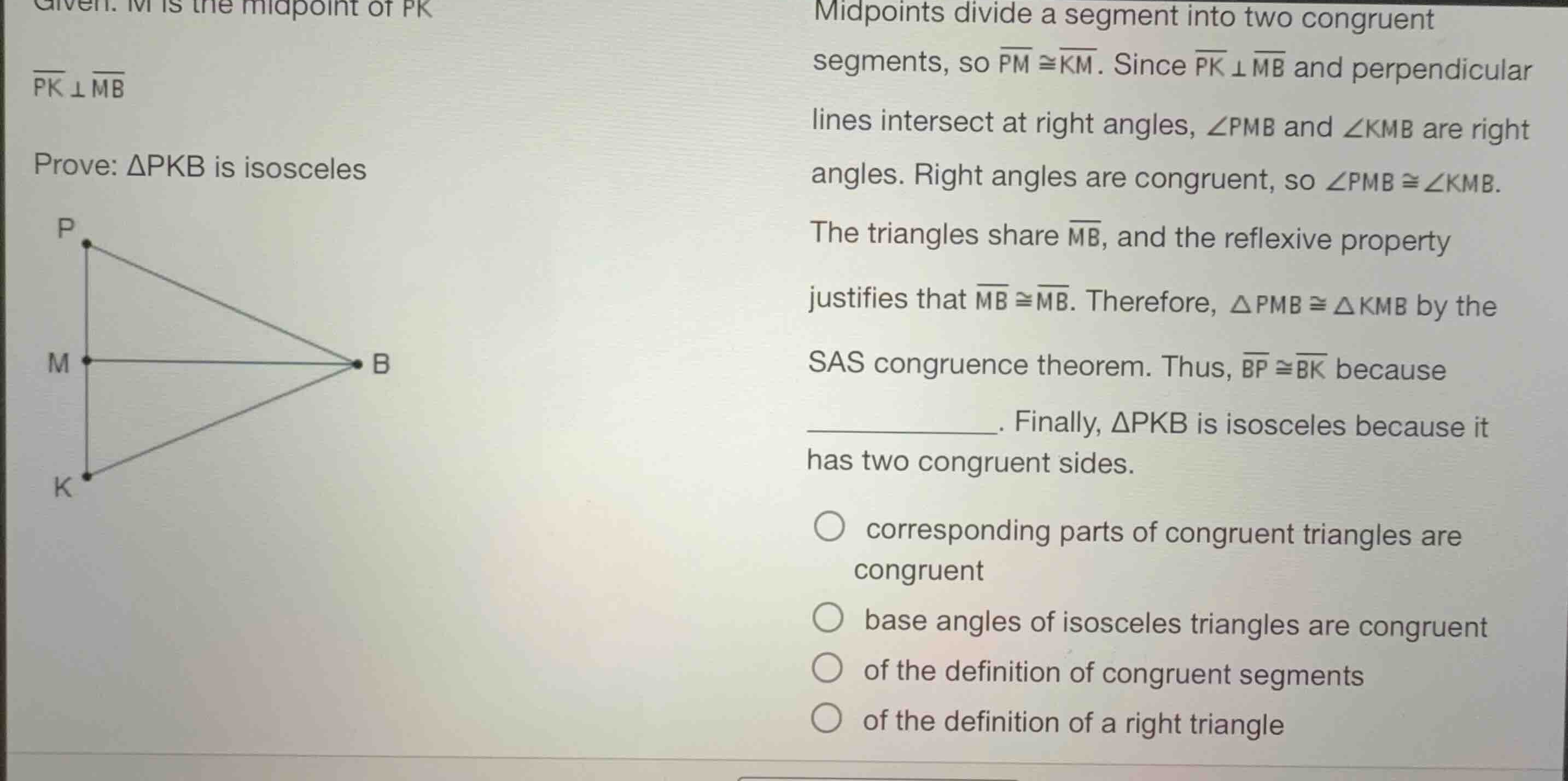
given: \\(m\\) is the midpoint of \\(\overline{pk}\\)
\\(\overline{pk} \perp \overline{mb}\\)
prove: \\(\delta pkb\\) is isosceles
midpoints divide a segment into two congruent segments, so \\(\overline{pm} \cong \overline{km}\\). since \\(\overline{pk} \perp \overline{mb}\\) and perpendicular lines intersect at right angles, \\(\angle pmb\\) and \\(\angle kmb\\) are right angles. right angles are congruent, so \\(\angle pmb \cong \angle kmb\\). the triangles share \\(\overline{mb}\\), and the reflexive property justifies that \\(\overline{mb} \cong \overline{mb}\\). therefore, \\(\delta pmb \cong \delta kmb\\) by the sas congruence theorem. thus, \\(\overline{bp} \cong \overline{bk}\\) because _______. finally, \\(\delta pkb\\) is isosceles because it has two congruent sides.
corresponding parts of congruent triangles are congruent
base angles of isosceles triangles are congruent
of the definition of congruent segments
of the definition of a right triangle
Analyze the given proof context
The proof establishes that \(\Delta PMB \cong \Delta KMB\) using the SAS Congruence Postulate.
Identify the missing reason
The next statement in the proof is: "Thus, \(\overline{BP} \cong \overline{BK}\) because _________."
Since \(\overline{BP}\) and \(\overline{BK}\) are corresponding sides of the congruent triangles \(\Delta PMB\) and \(\Delta KMB\), they are congruent by the principle that corresponding parts of congruent triangles are congruent (CPCTC).
Match with the given options
The first option states: "corresponding parts of congruent triangles are congruent". This matches the CPCTC principle perfectly.

Snap & solve any problem in the app
Get step-by-step solutions on Sovi AI
Photo-based solutions with guided steps
Explore more problems and detailed explanations
- corresponding parts of congruent triangles are congruent (Correct answer)
- base angles of isosceles triangles are congruent
- of the definition of congruent segments
- of the definition of a right triangle