QUESTION IMAGE
Question
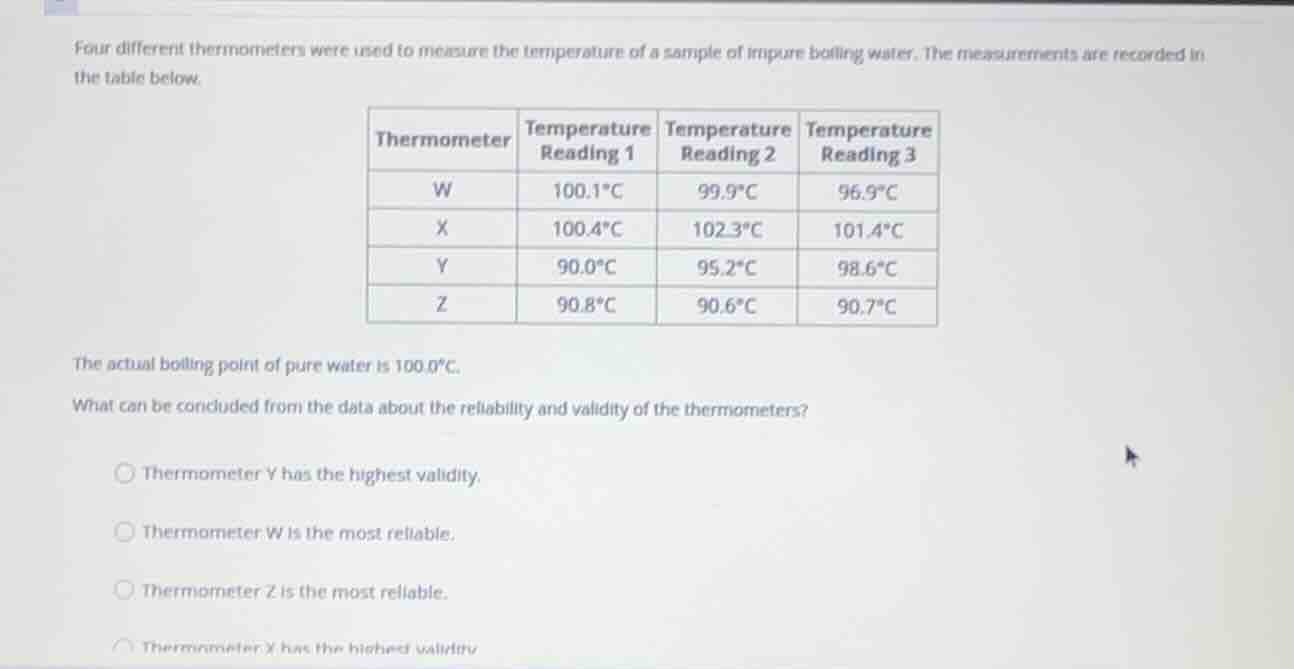
four different thermometers were used to measure the temperature of a sample of impure boiling water. the measurements are recorded in the table below.
\
the actual boiling point of pure water is 100.0^\circ\text{c}.
what can be concluded from the data about the reliability and validity of the thermometers?
- thermometer y has the highest validity.
- thermometer w is the most reliable.
- thermometer z is the most reliable.
- thermometer x has the highest validity.
Define reliability and validity
In the context of the Scientific Method, reliability refers to the consistency or reproducibility of measurements (how close repeated measurements are to each other). Validity refers to how close the measurements are to the true or actual value being targeted.
Analyze the data for reliability
Let's examine the consistency (spread) of the readings for each thermometer:
- Thermometer W: Readings are \(100.1^\circ\text{C}\), \(99.9^\circ\text{C}\), and \(96.9^\circ\text{C}\). The range is \(100.1 - 96.9 = 3.2^\circ\text{C}\).
- Thermometer X: Readings are \(100.4^\circ\text{C}\), \(102.3^\circ\text{C}\), and \(101.4^\circ\text{C}\). The range is \(102.3 - 100.4 = 1.9^\circ\text{C}\).
- Thermometer Y: Readings are \(90.0^\circ\text{C}\), \(95.2^\circ\text{C}\), and \(98.6^\circ\text{C}\). The range is \(98.6 - 90.0 = 8.6^\circ\text{C}\).
- Thermometer Z: Readings are \(90.8^\circ\text{C}\), \(90.6^\circ\text{C}\), and \(90.7^\circ\text{C}\). The range is \(90.8 - 90.6 = 0.2^\circ\text{C}\).
Since Thermometer Z has the smallest variation among its repeated trials, it is the most consistent and therefore the most reliable.
Analyze the data for validity
The prompt states that the sample is "impure boiling water" and notes that the actual boiling point of pure water is \(100.0^\circ\text{C}\). However, dissolved impurities elevate the boiling point of water. Therefore, the actual boiling point of this impure sample is expected to be higher than \(100.0^\circ\text{C}\).
- Thermometer Z's readings (around \(90.7^\circ\text{C}\)) are far below the boiling point of water, indicating low validity.
- Thermometer Y's readings are highly scattered, indicating low reliability and low validity.
- Thermometer W's readings average around \(99.0^\circ\text{C}\).
- Thermometer X's readings average around \(101.4^\circ\text{C}\), which is consistent with the expected elevated boiling point of impure water, suggesting high validity.
Evaluate the given options
- Option 1: "Thermometer Y has the highest validity." (Incorrect, Y has highly scattered readings well below the expected boiling point).
- Option 2: "Thermometer W is the most reliable." (Incorrect, Z is more consistent than W).
- Option 3: "Thermometer Z is the most reliable." (Correct, Z has the tightest grouping of measurements with a range of only \(0.2^\circ\text{C}\)).
- Option 4: "Thermometer X has the highest validity." (While X likely has high validity due to boiling point elevation, the option "Thermometer Z is the most reliable" is a direct, unambiguous conclusion regarding reliability based on the tight precision of Z's data).

Snap & solve any problem in the app
Get step-by-step solutions on Sovi AI
Photo-based solutions with guided steps
Explore more problems and detailed explanations
- Thermometer Y has the highest validity.
- Thermometer W is the most reliable.
- Thermometer Z is the most reliable. (Correct answer)
- Thermometer X has the highest validity.