QUESTION IMAGE
Question
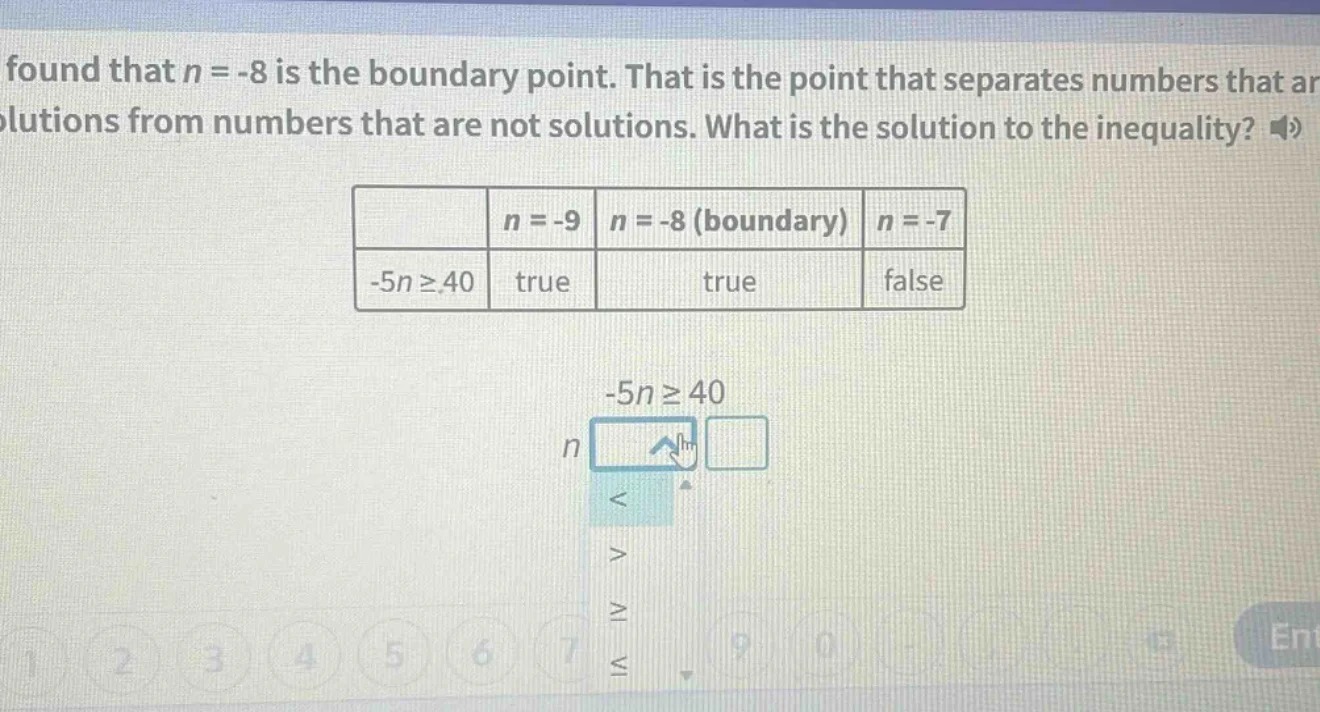
found that n = -8 is the boundary point. that is the point that separates numbers that ar solutions from numbers that are not solutions. what is the solution to the inequality?
| n = -9 | n = -8 (boundary) | n = -7 | |
| -5n ≥ 40 | true | true | false |
-5n ≥ 40
n
Step1: Analyze the inequality and test points
We have the inequality \(-5n \geq 40\). Let's analyze the test points:
- For \(n = -9\), \(-5\times(-9)=45\), and \(45\geq40\) (true).
- For \(n = -8\), \(-5\times(-8) = 40\), and \(40\geq40\) (true).
- For \(n=-7\), \(-5\times(-7)=35\), and \(35\geq40\) (false).
Step2: Solve the inequality algebraically
Start with \(-5n \geq 40\). Divide both sides by \(-5\). Remember that when dividing or multiplying an inequality by a negative number, the direction of the inequality sign flips. So we get \(n \leq -8\).

Snap & solve any problem in the app
Get step-by-step solutions on Sovi AI
Photo-based solutions with guided steps
Explore more problems and detailed explanations
\(n \leq -8\) (with the inequality symbol \(\leq\) and the number \(-8\))