QUESTION IMAGE
Question
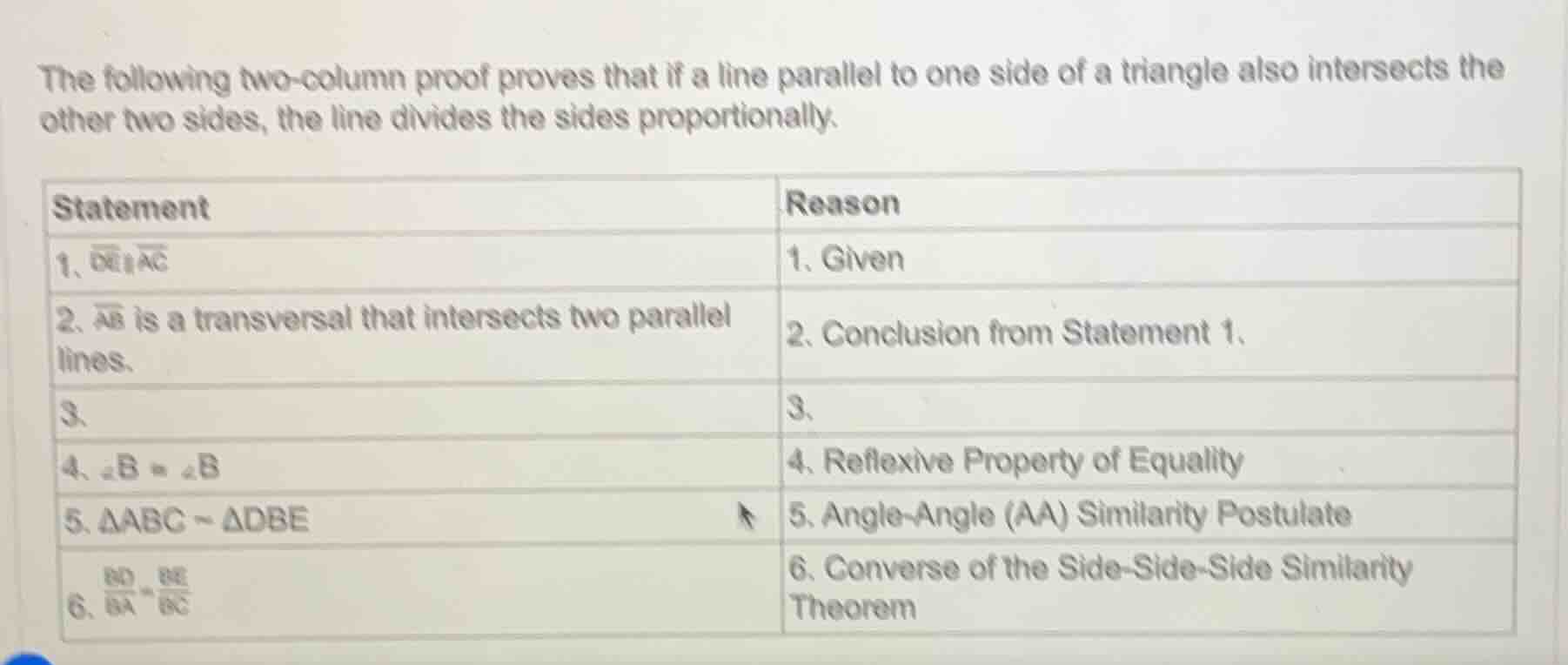
the following two-column proof proves that if a line parallel to one side of a triangle also intersects the other two sides, the line divides the sides proportionally.
\
Analyze the given proof structure
The proof aims to show that a line parallel to one side of a triangle divides the other two sides proportionally (the Triangle Proportionality Theorem). We are given a two-column proof with a missing Statement 3 and Reason 3.
Let's examine the surrounding statements:
- Statement 1: \(\overline{DE} \parallel \overline{AC}\) (Given)
- Statement 2: \(\overline{AB}\) is a transversal that intersects two parallel lines. (Conclusion from Statement 1)
- Statement 4: \(\angle B \cong \angle B\) (Reflexive Property of Equality)
- Statement 5: \(\Delta ABC \sim \Delta DBE\) (Angle-Angle (AA) Similarity Postulate)
Determine the missing step
To establish similarity between \(\Delta ABC\) and \(\Delta DBE\) using the AA Similarity Postulate (Statement 5), we need two pairs of congruent angles:
- One pair is already given in Statement 4: \(\angle B \cong \angle B\) (the shared angle at vertex \(B\)).
- The second pair must come from the parallel lines \(\overline{DE} \parallel \overline{AC}\) and the transversal \(\overline{AB}\) (or \(\overline{CB}\)).
When parallel lines are cut by a transversal, corresponding angles are congruent.
- The transversal \(\overline{AB}\) intersects the parallel lines \(\overline{AC}\) and \(\overline{DE}\).
- This creates corresponding angles \(\angle A\) (or \(\angle BAC\)) and \(\angle BDE\) (or \(\angle D\)).
- Therefore, Statement 3 must establish that these corresponding angles are congruent: \(\angle A \cong \angle BDE\) (or \(\angle BAC \cong \angle BDE\)).
- The corresponding Reason 3 is the Corresponding Angles Postulate (or "If two parallel lines are cut by a transversal, then the corresponding angles are congruent").

Snap & solve any problem in the app
Get step-by-step solutions on Sovi AI
Photo-based solutions with guided steps
Explore more problems and detailed explanations
The missing step in the proof is:
Statement 3: <blank>\(\angle A \cong \angle BDE\)</blank> (or <blank>\(\angle BAC \cong \angle BDE\)</blank>)
Reason 3: <blank>Corresponding Angles Postulate</blank> (or <blank>Corresponding angles are congruent</blank>)