QUESTION IMAGE
Question
first up, lets review the assignments
get familiar with this topic by reviewing instruction and a
question
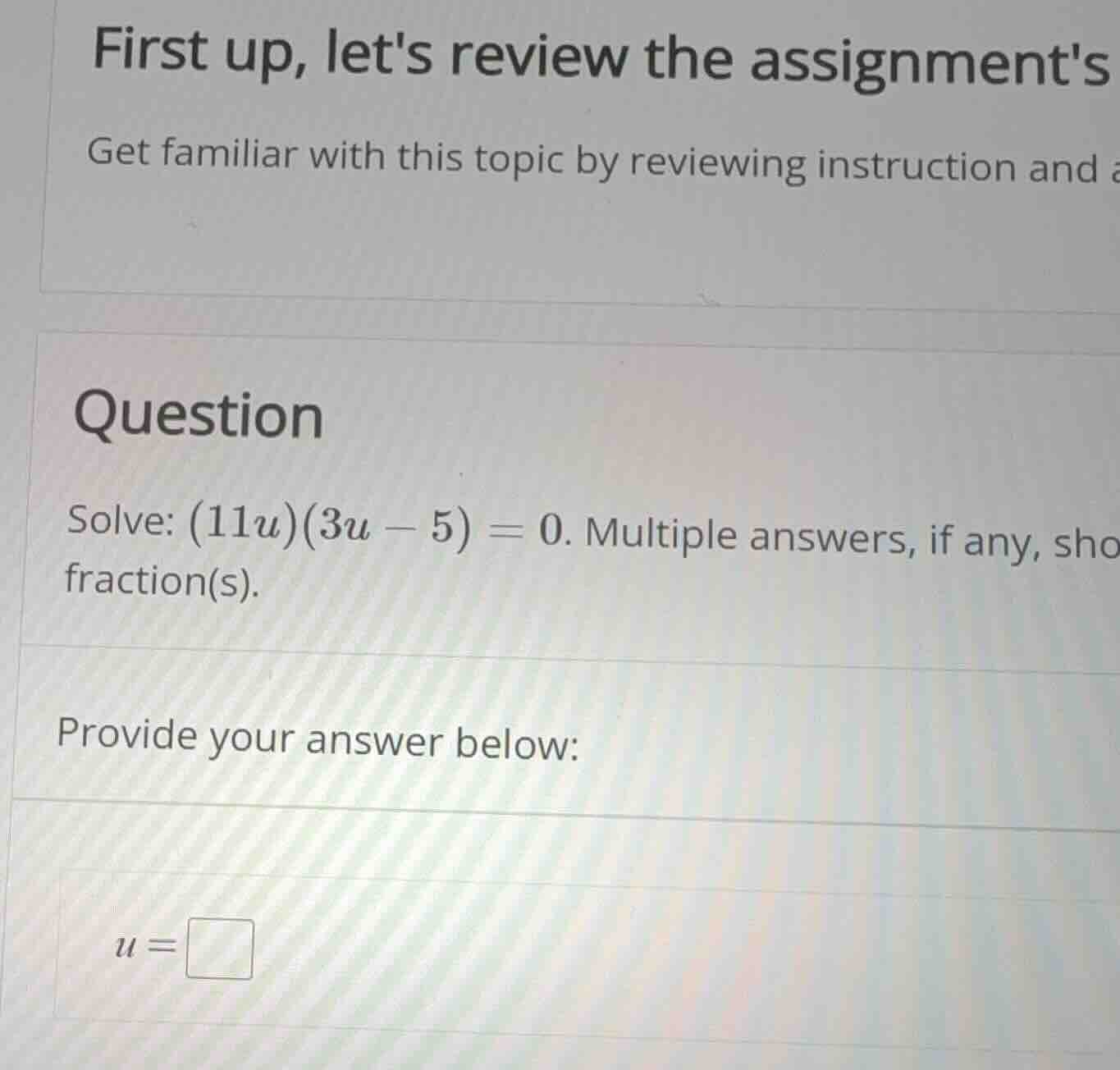
solve: \\((11u)(3u - 5) = 0\\). multiple answers, if any, should be separated by commas. enter your answer as an integer or a fraction(s).
provide your answer below:
\\(u = \\)
<pre_analysis>
{
"quality": "clear",
"question_count": 1,
"skills_matched": [
"step_cot",
"blank_filling_formatter",
"explain_then_answer",
"tutor"
],
"needs_drawing": false,
"concepts_used": [],
"new_concepts": [
"Zero Product Property",
"Solving Linear Equations"
],
"current_concepts": [
"Zero Product Property",
"Solving Linear Equations"
]
}
</pre_analysis>
<reasoning>
Identify the given equation
We are given a factored quadratic equation to solve for \(u\):
\[(11u)(3u - 5) = 0\]
Apply the Zero Product Property
The Zero Product Property states that if the product of two factors is zero, then at least one of the factors must be zero:
\[11u = 0 \quad \text{or} \quad 3u - 5 = 0\]
Solve the first linear equation
Solve for \(u\) in the first equation by dividing both sides by \(11\):
\[u = \frac{0}{11}\]
\[u = 0\]
Solve the second linear equation
Solve for \(u\) in the second equation by first adding \(5\) to both sides:
\[3u = 5\]
Now, divide both sides by \(3\) to isolate \(u\):
\[u = \frac{5}{3}\]
Combine the solutions
The solutions to the equation are:
\[u = 0, \frac{5}{3}\]
</reasoning>
<answer>
Solve: \((11u)(3u - 5) = 0\). Multiple answers, if any, should be separated by a comma. Enter fractional answers as simplified fraction(s).
Provide your answer below:
\(u =\) <blank>\(0, \frac{5}{3}\)</blank>
</answer>
<post_analysis>
{
"subject": "Mathematics",
"question_type": "Fill-in-the-blank",
"knowledge_point": [
"Mathematics",
"Algebra",
"Zero Product Property"
]
}
</post_analysis>
Snap & solve any problem in the app
Get step-by-step solutions on Sovi AI
Photo-based solutions with guided steps
Explore more problems and detailed explanations
<pre_analysis>
{
"quality": "clear",
"question_count": 1,
"skills_matched": [
"step_cot",
"blank_filling_formatter",
"explain_then_answer",
"tutor"
],
"needs_drawing": false,
"concepts_used": [],
"new_concepts": [
"Zero Product Property",
"Solving Linear Equations"
],
"current_concepts": [
"Zero Product Property",
"Solving Linear Equations"
]
}
</pre_analysis>
<reasoning>
Identify the given equation
We are given a factored quadratic equation to solve for \(u\):
\[(11u)(3u - 5) = 0\]
Apply the Zero Product Property
The Zero Product Property states that if the product of two factors is zero, then at least one of the factors must be zero:
\[11u = 0 \quad \text{or} \quad 3u - 5 = 0\]
Solve the first linear equation
Solve for \(u\) in the first equation by dividing both sides by \(11\):
\[u = \frac{0}{11}\]
\[u = 0\]
Solve the second linear equation
Solve for \(u\) in the second equation by first adding \(5\) to both sides:
\[3u = 5\]
Now, divide both sides by \(3\) to isolate \(u\):
\[u = \frac{5}{3}\]
Combine the solutions
The solutions to the equation are:
\[u = 0, \frac{5}{3}\]
</reasoning>
<answer>
Solve: \((11u)(3u - 5) = 0\). Multiple answers, if any, should be separated by a comma. Enter fractional answers as simplified fraction(s).
Provide your answer below:
\(u =\) <blank>\(0, \frac{5}{3}\)</blank>
</answer>
<post_analysis>
{
"subject": "Mathematics",
"question_type": "Fill-in-the-blank",
"knowledge_point": [
"Mathematics",
"Algebra",
"Zero Product Property"
]
}
</post_analysis>