QUESTION IMAGE
Question
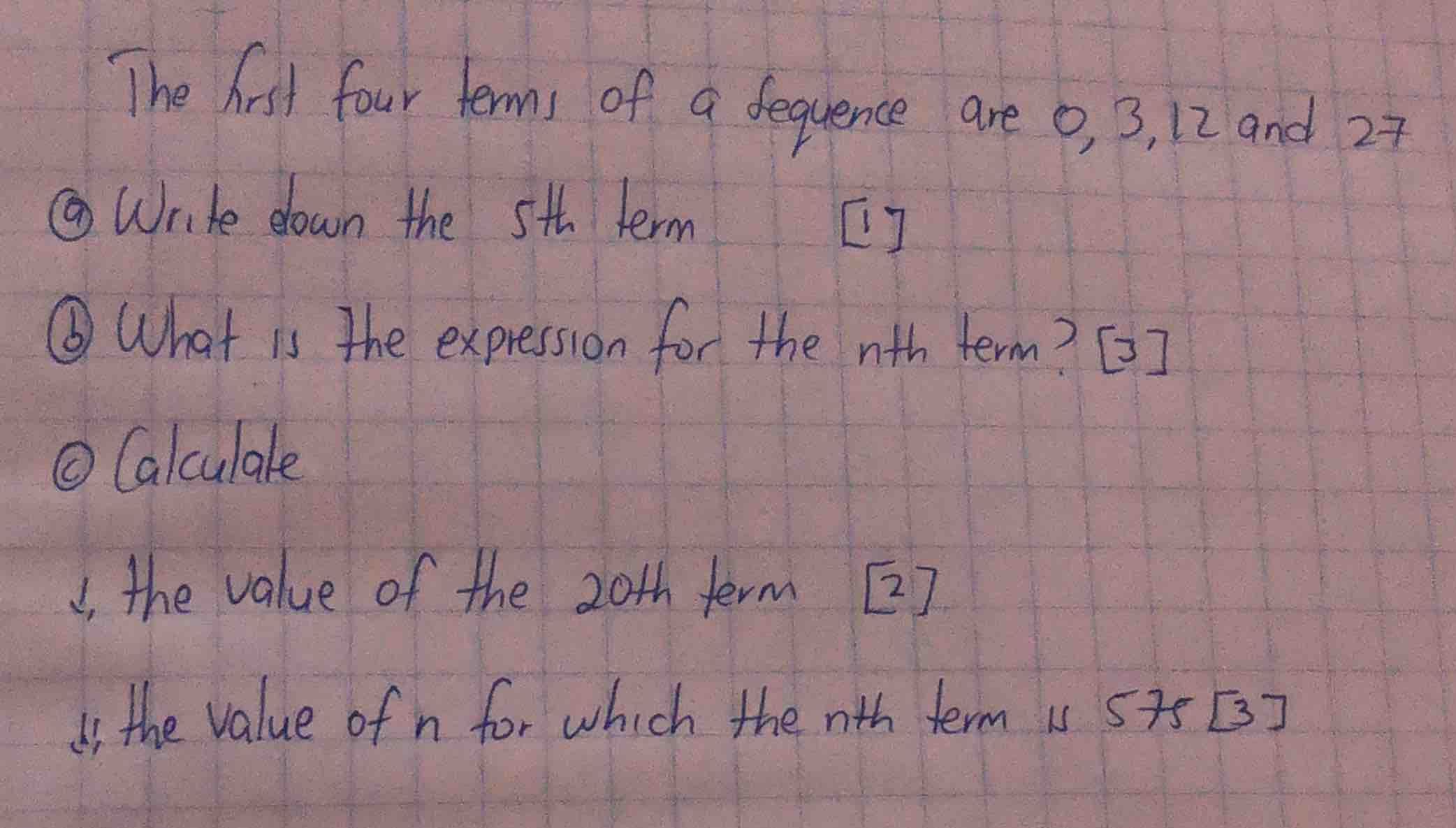
the first four terms of a sequence are 0, 3, 12 and 27
a) write down the 5th term 1
b) what is the expression for the nth term? 3
c) calculate
i. the value of the 20th term 2
ii. the value of n for which the nth term is 575 3
Analyze the given sequence terms
The first four terms of the sequence are:
Let's look at the differences between consecutive terms:
- First differences:
- Second differences:
Since the second differences are constant, this is a quadratic sequence.
Find the expression for the nth term
A quadratic sequence has the general form:
The constant second difference is equal to \(2a\):
Now we subtract \(3n^2\) from each term to find the remaining linear part:
- For \(n = 1\): \(0 - 3(1)^2 = -3\)
- For \(n = 2\): \(3 - 3(2)^2 = 3 - 12 = -9\)
- For \(n = 3\): \(12 - 3(3)^2 = 12 - 27 = -15\)
- For \(n = 4\): \(27 - 3(4)^2 = 27 - 48 = -21\)
The remaining sequence is \(-3, -9, -15, -21, \dots\), which is an arithmetic sequence with a first term of \(-3\) and a common difference of \(-6\).
Thus, the linear part \(bn + c\) is:
Let's combine these parts to get the general formula:
We can factor this expression:
Let's verify this formula with the given terms:
- For \(n = 1\): \(3(1 - 1)^2 = 0\) (Correct)
- For \(n = 2\): \(3(2 - 1)^2 = 3\) (Correct)
- For \(n = 3\): \(3(3 - 1)^2 = 12\) (Correct)
- For \(n = 4\): \(3(4 - 1)^2 = 27\) (Correct)
Determine the 5th term
Using our verified formula \(a_n = 3(n - 1)^2\) for \(n = 5\):
Calculate the value of the 20th term
Using the formula for \(n = 20\):
First, calculate \(19^2\):
Now, multiply by 3:
Find the value of n when the term is 575
We set the general term formula equal to 575 and solve for \(n\):
Divide both sides by 3:
Since \(n\) must be an integer, let's re-examine the question text. The handwritten text says "575". Let's check if there is a typo in the question or if we should solve it algebraically:
If the value was intended to be \(507\) instead of \(575\):
If the value is strictly \(575\) as written:
Let's provide the exact algebraic solution for the written value \(575\).

Snap & solve any problem in the app
Get step-by-step solutions on Sovi AI
Photo-based solutions with guided steps
Explore more problems and detailed explanations
Question a
The 5th term is <blank>48</blank>.
Question b
The expression for the \(n\)th term is <blank>\(3(n - 1)^2\)</blank>.
Question c
Part i
The value of the 20th term is <blank>1083</blank>.
Part ii
The value of \(n\) for which the \(n\)th term is 575 is <blank>\(1 + \sqrt{\frac{575}{3}}\)</blank> (approximately \(14.84\)).