QUESTION IMAGE
Question
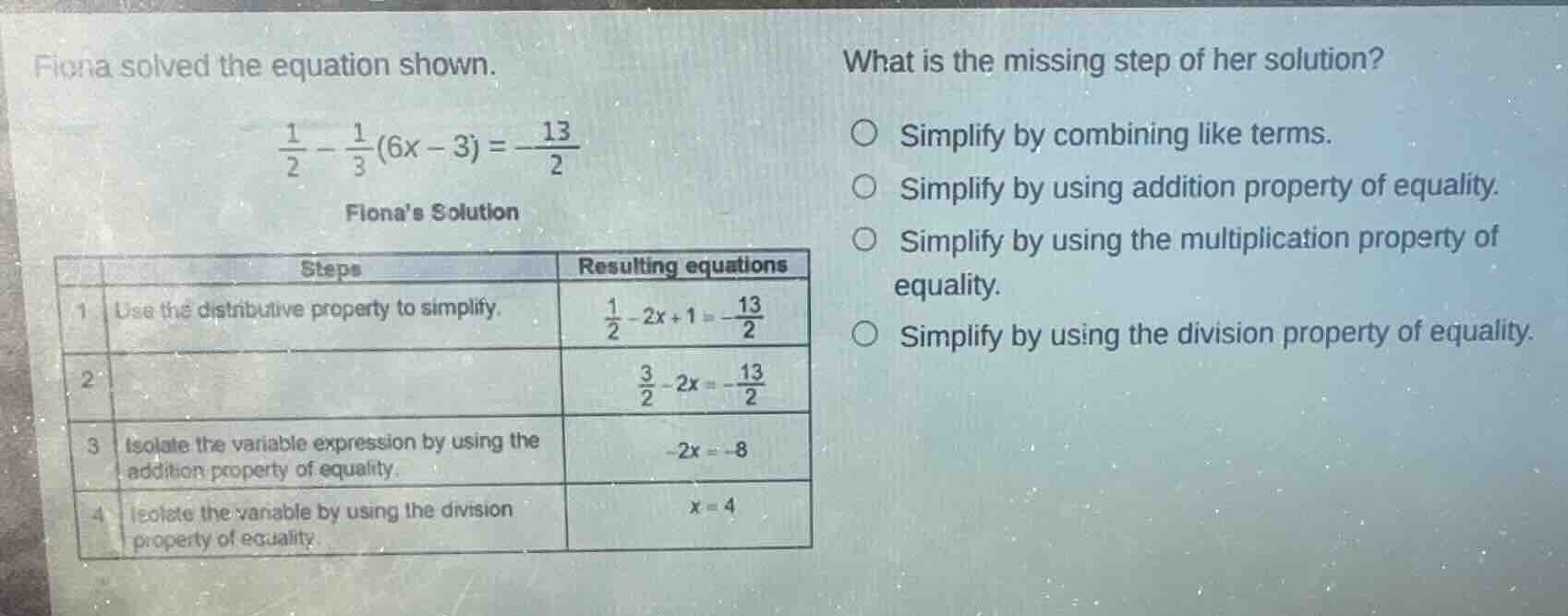
fiona solved the equation shown.
\\(\frac{1}{2} - \frac{1}{3}(6x - 3) = -\frac{13}{2}\\)
fionas solution
| steps | resulting equations |
|---|---|
| 2 | \\(\frac{3}{2} - 2x = -\frac{13}{2}\\) |
| 3 isolate the variable expression by using the addition property of equality. | \\(-2x = -8\\) |
| 4 isolate the variable by using the division property of equality. | \\(x = 4\\) |
what is the missing step of her solution?
\\(\circ\\) simplify by combining like terms.
\\(\circ\\) simplify by using addition property of equality.
\\(\circ\\) simplify by using the multiplication property of equality.
\\(\circ\\) simplify by using the division property of equality.
In step 1, we have \(\frac{1}{2}-2x + 1=-\frac{13}{2}\). To get to step 2's equation \(\frac{3}{2}-2x=-\frac{13}{2}\), we combine the constant terms \(\frac{1}{2}\) and \(1\) (since \(1=\frac{2}{2}\), so \(\frac{1}{2}+\frac{2}{2}=\frac{3}{2}\)). Combining like terms (the constant terms here) simplifies the equation. The other options: addition property of equality involves adding/subtracting to both sides (step 3 does that), multiplication/division properties are for multiplying/dividing both sides (step 4 does division), so step 2 is combining like terms.

Snap & solve any problem in the app
Get step-by-step solutions on Sovi AI
Photo-based solutions with guided steps
Explore more problems and detailed explanations
Simplify by combining like terms.