QUESTION IMAGE
Question
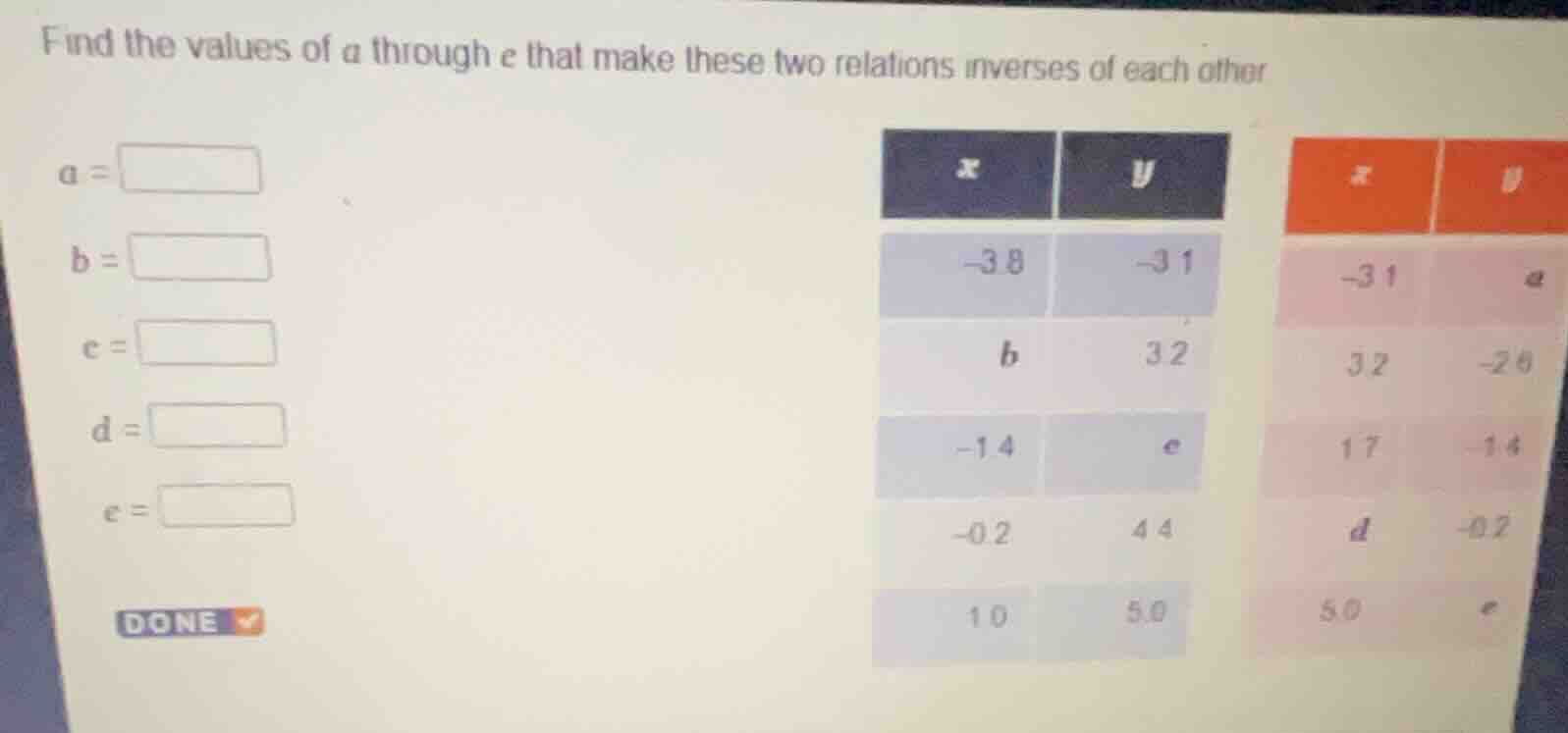
find the values of a through e that make these two relations inverses of each other
\\(a = \\)
\\(b = \\)
\\(c = \\)
\\(d = \\)
\\(e = \\)
Understand the definition of inverse relations
For two relations to be inverses of each other, every ordered pair \((x, y)\) in the first relation must correspond to an ordered pair \((y, x)\) in the second relation. This means the input values of one relation are the output values of the other, and vice versa.
Match corresponding pairs to find a
The first relation contains the pair \((-3.8, -31)\).
For the second relation to be its inverse, it must contain the reversed pair \((-31, -3.8)\).
Looking at the first row of the second table, we have the pair \((-31, a)\).
Therefore, we find:
Match corresponding pairs to find b
The second relation contains the pair \((32, -26)\).
For the first relation to be its inverse, it must contain the reversed pair \((-26, 32)\).
Looking at the second row of the first table, we have the pair \((b, 32)\).
Therefore, we find:
Match corresponding pairs to find c
The second relation contains the pair \((5.0, c)\).
For the first relation to be its inverse, it must contain the reversed pair \((c, 5.0)\).
Looking at the fifth row of the first table, we have the pair \((1.0, 5.0)\).
Therefore, we find:
Match corresponding pairs to find d and e
The second relation contains the pair \((17, -14)\).
Its inverse pair is \((-14, 17)\).
Looking at the third row of the first table, we have \((-14, e)\).
Therefore, we find:
The first relation contains the pair \((-0.2, 44)\).
Its inverse pair is \((44, -0.2)\).
Looking at the fourth row of the second table, we have \((d, -0.2)\).
Therefore, we find:

Snap & solve any problem in the app
Get step-by-step solutions on Sovi AI
Photo-based solutions with guided steps
Explore more problems and detailed explanations
Find the values of a through e that make these two relations inverses of each other:
\(a =\) <blank>\(-3.8\)</blank>
\(b =\) <blank>\(-26\)</blank>
\(c =\) <blank>\(1.0\)</blank>
\(d =\) <blank>\(44\)</blank>
\(e =\) <blank>\(17\)</blank>