QUESTION IMAGE
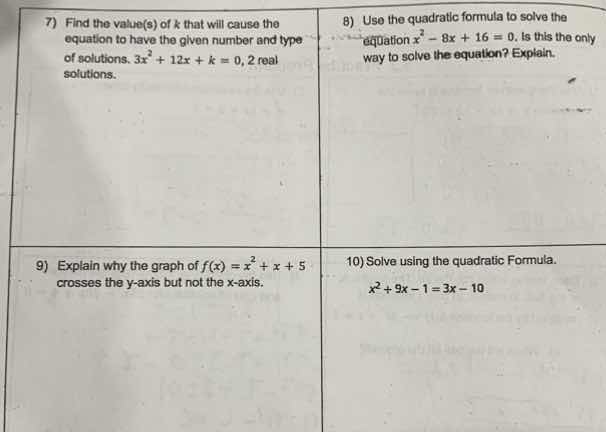
Question
- find the value(s) of ( k ) that will cause the equation to have the given number and type of solutions. ( 3x^2 + 12x + k = 0 ), 2 real solutions.
- use the quadratic formula to solve the equation ( x^2 - 8x + 16 = 0 ). is this the only way to solve the equation? explain.
- explain why the graph of ( f(x) = x^2 + x + 5 ) crosses the ( y )-axis but not the ( x )-axis.
- solve using the quadratic formula. ( x^2 + 9x - 1 = 3x - 10 )
Problem 7
Step 1: Recall the discriminant formula
For a quadratic equation \(ax^2 + bx + c = 0\), the discriminant \(D\) is given by \(D = b^2 - 4ac\). If the equation has 2 real solutions, then \(D>0\).
Step 2: Identify \(a\), \(b\), and \(c\)
In the equation \(3x^2 + 12x + k = 0\), we have \(a = 3\), \(b = 12\), and \(c = k\).
Step 3: Calculate the discriminant
Substitute the values of \(a\), \(b\), and \(c\) into the discriminant formula:
\(D=(12)^2 - 4\times3\times k\)
\(D = 144 - 12k\)
Step 4: Set up the inequality for 2 real solutions
Since we need 2 real solutions, \(D>0\):
\(144 - 12k>0\)
Step 5: Solve the inequality for \(k\)
Subtract 144 from both sides:
\(-12k> - 144\)
Divide both sides by -12 (remember to reverse the inequality sign when dividing by a negative number):
\(k < 12\)
Step 1: Recall the quadratic formula
The quadratic formula for a quadratic equation \(ax^2 + bx + c = 0\) is \(x=\frac{-b\pm\sqrt{b^2 - 4ac}}{2a}\).
Step 2: Identify \(a\), \(b\), and \(c\)
In the equation \(x^2 - 8x + 16 = 0\), we have \(a = 1\), \(b=-8\), and \(c = 16\).
Step 3: Substitute into the quadratic formula
\(x=\frac{-(-8)\pm\sqrt{(-8)^2 - 4\times1\times16}}{2\times1}\)
\(x=\frac{8\pm\sqrt{64 - 64}}{2}\)
\(x=\frac{8\pm\sqrt{0}}{2}\)
\(x=\frac{8\pm0}{2}\)
\(x = 4\) (double root)
Step 4: Check if there's another way
We can also factor the quadratic equation. Let's try factoring:
\(x^2 - 8x + 16=(x - 4)^2\)
Setting \((x - 4)^2 = 0\) gives \(x = 4\) (double root). So factoring is another way to solve this equation.
- Crossing the y - axis: To find where a graph crosses the y - axis, we set \(x = 0\) in the function \(f(x)\). For \(f(x)=x^2 + x + 5\), when \(x = 0\), \(f(0)=0^2+0 + 5=5\). So the graph intersects the y - axis at the point \((0,5)\), which means it crosses the y - axis.
- Not crossing the x - axis: To find where a graph crosses the x - axis, we set \(f(x)=0\), so we solve the equation \(x^2 + x + 5 = 0\). The discriminant of this quadratic equation is \(D=b^2 - 4ac\) with \(a = 1\), \(b = 1\), and \(c = 5\). So \(D=(1)^2-4\times1\times5=1 - 20=-19\). Since the discriminant \(D<0\), the quadratic equation \(x^2 + x + 5 = 0\) has no real solutions. This means the graph of \(f(x)\) does not intersect the x - axis.

Snap & solve any problem in the app
Get step-by-step solutions on Sovi AI
Photo-based solutions with guided steps
Explore more problems and detailed explanations
\(k < 12\)