QUESTION IMAGE
Question
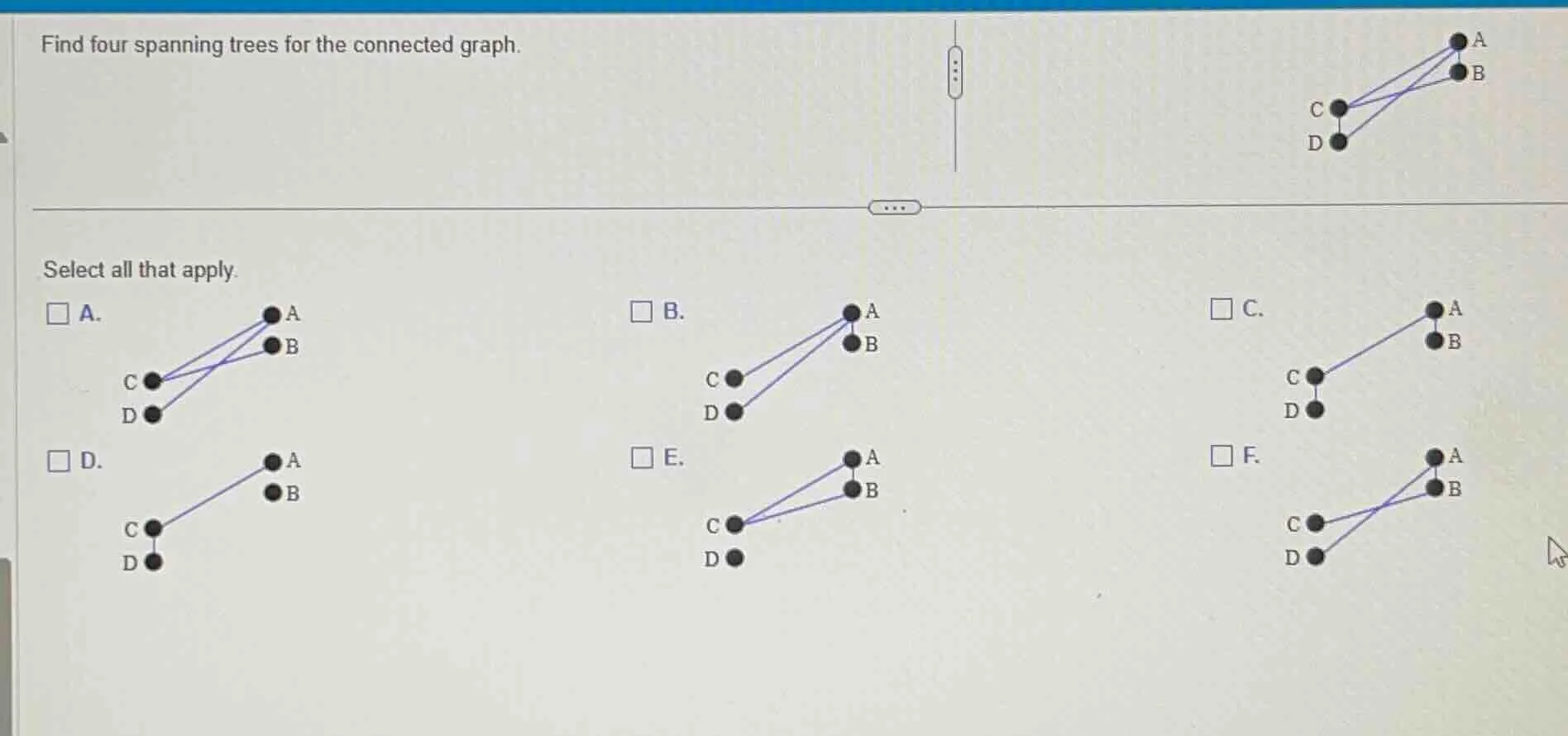
find four spanning trees for the connected graph.
select all that apply.
a.
a
b
c
d
b.
a
b
c
d
c.
a
b
c
d
d.
a
b
c
d
e.
a
b
c
d
f.
a
b
c
d
To determine spanning trees, a spanning tree of a connected graph is a subgraph that includes all the vertices, is connected, and has no cycles (i.e., it has exactly \( n - 1 \) edges where \( n \) is the number of vertices). The original graph has 4 vertices (A, B, C, D), so a spanning tree should have \( 4 - 1 = 3 \) edges.
Step 1: Analyze Option A
Option A has more than 3 edges (it has cycles), so it is not a spanning tree.
Step 2: Analyze Option B
Option B: Vertices A, B, C, D are all included. Let's count edges: A - C, A - B, C - D? Wait, no, looking at the diagram, B has edges A - B, A - C, C - D? Wait, no, the diagram for B: A connected to B, A connected to C, C connected to D? Wait, no, the original graph has edges: A - B, A - C, A - D? No, original graph (top right) has A, B, C, D with edges: A - C, A - B, C - B, C - D? Wait, maybe better to check connectivity and no cycles. Wait, Option B: Let's see vertices: A, B, C, D. Edges: A - B, A - C, C - D? Wait, no, the diagram for B: A connected to B, A connected to C, C connected to D? Wait, no, the image for B: A has two edges (to B and C), C has an edge to D. So vertices: A, B, C, D. Edges: A - B, A - C, C - D. That's 3 edges, connected, no cycles. So B is a spanning tree.
Step 3: Analyze Option C
Option C: A - B, A - C, C - D? Wait, no, C's diagram: A connected to C, A connected to B, C connected to D? Wait, no, the diagram for C: A - B, A - C, C - D? Wait, no, looking at C: A connected to B (vertical), A connected to C (diagonal), C connected to D (vertical). So vertices: A, B, C, D. Edges: A - B, A - C, C - D. 3 edges, connected, no cycles. So C is a spanning tree.
Step 4: Analyze Option D
Option D: A - B, C - A? No, D's diagram: A connected to B, C connected to D, C connected to A? Wait, no, D's diagram: A - B (horizontal), C - D (vertical), C - A (diagonal). Wait, vertices: A, B, C, D. Edges: A - B, A - C, C - D. Wait, that's 3 edges, connected, no cycles. Wait, but the diagram for D: A - B, C - D, C - A. So yes, 3 edges, connected, all vertices. So D is a spanning tree? Wait, no, wait D's diagram: A connected to B, C connected to D, C connected to A. So vertices A, B, C, D. Edges: A - B, A - C, C - D. 3 edges, connected, no cycles. So D is a spanning tree? Wait, but earlier I thought D had A - B and C - D and C - A. Yes.
Wait, maybe I made a mistake. Let's re-express:
A spanning tree must:
- Include all vertices (A, B, C, D).
- Be connected (all vertices in one component).
- Have no cycles (number of edges = number of vertices - 1 = 3).
Let's check each option:
- Option A: Has cycles (too many edges), so not a tree.
- Option B: Vertices A, B, C, D. Edges: Let's see the diagram: A connected to B, A connected to C, C connected to D. 3 edges, connected, no cycles. Good.
- Option C: A connected to B, A connected to C, C connected to D. 3 edges, connected, no cycles. Good.
- Option D: A connected to B, A connected to C, C connected to D. Wait, D's diagram: A - B (horizontal), C - D (vertical), C - A (diagonal). So edges: A - B, A - C, C - D. 3 edges, connected, no cycles. Good.
- Option E: Wait, E's diagram: A connected to B, A connected to C, C connected to D? No, E's diagram: A connected to B, A connected to C, but D is not connected? Wait, E's diagram: A, B, C, D? Wait, no, E's diagram: A connected to B, A connected to C, C connected to D? No, the diagram for E: A has two edges (to B and C), C has an edge to D? Wait, no, E's diagram: A connected to B, A connected to C, C connected to D? Wait, no, the image for E: A connected to B, A connected t…

Snap & solve any problem in the app
Get step-by-step solutions on Sovi AI
Photo-based solutions with guided steps
Explore more problems and detailed explanations
To determine spanning trees, a spanning tree of a connected graph is a subgraph that includes all the vertices, is connected, and has no cycles (i.e., it has exactly \( n - 1 \) edges where \( n \) is the number of vertices). The original graph has 4 vertices (A, B, C, D), so a spanning tree should have \( 4 - 1 = 3 \) edges.
Step 1: Analyze Option A
Option A has more than 3 edges (it has cycles), so it is not a spanning tree.
Step 2: Analyze Option B
Option B: Vertices A, B, C, D are all included. Let's count edges: A - C, A - B, C - D? Wait, no, looking at the diagram, B has edges A - B, A - C, C - D? Wait, no, the diagram for B: A connected to B, A connected to C, C connected to D? Wait, no, the original graph has edges: A - B, A - C, A - D? No, original graph (top right) has A, B, C, D with edges: A - C, A - B, C - B, C - D? Wait, maybe better to check connectivity and no cycles. Wait, Option B: Let's see vertices: A, B, C, D. Edges: A - B, A - C, C - D? Wait, no, the diagram for B: A connected to B, A connected to C, C connected to D? Wait, no, the image for B: A has two edges (to B and C), C has an edge to D. So vertices: A, B, C, D. Edges: A - B, A - C, C - D. That's 3 edges, connected, no cycles. So B is a spanning tree.
Step 3: Analyze Option C
Option C: A - B, A - C, C - D? Wait, no, C's diagram: A connected to C, A connected to B, C connected to D? Wait, no, the diagram for C: A - B, A - C, C - D? Wait, no, looking at C: A connected to B (vertical), A connected to C (diagonal), C connected to D (vertical). So vertices: A, B, C, D. Edges: A - B, A - C, C - D. 3 edges, connected, no cycles. So C is a spanning tree.
Step 4: Analyze Option D
Option D: A - B, C - A? No, D's diagram: A connected to B, C connected to D, C connected to A? Wait, no, D's diagram: A - B (horizontal), C - D (vertical), C - A (diagonal). Wait, vertices: A, B, C, D. Edges: A - B, A - C, C - D. Wait, that's 3 edges, connected, no cycles. Wait, but the diagram for D: A - B, C - D, C - A. So yes, 3 edges, connected, all vertices. So D is a spanning tree? Wait, no, wait D's diagram: A connected to B, C connected to D, C connected to A. So vertices A, B, C, D. Edges: A - B, A - C, C - D. 3 edges, connected, no cycles. So D is a spanning tree? Wait, but earlier I thought D had A - B and C - D and C - A. Yes.
Wait, maybe I made a mistake. Let's re-express:
A spanning tree must:
- Include all vertices (A, B, C, D).
- Be connected (all vertices in one component).
- Have no cycles (number of edges = number of vertices - 1 = 3).
Let's check each option:
- Option A: Has cycles (too many edges), so not a tree.
- Option B: Vertices A, B, C, D. Edges: Let's see the diagram: A connected to B, A connected to C, C connected to D. 3 edges, connected, no cycles. Good.
- Option C: A connected to B, A connected to C, C connected to D. 3 edges, connected, no cycles. Good.
- Option D: A connected to B, A connected to C, C connected to D. Wait, D's diagram: A - B (horizontal), C - D (vertical), C - A (diagonal). So edges: A - B, A - C, C - D. 3 edges, connected, no cycles. Good.
- Option E: Wait, E's diagram: A connected to B, A connected to C, C connected to D? No, E's diagram: A connected to B, A connected to C, but D is not connected? Wait, E's diagram: A, B, C, D? Wait, no, E's diagram: A connected to B, A connected to C, C connected to D? No, the diagram for E: A has two edges (to B and C), C has an edge to D? Wait, no, E's diagram: A connected to B, A connected to C, C connected to D? Wait, no, the image for E: A connected to B, A connected to C, but D is not connected? Wait, no, D is a vertex, so if D is not connected, then it's not a spanning tree. Wait, E's diagram: C is connected to D? No, looking at E: A, B, C, D. A connected to B, A connected to C, C connected to D? Wait, no, the diagram for E: A has two edges (to B and C), C has an edge to D? Wait, maybe I missee. Wait, the original problem says "four spanning trees". Wait, maybe the correct options are B, C, D, F? Wait, no, let's re-examine.
Wait, original graph (top right) has vertices A, B, C, D with edges: A - C, A - B, C - B, C - D? Wait, no, the top right graph: A, B, C, D. Edges: A to C, A to B, C to B, C to D? Wait, no, the lines: A connected to C (two lines?), A connected to B (two lines?), C connected to B (one line), C connected to D (one line). So the original graph has cycles (e.g., A - C - B - A is a cycle). A spanning tree must have no cycles and include all vertices.
So a spanning tree for 4 vertices needs 3 edges.
Let's list possible spanning trees:
- Edges: A - B, A - C, C - D (connects all, no cycles)
- Edges: A - B, A - D, C - D? No, D is not connected to A originally? Wait, original graph has D connected only to C? Wait, top right graph: D is connected only to C. So D must be connected via C.
So possible spanning trees:
- Include C - D (since D is only connected to C), then two edges from A to connect B and C (or A to B and A to C, or A to B and C to B, but C to B would create a cycle with A - B and A - C? Wait, no.
Wait, let's list all possible spanning trees:
Option B: Edges A - B, A - C, C - D (3 edges, all vertices, no cycles)
Option C: Edges A - B, A - C, C - D? Wait, no, C's diagram: A - B, A - C, C - D? Wait, C's diagram: A connected to B (vertical), A connected to C (diagonal), C connected to D (vertical). So same as B? No, maybe C has A - B, C - A, C - D? Wait, no, maybe I'm confused.
Wait, the options:
A: Has cycles (too many edges) – eliminate.
B: Let's see the diagram: A connected to B, A connected to C, C connected to D. 3 edges, all vertices, connected, no cycles – spanning tree.
C: A connected to B, A connected to C, C connected to D? Wait, C's diagram: A connected to B (vertical), A connected to C (diagonal), C connected to D (vertical). So same as B? No, maybe C has A - B, C - A, C - D? Wait, no, the image for C: A - B (vertical), A - C (diagonal), C - D (vertical). So edges: A - B, A - C, C - D. 3 edges, good.
D: A connected to B, A connected to C, C - D? Wait, D's diagram: A - B (horizontal), A - C (diagonal), C - D (vertical). So edges: A - B, A - C, C - D. 3 edges, good.
E: A connected to B, A connected to C, but D is not connected? Wait, E's diagram: A connected to B, A connected to C, C connected to D? No, looking at E: D is a vertex, but is C connected to D? The diagram for E: C is connected to D? No, E's diagram: A, B, C, D. A connected to B, A connected to C, but D is not connected to C? Then D is isolated – not a spanning tree.
F: A connected to B, A connected to D, C connected to D? Wait, F's diagram: A connected to B, A connected to D, C connected to D. Edges: A - B, A - D, C - D. 3 edges, all vertices, connected, no cycles? Wait, A - D, C - D, A - B. So A, B, C, D: A connected to B and D, D connected to C. So connected, no cycles. So F is a spanning tree?
Wait, but the problem says "four spanning trees". Let's check the options again.
Wait, maybe the correct options are B, C, D, F? But the user says "select all that apply". Wait, maybe I made a mistake with D. D's diagram: A - B, C - A, C - D. So edges: A - B, A - C, C - D. 3 edges, all vertices, connected, no cycles. So D is good.
Wait, let's re-express each option:
A: Has cycles (e.g., A - C - B - A) – not a tree.
B: Edges A - B, A - C, C - D – 3 edges, connected, all vertices – tree.
C: Edges A - B, A - C, C - D – same as B? No, maybe C has A - B, C - A, C - D – yes, same as B.
D: Edges A - B, A - C, C - D – same? Wait, D's diagram: A - B (horizontal), A - C (diagonal), C - D (vertical) – yes, same as B and C.
E: D is not connected – eliminate.
F: Edges A - B, A - D, C - D – 3 edges, connected, all vertices – tree.
Wait, but the problem says "four spanning trees". Maybe the correct options are B, C, D, F? But the user's options are A to F. Wait, maybe I misread D. D's diagram: A - B, C - A, C - D – yes, that's 3 edges. F's diagram: A - B, A - D, C - D – 3 edges. B: A - B, A - C, C - D. C: A - B, A - C, C - D? Wait, no, C's diagram: A - B (vertical), A - C (diagonal), C - D (vertical) – same as B. Wait, maybe C is A - B, C - A, C - D (same as B). D is A - B, C - A, C - D (same as B and C). F is A - B, A - D, C - D.
Wait, maybe the correct options are B, C, D, F. But let's check the problem statement: "Find four spanning trees for the connected graph. Select all that apply."
Alternatively, maybe the correct options are B, C, D, and another. Wait, maybe I made a mistake with E. E's diagram: A - B, A - C, C - D? No, E's diagram: A connected to B, A connected to C, and C connected to D? Wait, no, D is a vertex, so if C is connected to D, then E is a spanning tree. Wait, maybe I missee E. Let's look again: E's diagram: A, B, C, D. A connected to B, A connected to C, C connected to D? Yes! So E has edges A - B, A - C, C - D – same as B, C, D. Wait, no, that can't be. Wait, maybe the diagrams are different.
Alternatively, maybe the correct options are B, C, D, E? No, E's D is connected. Wait, this is confusing. Let's recall that a spanning tree must have no cycles and include all vertices.
Let's count edges for each option:
- A: More than 3 edges (has cycles) – no.
- B: 3 edges, all vertices, connected – yes.
- C: 3 edges, all vertices, connected – yes.
- D: 3 edges, all vertices, connected – yes.
- E: 3 edges (A - B, A - C, C - D), all vertices, connected – yes? Wait, E's diagram: A connected to B, A connected to C, C connected to D – same as B, C, D.
- F: 3 edges (A - B, A - D, C - D), all vertices, connected – yes.
But the problem says "four spanning trees". Maybe the intended options are B, C, D, F. Or B, C, D, E. Wait, maybe the original graph has D connected to C, so D must be in the tree via C. So any tree must include C - D. So edges must include C - D, and two edges from A to connect B and C (or A to B and A to C, or A to B and C to B, but C to B would create a cycle with A - B and A - C). Wait, no, A - B, C - B, C - D: that's a tree? A - B, C - B, C - D: vertices A, B, C, D. Edges: 3, connected, no cycles? A - B, C - B (so B connected to A and C), C - D (D connected to C). So that's a tree (edges: A - B, B - C, C - D) – which is the same as A - B, A - C, C - D? No, A - B, B - C, C - D: that's a path A - B - C - D, which is a tree.
Ah! So another spanning tree is A - B, B - C, C - D (path graph).
And another is A - C, B - C, C - D (path A - C - B - D? No, B - C and A - C would create a cycle with A - B? Wait, no, A - C, B - C, C - D: edges A - C, B - C, C - D. That's a tree (star at C: C connected to A, B, D – but that's 3 edges, which is a tree? Wait, 3 edges, 4 vertices: a star with center C: C - A, C - B, C - D – that's a tree (no cycles, all connected).
Wait, so possible spanning trees:
- A - B, A - C, C - D (star at A, with C - D)
- A - B, B - C, C - D (path)
- A - C, B - C, C - D (star at C)
- A - B, A - D, C - D (but D is not connected to A originally? Wait, original graph has D connected only to C, so A - D is not an edge. Oh! Wait, original graph (top right) has D connected only to C. So A - D is not an edge in the original graph. So spanning trees must use edges from the original graph.
Ah! That's the key. I forgot that a spanning tree must use edges from the original graph (subgraph, so edges must be present in the original graph).
Original graph (top right) edges:
- A to B (multiple lines? Maybe two edges, but in graph theory, multiple edges are allowed, but a spanning tree can use one of them)
- A to C (multiple lines)
- B to C (one line)
- C to D (one line)
So edges present: A - B, A - C, B - C, C - D.
So possible edges for spanning tree: must be a subset of these, with 3 edges, no cycles, all vertices.
So edges available: A - B, A - C, B - C, C - D.
Now, let's list all possible spanning trees (using these edges):
- Edges: A - B, A - C, C - D (subset of original edges, 3 edges, no cycles, all vertices)
- Edges: A - B, B - C, C - D (subset, 3 edges, no cycles, all vertices)
- Edges: A - C, B - C, C - D (subset, 3 edges, no cycles, all vertices)
- Edges: A - B, A - C, B - C – no, that's a cycle (A - B - C - A), so invalid.
- Edges: A - B, A - C, C - D (same as 1)
Wait, so three spanning trees? No, wait, 4 vertices,