QUESTION IMAGE
Question
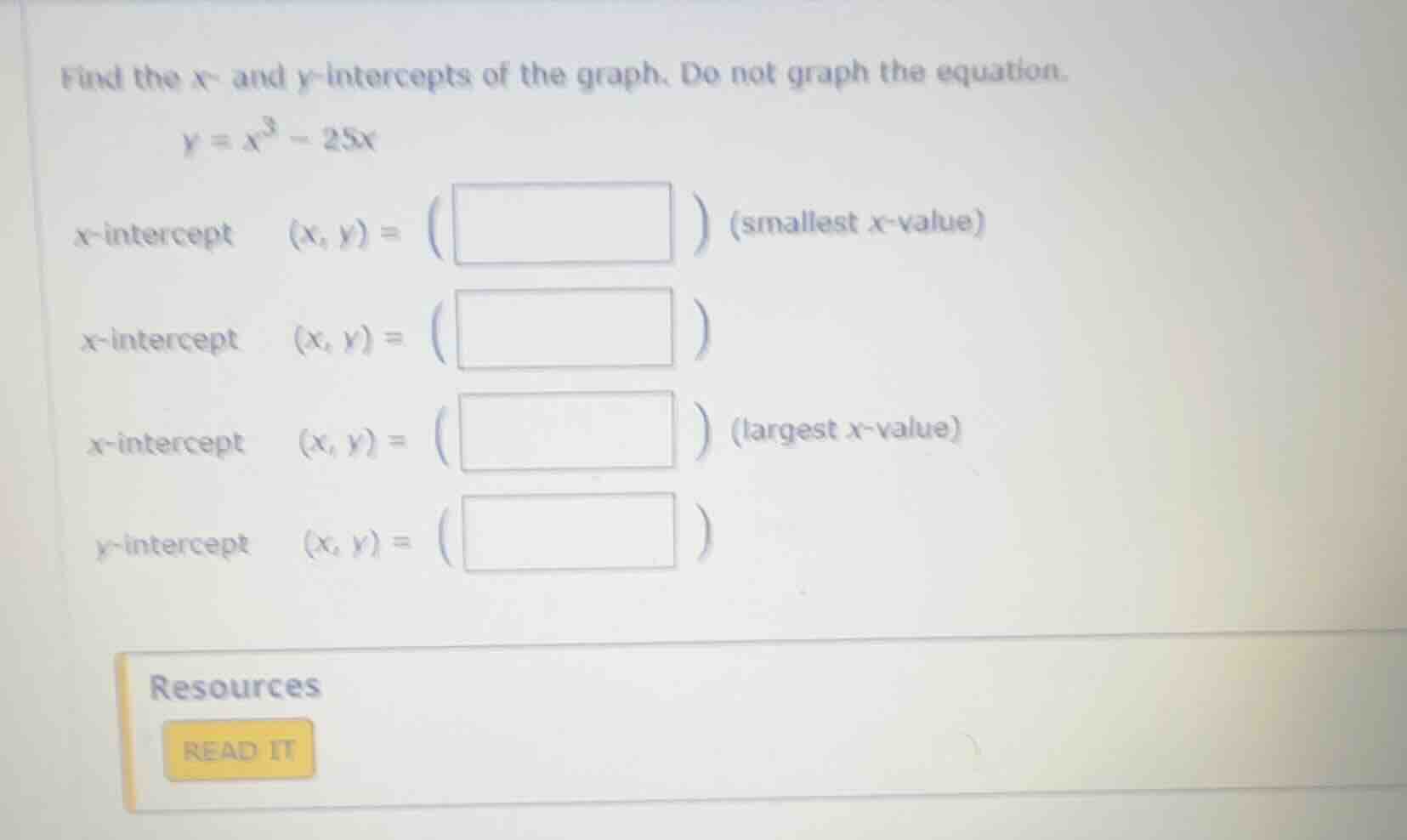
find the \\(x\\)- and \\(y\\)-intercepts of the graph. do not graph the equation.
\\y = x^3 - 25x\\
\\(x\\)-intercept \\((x, y) = \left(\quad\
ight)\\) (smallest \\(x\\)-value)
\\(x\\)-intercept \\((x, y) = \left(\quad\
ight)\\)
\\(x\\)-intercept \\((x, y) = \left(\quad\
ight)\\) (largest \\(x\\)-value)
\\(y\\)-intercept \\((x, y) = \left(\quad\
ight)\\)
⚡ Using what you learned: factoring and solving quadratic equations · 🆕 New: Finding x- and y-intercepts
To find where a graph crosses the axes, we set one variable to zero and solve for the other.
Step 1: Find the y-intercept
To find the \(y\)-intercept, set \(x = 0\) in the equation:
So, the \(y\)-intercept is:
Step 2: Find the x-intercepts
To find the \(x\)-intercepts, set \(y = 0\) and solve for \(x\):
Factor out the greatest common factor, \(x\):
Step 3: Factor completely and solve
Factor the difference of squares, \(x^2 - 25\):
Set each factor to zero to find the solutions:
The \(x\)-intercepts are:

Snap & solve any problem in the app
Get step-by-step solutions on Sovi AI
Photo-based solutions with guided steps
Explore more problems and detailed explanations
- \(x\)-intercept (smallest \(x\)-value): \((-5, 0)\)
- \(x\)-intercept: \((0, 0)\)
- \(x\)-intercept (largest \(x\)-value): \((5, 0)\)
- \(y\)-intercept: \((0, 0)\)