QUESTION IMAGE
Question
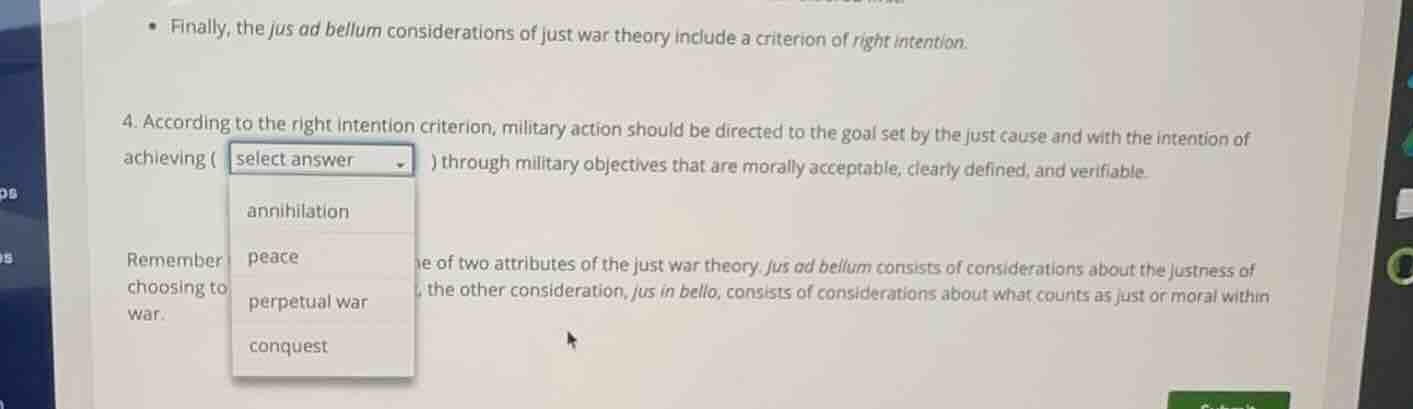
finally, the jus ad bellum considerations of just war theory include a criterion of right intention.
- according to the right intention criterion, military action should be directed to the goal set by the just cause and with the intention of achieving (select answer) through military objectives that are morally acceptable, clearly defined, and verifiable.
options:
- annihilation
- peace
- perpetual war
- conquest
remember: jus ad bellum is one of two attributes of the just war theory. jus ad bellum consists of considerations about the justness of choosing to go to war, while the other consideration, jus in bello, consists of considerations about what counts as just or moral within war.
<pre_analysis>
{
"quality": "clear",
"question_count": 1,
"skills_matched": [
"direct_cot",
"multiple_choice_formatter",
"explain_then_answer",
"quick"
],
"needs_drawing": false,
"concepts_used": [
"Just War Theory",
"Jus ad bellum"
],
"new_concepts": [],
"current_concepts": [
"Just War Theory",
"Jus ad bellum"
]
}
</pre_analysis>
<reasoning>
Analyze the right intention criterion in just war theory
Under the jus ad bellum framework of just war theory, the criterion of "right intention" dictates that the ultimate moral purpose of resorting to military force must be to establish a just and lasting peace, rather than pursuing self-interest, expansion, or destruction.
Evaluate the dropdown options
- annihilation: Contradicts the moral limits of just war theory.
- peace: Aligns precisely with the core philosophical goal of right intention, which is to secure a just peace.
- perpetual war: Directly opposes the goal of ending conflict.
- conquest: Represents an unjust, self-serving motive explicitly forbidden by the theory.
</reasoning>
<answer>
<mcq-option>annihilation</mcq-option>
<mcq-correct>peace</mcq-correct>
<mcq-option>perpetual war</mcq-option>
<mcq-option>conquest</mcq-option>
</answer>
<post_analysis>
{
"subject": "Social Science",
"question_type": "Multiple Choice",
"knowledge_point": [
"Social Science",
"Political Science",
"Just War Theory"
]
}
</post_analysis>
Snap & solve any problem in the app
Get step-by-step solutions on Sovi AI
Photo-based solutions with guided steps
Explore more problems and detailed explanations
<pre_analysis>
{
"quality": "clear",
"question_count": 1,
"skills_matched": [
"direct_cot",
"multiple_choice_formatter",
"explain_then_answer",
"quick"
],
"needs_drawing": false,
"concepts_used": [
"Just War Theory",
"Jus ad bellum"
],
"new_concepts": [],
"current_concepts": [
"Just War Theory",
"Jus ad bellum"
]
}
</pre_analysis>
<reasoning>
Analyze the right intention criterion in just war theory
Under the jus ad bellum framework of just war theory, the criterion of "right intention" dictates that the ultimate moral purpose of resorting to military force must be to establish a just and lasting peace, rather than pursuing self-interest, expansion, or destruction.
Evaluate the dropdown options
- annihilation: Contradicts the moral limits of just war theory.
- peace: Aligns precisely with the core philosophical goal of right intention, which is to secure a just peace.
- perpetual war: Directly opposes the goal of ending conflict.
- conquest: Represents an unjust, self-serving motive explicitly forbidden by the theory.
</reasoning>
<answer>
<mcq-option>annihilation</mcq-option>
<mcq-correct>peace</mcq-correct>
<mcq-option>perpetual war</mcq-option>
<mcq-option>conquest</mcq-option>
</answer>
<post_analysis>
{
"subject": "Social Science",
"question_type": "Multiple Choice",
"knowledge_point": [
"Social Science",
"Political Science",
"Just War Theory"
]
}
</post_analysis>