QUESTION IMAGE
Question
final exam review packet (study guide) 2026
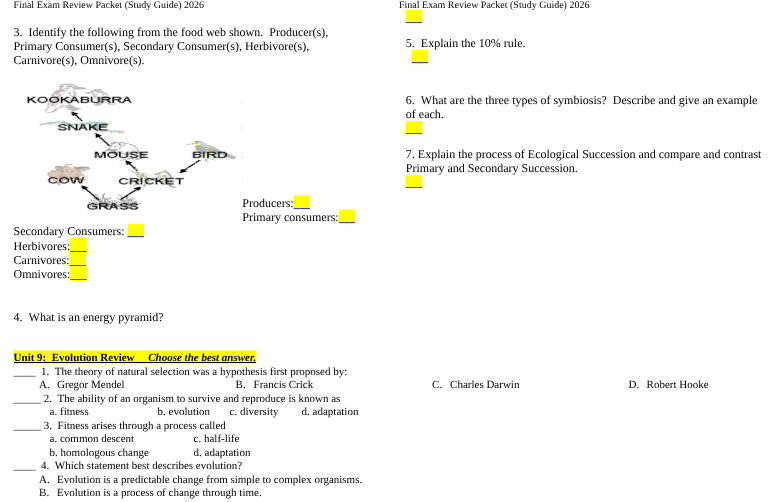
- identify the following from the food web shown. producer(s), primary consumer(s), secondary consumer(s), herbivore(s), carnivore(s), omnivore(s).
producers:
primary consumers:
secondary consumers:
herbivores:
carnivores:
omnivores:
- what is an energy pyramid?
final exam review packet (study guide) 2026
- explain the 10% rule.
- what are the three types of symbiosis? describe and give an example of each.
- explain the process of ecological succession and compare and contrast primary and secondary succession.
unit 9: evolution review choose the best answer.
- the theory of natural selection was a hypothesis first proposed by:
a. gregor mendel
b. francis crick
c. charles darwin
d. robert hooke
- the ability of an organism to survive and reproduce is known as
a. fitness
b. evolution
c. diversity
d. adaptation
- fitness arises through a process called
a. common descent
c. half-life
b. homologous change
d. adaptation
- which statement best describes evolution?
a. evolution is a predictable change from simple to complex organisms.
b. evolution is a process of change through time.
🆕 New Concept Discovered: Trophic Levels and Food Web Dynamics
How energy flows and organisms interact in an ecosystem
---
Step 1: Analyze the Food Web (Question 3)
To classify each organism, we trace the arrows in the food web. Remember: arrows point in the direction of energy flow (from the organism being eaten to the organism that eats it).
- Grass: Has arrows pointing away from it to Cow, Mouse, and Cricket. It makes its own food.
- Classification: Producer.
- Cow: Eats Grass.
- Classification: Primary Consumer, Herbivore.
- Cricket: Eats Grass.
- Classification: Primary Consumer, Herbivore.
- Mouse: Eats Grass and Cricket.
- Classification: Because it eats both a producer (Grass) and a consumer (Cricket), it is both a Primary and Secondary Consumer, making it an Omnivore.
- Bird: Eats Cricket.
- Classification: Secondary Consumer, Carnivore.
- Snake: Eats Mouse.
- Classification: Secondary/Tertiary Consumer, Carnivore.
- Kookaburra: Eats Snake.
- Classification: Tertiary/Quaternary Consumer, Carnivore.
---
Step 2: Define an Energy Pyramid (Question 4)
An energy pyramid is a graphical representation designed to show the biomass or bio-productivity at each trophic level in a given ecosystem. It shows how energy is lost as it flows upwards through the trophic levels.
---
Step 3: Explain the 10% Rule (Question 5)
The 10% Rule states that when energy is passed in an ecosystem from one trophic level to the next, only about \(10\%\) of the energy is stored as biomass to be passed on to the next level. The other \(90\%\) of the energy is lost as heat during metabolic processes (like respiration) or excreted as waste.
---
Step 4: Describe the Three Types of Symbiosis (Question 6)
Symbiosis describes close, long-term interactions between different biological species:
- Mutualism: Both species benefit from the interaction.
- Example: Bees and flowers (bees get nectar, flowers get pollinated).
- Commensalism: One species benefits, while the other is neither helped nor harmed.
- Example: Barnacles on a whale (barnacles get a ride to nutrient-rich waters; the whale is unaffected).
- Parasitism: One species benefits (the parasite) at the expense of the other (the host).
- Example: A tick feeding on a dog.
---
Step 5: Explain Ecological Succession (Question 7)
Ecological succession is the gradual process by which ecosystems change and develop over time.
- Primary Succession: Occurs in essentially lifeless areas—regions in which the soil is incapable of sustaining life (e.g., after a volcanic eruption or retreating glacier). It begins with pioneer species like lichens or mosses that break down rock into soil.
- Secondary Succession: Occurs in areas where an existing community has been cleared by a disturbance (e.g., a forest fire or abandoned farm), but the soil remains intact. It occurs much faster than primary succession because soil is already present.
---
Step 6: Solve the Evolution Review Multiple Choice (Unit 9)
- The theory of natural selection was a hypothesis first proposed by:
- Answer: C. Charles Darwin (He famously proposed natural selection in On the Origin of Species).
- The ability of an organism to survive and reproduce is known as:
- Answer: a. fitness (In evolutionary biology, fitness is defined by reproductive success).
- Fitness arises through a process called:
- Answer: **d. adaptati…

Snap & solve any problem in the app
Get step-by-step solutions on Sovi AI
Photo-based solutions with guided steps
Explore more problems and detailed explanations
Question 3: Food Web Identification
- Producers: Grass
- Primary Consumers: Cow, Cricket, Mouse
- Secondary Consumers: Mouse, Bird, Snake
- Herbivores: Cow, Cricket
- Carnivores: Bird, Snake, Kookaburra
- Omnivores: Mouse
Question 4: Energy Pyramid
An energy pyramid is a diagram that shows the amount of energy available at each trophic level of an ecosystem, illustrating how energy decreases as you move up the food chain.
Question 5: The 10% Rule
The 10% rule states that only about \(10\%\) of the energy at one trophic level is transferred to the next level. The remaining \(90\%\) is lost as heat or used by the organisms for life processes.
Question 6: Three Types of Symbiosis
- Mutualism: Both organisms benefit. (Example: Bees and flowers)
- Commensalism: One organism benefits, the other is unaffected. (Example: Barnacles on a whale)
- Parasitism: One organism benefits, the other is harmed. (Example: Ticks on a dog)
Question 7: Ecological Succession
- Ecological Succession is the gradual process of ecosystem recovery and change over time.
- Primary Succession starts in an environment with no soil (e.g., bare rock after a volcano).
- Secondary Succession occurs after a disturbance in an environment that already has soil (e.g., forest regrowth after a fire).
Unit 9: Evolution Review
- C (Charles Darwin)
- a (fitness)
- d (adaptation)
- B (Evolution is a process of change through time.)