QUESTION IMAGE
Question
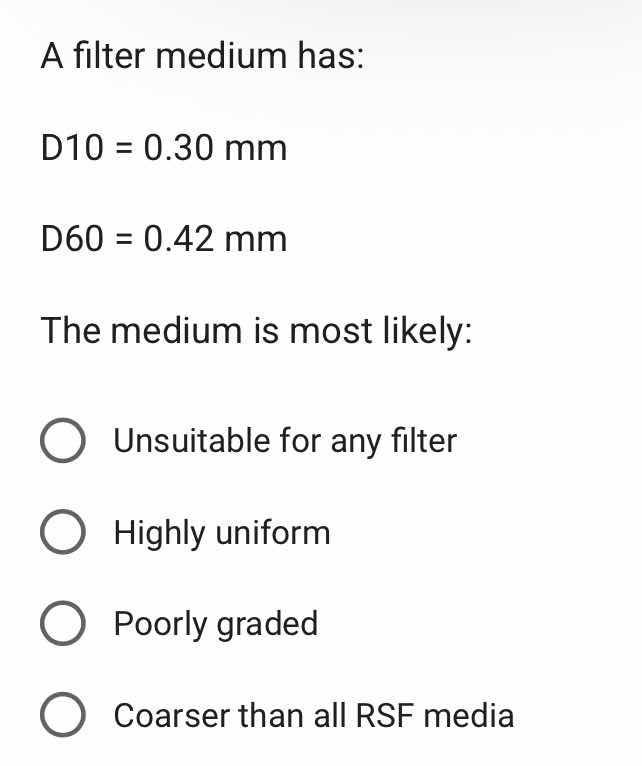
a filter medium has:
\\(d_{10} = 0.30\text{ mm}\\)
\\(d_{60} = 0.42\text{ mm}\\)
the medium is most likely:
unsuitable for any filter
highly uniform
poorly graded
coarser than all rsf media
🆕 New Concept Discovered: Uniformity Coefficient
Measuring how uniform a granular material is.
Step 1: Calculate the Uniformity Coefficient
The uniformity coefficient \( U_c \) (or \( C_u \)) is a measure of how uniform the particle sizes are in a granular medium. It is calculated using the formula:
$$ U_c = \frac{D_{60}}{D_{10}} $$
Given:
- \( D_{10} = 0.30\text{ mm} \)
- \( D_{60} = 0.42\text{ mm} \)
$$ U_c = \frac{0.42}{0.30} = 1.4 $$
Step 2: Interpret the Uniformity Coefficient
A uniformity coefficient \( U_c \) close to \( 1.0 \) indicates that the particles are nearly all the same size (highly uniform).
- In water treatment filtration (such as rapid sand filters), a filter medium is considered highly uniform if \( U_c \) is typically less than \( 1.5 \) (often aiming for \( 1.3 \) to \( 1.5 \)).
- Since \( U_c = 1.4 \), the filter medium is highly uniform.

Snap & solve any problem in the app
Get step-by-step solutions on Sovi AI
Photo-based solutions with guided steps
Explore more problems and detailed explanations
Highly uniform