Sovi.AI - AI Math Tutor

Scan to solve math questions

QUESTION IMAGE

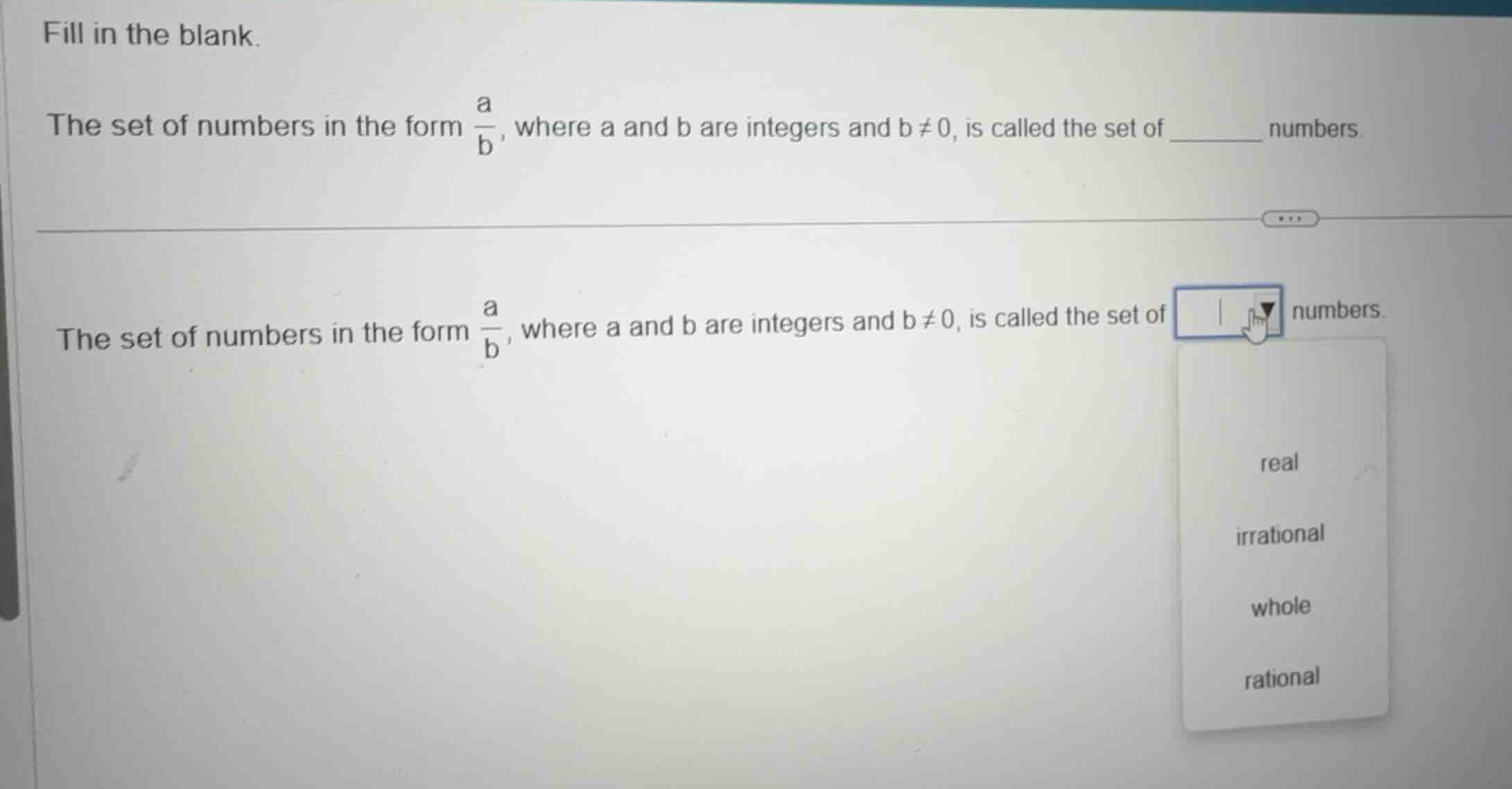
fill in the blank. the set of numbers in the form \\(\\frac{a}{b}\\), w…

Question

fill in the blank.

the set of numbers in the form \\(\frac{a}{b}\\), where a and b are integers and \\(b \
eq 0\\), is called the set of ______ numbers.

real
irrational
whole
rational

Explanation:

Response

<pre_analysis>
{
"quality": "clear",
"question_count": 1,
"skills_matched": [
"direct_cot",
"blank_filling_formatter",
"explain_then_answer",
"tutor"
],
"needs_drawing": false,
"concepts_used": [
"Number Systems",
"Integers"
],
"new_concepts": [
"Rational Numbers"
],
"current_concepts": [
"Number Systems",
"Integers",
"Rational Numbers"
]
}
</pre_analysis>

<reasoning>

Identify the given definition

The problem asks us to identify a specific set of numbers. We are given the mathematical definition:
The set of numbers in the form \(\frac{a}{b}\), where \(a\) and \(b\) are integers and \(b
eq 0\).

Analyze the options

Using the Number Systems and Integers knowledge points, let's evaluate the given choices:

  • real: Real numbers include all rational and irrational numbers. This definition is too specific to represent all real numbers.
  • irrational: Irrational numbers cannot be written in the form \(\frac{a}{b}\) where \(a\) and \(b\) are integers.
  • whole: Whole numbers are non-negative integers \(\{0, 1, 2, 3, \dots\}\), which do not generally require a fractional representation with a non-zero denominator.
  • rational: By definition, any number that can be expressed as the quotient or fraction \(\frac{a}{b}\) of two integers, a numerator \(a\) and a non-zero denominator \(b\), is a rational number.

Select the correct term

The definition perfectly matches the mathematical definition of rational numbers. Therefore, the blank should be filled with "rational".
</reasoning>

<answer>
Fill in the blank.

The set of numbers in the form \(\frac{a}{b}\), where a and b are integers and \(b
eq 0\), is called the set of <blank>rational</blank> numbers.
</answer>

<post_analysis>
{
"subject": "Mathematics",
"question_type": "Fill-in-the-blank",
"knowledge_point": [
"Mathematics",
"Algebra",
"Number Systems"
]
}
</post_analysis>

Answer:

<pre_analysis>
{
"quality": "clear",
"question_count": 1,
"skills_matched": [
"direct_cot",
"blank_filling_formatter",
"explain_then_answer",
"tutor"
],
"needs_drawing": false,
"concepts_used": [
"Number Systems",
"Integers"
],
"new_concepts": [
"Rational Numbers"
],
"current_concepts": [
"Number Systems",
"Integers",
"Rational Numbers"
]
}
</pre_analysis>

<reasoning>

Identify the given definition

The problem asks us to identify a specific set of numbers. We are given the mathematical definition:
The set of numbers in the form \(\frac{a}{b}\), where \(a\) and \(b\) are integers and \(b
eq 0\).

Analyze the options

Using the Number Systems and Integers knowledge points, let's evaluate the given choices:

  • real: Real numbers include all rational and irrational numbers. This definition is too specific to represent all real numbers.
  • irrational: Irrational numbers cannot be written in the form \(\frac{a}{b}\) where \(a\) and \(b\) are integers.
  • whole: Whole numbers are non-negative integers \(\{0, 1, 2, 3, \dots\}\), which do not generally require a fractional representation with a non-zero denominator.
  • rational: By definition, any number that can be expressed as the quotient or fraction \(\frac{a}{b}\) of two integers, a numerator \(a\) and a non-zero denominator \(b\), is a rational number.

Select the correct term

The definition perfectly matches the mathematical definition of rational numbers. Therefore, the blank should be filled with "rational".
</reasoning>

<answer>
Fill in the blank.

The set of numbers in the form \(\frac{a}{b}\), where a and b are integers and \(b
eq 0\), is called the set of <blank>rational</blank> numbers.
</answer>

<post_analysis>
{
"subject": "Mathematics",
"question_type": "Fill-in-the-blank",
"knowledge_point": [
"Mathematics",
"Algebra",
"Number Systems"
]
}
</post_analysis>