QUESTION IMAGE
Question
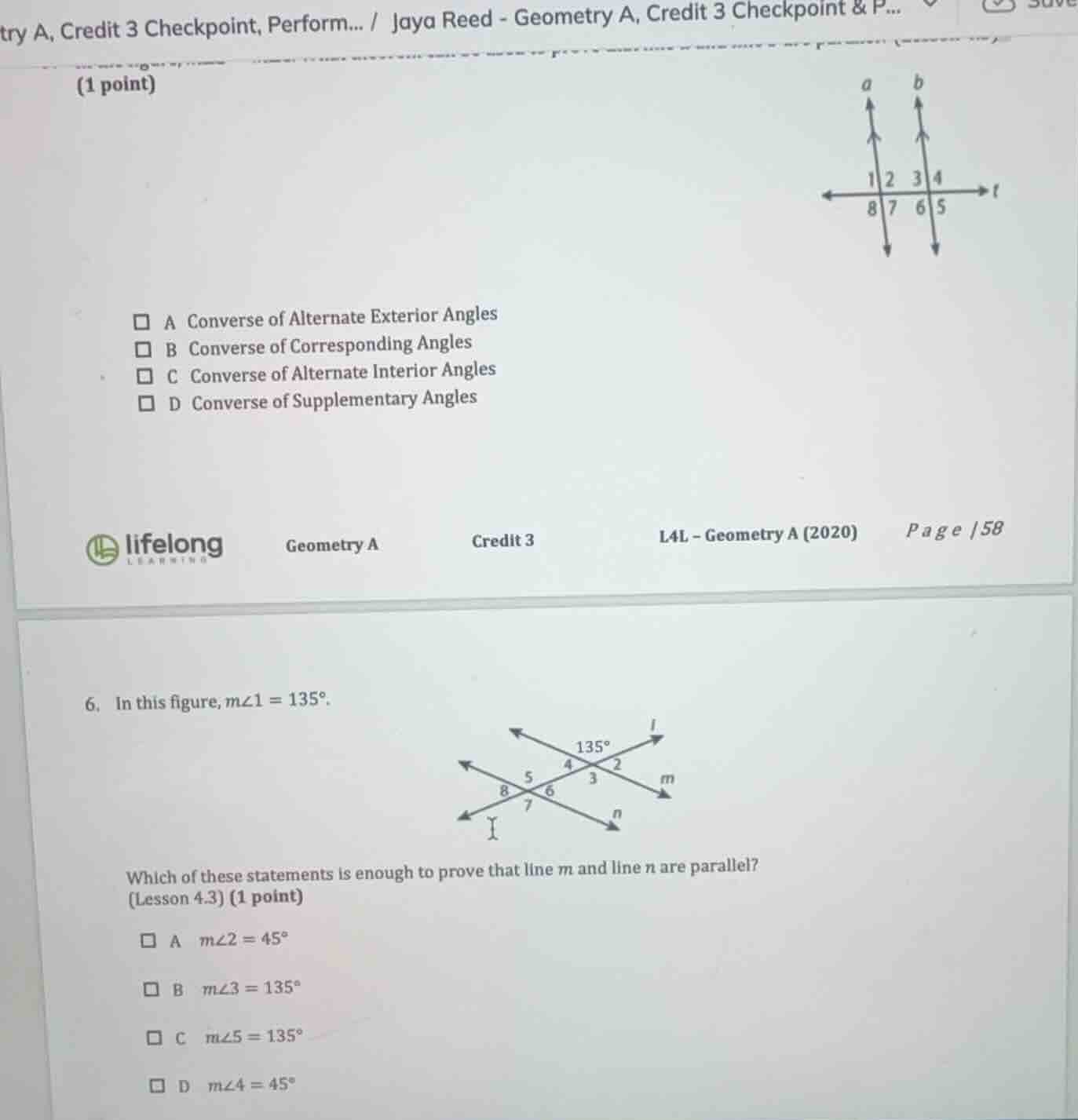
- in this figure, \\(m\angle 1 = 135^\circ\\).
which of these statements is enough to prove that line \\(m\\) and line \\(n\\) are parallel? (lesson 4.3) (1 point)
a \\(m\angle 2 = 45^\circ\\)
b \\(m\angle 3 = 135^\circ\\)
c \\(m\angle 5 = 135^\circ\\)
d \\(m\angle 4 = 45^\circ\\)
Identify the given information
We are given a figure with three lines: a transversal line \(l\), and two lines \(m\) and \(n\).
The measure of angle 1 is given as:
Analyze the relationship between the angles
We want to find which statement is sufficient to prove that line \(m\) is parallel to line \(n\) (\(m \parallel n\)).
Let's examine the position of the given angle \(\angle1\) and the angles in the options:
- \(\angle1\) is located at the intersection of transversal \(l\) and line \(m\).
- \(\angle5\), \(\angle6\), \(\angle7\), and \(\angle8\) are located at the intersection of transversal \(l\) and line \(n\).
To prove lines \(m\) and \(n\) are parallel, we need a relationship between an angle at line \(m\) (like \(\angle1\)) and an angle at line \(n\) (like \(\angle5\)).
- \(\angle1\) and \(\angle5\) are in the same relative position at each intersection, making them corresponding angles.
Apply the parallel line converse theorem
Using the Converse of Alternate Interior Angles Theorem knowledge point
Evaluate the given options
- Option A: \(m\angle2 = 45^\circ\). Both \(\angle1\) and \(\angle2\) are on line \(m\). This does not relate line \(m\) to line \(n\).
- Option B: \(m\angle3 = 135^\circ\). Both \(\angle1\) and \(\angle3\) are on line \(m\). This does not relate line \(m\) to line \(n\).
- Option C: \(m\angle5 = 135^\circ\). Since \(m\angle1 = 135^\circ\), if \(m\angle5 = 135^\circ\), then corresponding angles are equal, which proves \(m \parallel n\).
- Option D: \(m\angle4 = 45^\circ\). Both \(\angle1\) and \(\angle4\) are on line \(m\). This does not relate line \(m\) to line \(n\).

Snap & solve any problem in the app
Get step-by-step solutions on Sovi AI
Photo-based solutions with guided steps
Explore more problems and detailed explanations
- A \(m\angle2 = 45^\circ\)
- B \(m\angle3 = 135^\circ\)
- C \(m\angle5 = 135^\circ\) (Correct answer)
- D \(m\angle4 = 45^\circ\)