QUESTION IMAGE
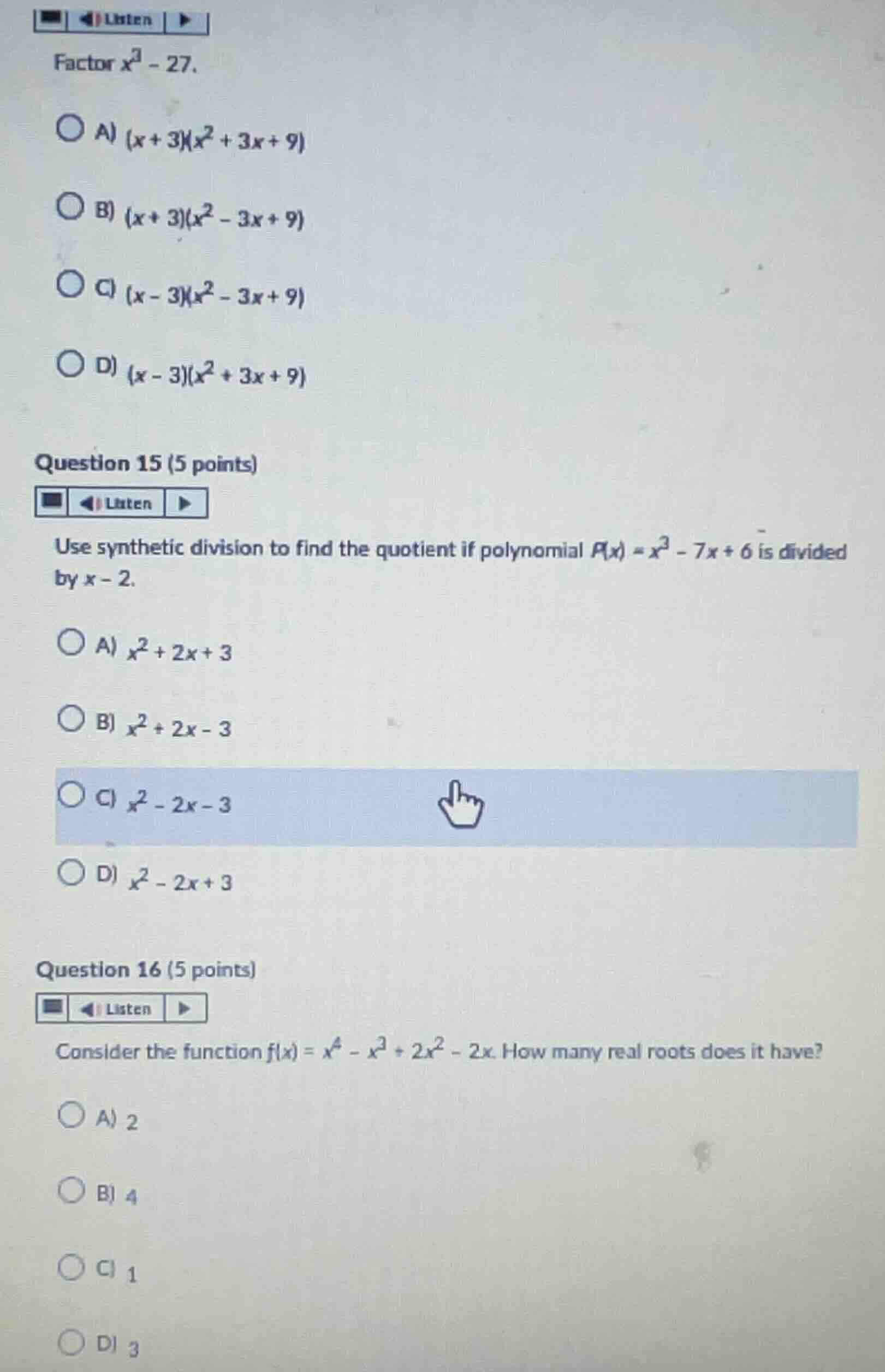
Question
factor \\(x^3 - 27\\).
a) \\((x + 3)(x^2 + 3x + 9)\\)
b) \\((x + 3)(x^2 - 3x + 9)\\)
c) \\((x - 3)(x^2 - 3x + 9)\\)
d) \\((x - 3)(x^2 + 3x + 9)\\)
question 15 (5 points)
use synthetic division to find the quotient if polynomial \\(p(x) = x^3 - 7x + 6\\) is divided by \\(x - 2\\).
a) \\(x^2 + 2x + 3\\)
b) \\(x^2 + 2x - 3\\)
c) \\(x^2 - 2x - 3\\)
d) \\(x^2 - 2x + 3\\)
question 16 (5 points)
consider the function \\(f(x) = x^4 - x^3 + 2x^2 - 2x\\). how many real roots does it have?
a) 2
b) 4
c) 1
d) 3
Factor the difference of cubes
Using the Difference of Squares Factoring knowledge point as a foundation, we apply the difference of cubes formula:
Here, \(a = x\) and \(b = 3\) since \(3^3 = 27\):
Perform synthetic division
Using the Synthetic Division knowledge point
The quotient is \(x^2 + 2x - 3\).
Factor the quartic function
To find the real roots of \(f(x) = x^4 - x^3 + 2x^2 - 2x\), we first factor by grouping:
Factoring out \(x\) from the first term:
Determine the number of real roots
We set each factor to zero to find the roots:
- \(x = 0\) (real root)
- \(x - 1 = 0 \implies x = 1\) (real root)
- \(x^2 + 2 = 0 \implies x^2 = -2\) (no real roots, only complex roots \(x = \pm i\sqrt{2}\))
Thus, there are exactly 2 real roots.

Snap & solve any problem in the app
Get step-by-step solutions on Sovi AI
Photo-based solutions with guided steps
Explore more problems and detailed explanations
Question 14
- (A) \((x + 3)(x^2 + 3x + 9)\)
- (B) \((x + 3)(x^2 - 3x + 9)\)
- (C) \((x - 3)(x^2 - 3x + 9)\)
- (D) \((x - 3)(x^2 + 3x + 9)\) (Correct answer)
Question 15
- (A) \(x^2 + 2x + 3\)
- (B) \(x^2 + 2x - 3\) (Correct answer)
- (C) \(x^2 - 2x - 3\)
- (D) \(x^2 - 2x + 3\)
Question 16
- (A) 2 (Correct answer)
- (B) 4
- (C) 1
- (D) 3