QUESTION IMAGE
Question
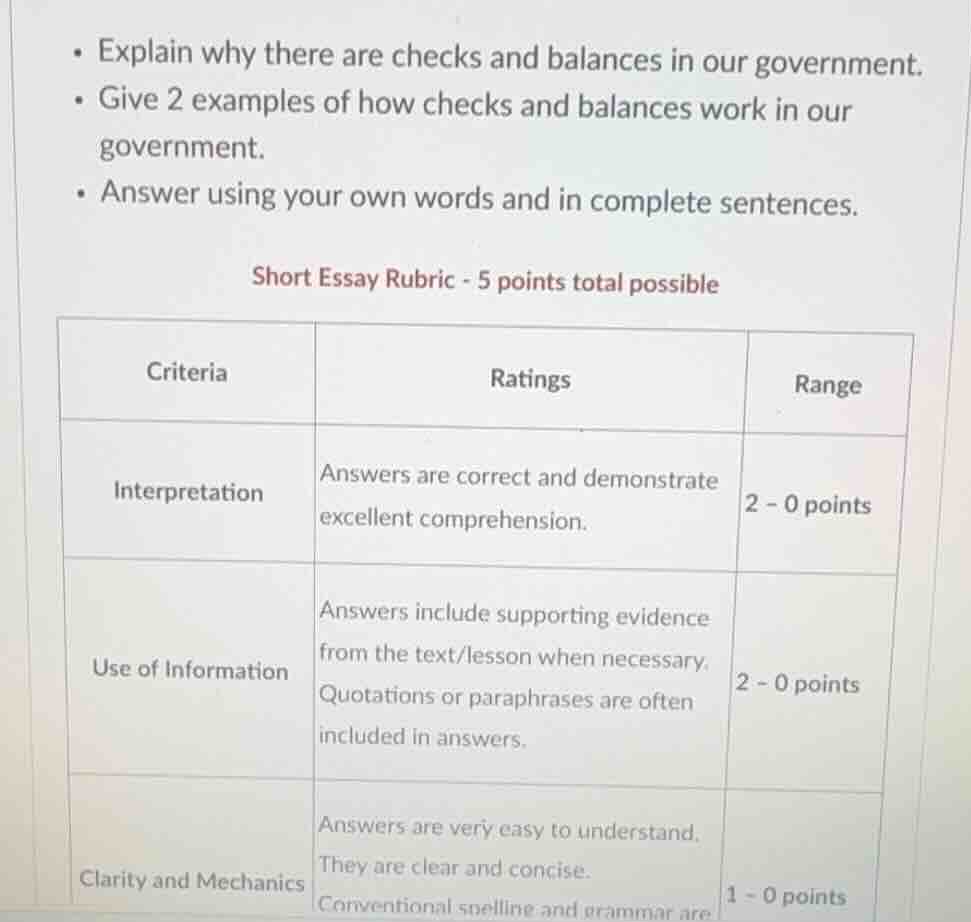
explain why there are checks and balances in our government.
give 2 examples of how checks and balances work in our government.
answer using your own words and in complete sentences.
Purpose of checks and balances
The system of checks and balances prevents any single branch of government from becoming too powerful. By distributing power among the legislative, executive, and judicial branches, the Framers of the Constitution ensured that each branch can limit, or "check," the actions of the others, thereby protecting individual liberties and preventing tyranny.
Executive check on the legislative branch
One clear example of checks and balances is the President's power to veto legislation. When Congress passes a bill, the President (executive branch) can refuse to sign it into law, sending it back to Congress with objections.
Legislative check on the executive branch
Congress can check the President's veto power. If a bill is vetoed, Congress (legislative branch) can override that veto with a two-thirds majority vote in both the House of Representatives and the Senate, allowing the bill to become law without the President's signature.
Judicial check on both branches
The Supreme Court (judicial branch) can declare laws passed by Congress or executive actions taken by the President unconstitutional through the power of judicial review, ensuring all government actions align with the Constitution.

Snap & solve any problem in the app
Get step-by-step solutions on Sovi AI
Photo-based solutions with guided steps
Explore more problems and detailed explanations
Checks and balances exist in our government to prevent any single branch—executive, legislative, or judicial—from gaining too much power, thereby protecting individual liberties and preventing tyranny.
Two examples of how this system works are:
- The Presidential Veto: Congress (the legislative branch) has the power to draft and pass bills, but the President (the executive branch) can check this power by vetoing a bill to prevent it from becoming law.
- The Congressional Override: If the President vetoes a bill, Congress can check the executive branch by overriding the veto with a two-thirds majority vote in both chambers, which allows the bill to become law despite the President's objection.