QUESTION IMAGE
Question
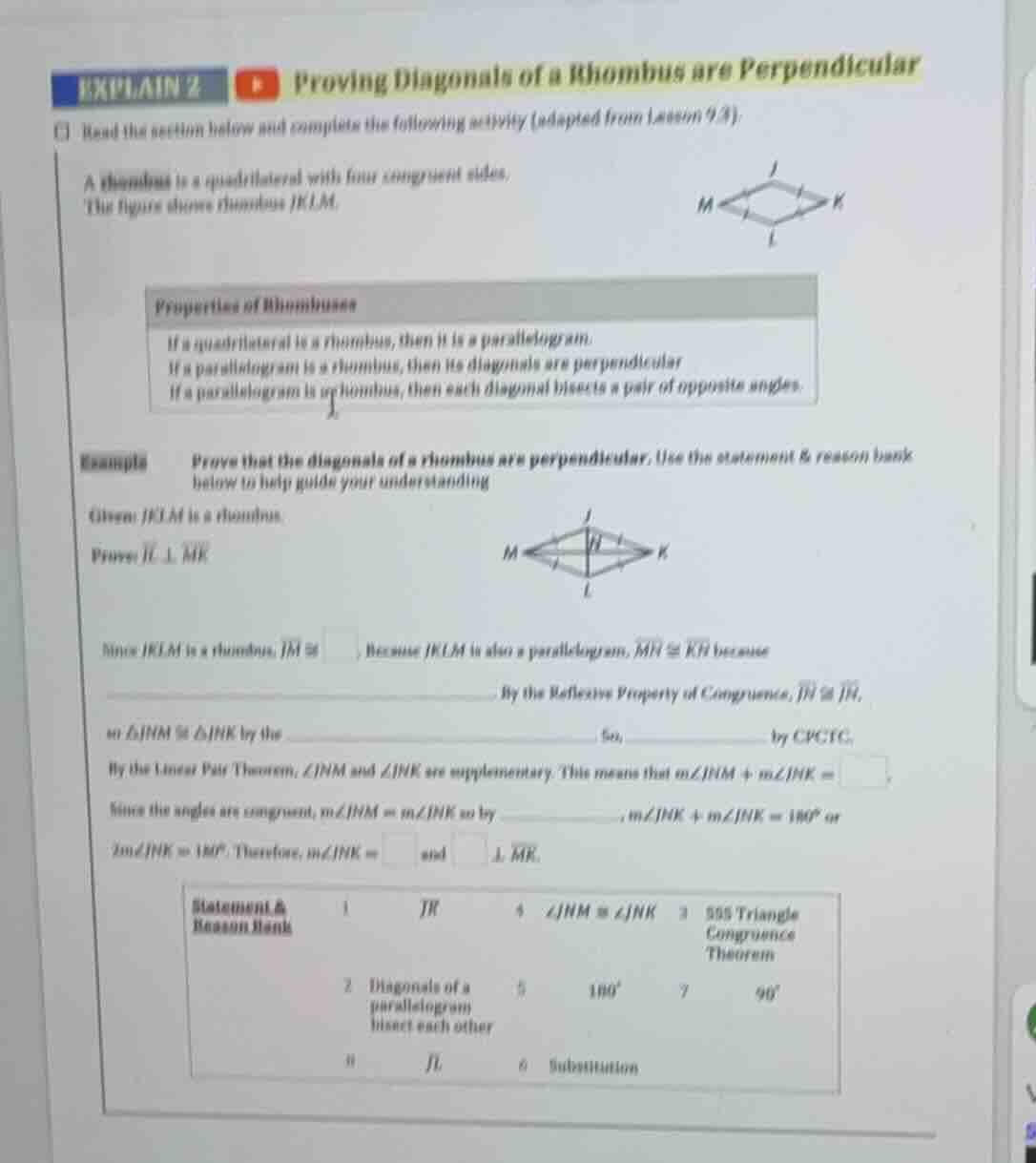
explain 2 proving diagonals of a rhombus are perpendicular
read the section below and complete the following activity (adapted from lesson 9.3).
a rhombus is a quadrilateral with four congruent sides.
the figure shows rhombus jklm.
properties of rhombuses
- if a quadrilateral is a rhombus, then it is a parallelogram.
- if a parallelogram is a rhombus, then its diagonals are perpendicular.
- if a parallelogram is a rhombus, then each diagonal bisects a pair of opposite angles.
example
prove that the diagonals of a rhombus are perpendicular. use the statement & reason bank below to help guide your understanding.
given: jklm is a rhombus.
prove: \\(jl \perp mk\\)
since jklm is a rhombus, \\(jm \cong\\) __. because jklm is also a parallelogram, \\(mn \cong kn\\) because . by the reflexive property of congruence, \\(jn \cong jn\\), so \\(\delta jnm \cong \delta jnk\\) by the . so, __ by cpctc.
by the linear pair theorem, \\(\angle jnm\\) and \\(\angle jnk\\) are supplementary. this means that \\(m\angle jnm + m\angle jnk =\\) __. since the angles are congruent, \\(m\angle jnm = m\angle jnk\\) so by , \\(m\angle jnk + m\angle jnk = 180^\circ\\) or \\(2m\angle jnk = 180^\circ\\). therefore, \\(m\angle jnk =\\) and __ \\(\perp mk\\).
statement & reason bank
- \\(jk\\)
- diagonals of a parallelogram bisect each other
- \\(jl\\)
- \\(\angle jnm \cong \angle jnk\\)
- \\(180^\circ\\)
- substitution
- \\(sss\\) triangle congruence theorem
- \\(90^\circ\\)
Identify given information and target blanks
We need to fill in the blanks of the proof showing that the diagonals of a rhombus are perpendicular.
The given rhombus is \(JKLM\) with diagonals intersecting at \(N\).
We want to prove \(JL \perp MK\).
The proof text with blanks is:
- "Since \(JKLM\) is a rhombus, \(JM \cong\) [Blank 1]."
- "Because \(JKLM\) is also a parallelogram, \(MN \cong KN\) because [Blank 2]."
- "By the Reflexive Property of Congruence, \(JN \cong JN\)." (This line has a blank line before it, which seems to be a formatting separator or part of the text, but the statement is complete. Let's look closely at the image: "_____________________. By the Reflexive Property of Congruence, \(JN \cong JN\)." The bank has "8. \(JN\)" or "8. \(JL\)". Let's check the bank: 1 is \(JK\), 2 is "Diagonals of a parallelogram bisect each other", 3 is "SSS Triangle Congruence Theorem", 4 is \(\angle JNM \cong \angle JNK\), 5 is \(180^\circ\), 6 is "Substitution", 7 is \(90^\circ\), 8 is \(JL\).
Wait, let's match the blanks to the numbered items in the "Statement & Reason Bank":
- "Since \(JKLM\) is a rhombus, \(JM \cong\) [Blank 1]." Since a rhombus has four congruent sides, \(JM \cong JK\). Item 1 in the bank is \(JK\).
- "Because \(JKLM\) is also a parallelogram, \(MN \cong KN\) because [Blank 2]." The reason is "Diagonals of a parallelogram bisect each other", which is Item 2 in the bank.
- "___________________. By the Reflexive Property of Congruence, \(JN \cong JN\)." This line has a blank line. Let's look at the bank: Item 8 is \(JL\). Wait, the line is "_________________. By the Reflexive Property of Congruence, \(JN \cong JN\)." No, the line is "___________________. By the Reflexive Property of Congruence, \(JN \cong JN\)." Wait, is it a blank for a statement? No, the line is just a blank line, or maybe it's asking for a statement? Let's check the bank items:
1: \(JK\)
2: Diagonals of a parallelogram bisect each other
3: SSS Triangle Congruence Theorem
4: \(\angle JNM \cong \angle JNK\)
5: \(180^\circ\)
6: Substitution
7: \(90^\circ\)
8: \(JL\)
Let's read the proof text carefully:
"Since \(JKLM\) is a rhombus, \(JM \cong\) [Blank A]. Because \(JKLM\) is also a parallelogram, \(MN \cong KN\) because [Blank B]."
"_____________________. By the Reflexive Property of Congruence, \(JN \cong JN\)."
Wait, is the blank before "By the Reflexive Property..." actually asking for something? No, it's a line, but let's look at the next line:
"so \(\triangle JNM \cong \triangle JNK\) by the [Blank C]."
This must be the "SSS Triangle Congruence Theorem" (Item 3).
"So, [Blank D] by CPCTC."
By CPCTC, the corresponding angles are congruent: \(\angle JNM \cong \angle JNK\) (Item 4).
"By the Linear Pair Theorem, \(\angle JNM\) and \(\angle JNK\) are supplementary. This means that \(m\angle JNM + m\angle JNK =\) […

Snap & solve any problem in the app
Get step-by-step solutions on Sovi AI
Photo-based solutions with guided steps
Explore more problems and detailed explanations
Read the section below and complete the following activity (adapted from Lesson 9.3).
A rhombus is a quadrilateral with four congruent sides.
The figure shows rhombus \(JKLM\).
Properties of Rhombuses
- If a quadrilateral is a rhombus, then it is a parallelogram.
- If a parallelogram is a rhombus, then its diagonals are perpendicular.
- If a parallelogram is a rhombus, then each diagonal bisects a pair of opposite angles.
Example: Prove that the diagonals of a rhombus are perpendicular. Use the statement & reason bank below to help guide your understanding.
Given: \(JKLM\) is a rhombus.
Prove: \(JL \perp MK\)
Since \(JKLM\) is a rhombus, \(JM \cong\) <blank>\(JK\)</blank>. Because \(JKLM\) is also a parallelogram, \(MN \cong KN\) because <blank>Diagonals of a parallelogram bisect each other</blank>.
By the Reflexive Property of Congruence, \(JN \cong JN\).
so \(\triangle JNM \cong \triangle JNK\) by the <blank>SSS Triangle Congruence Theorem</blank>. So, <blank>\(\angle JNM \cong \angle JNK\)</blank> by CPCTC.
By the Linear Pair Theorem, \(\angle JNM\) and \(\angle JNK\) are supplementary. This means that \(m\angle JNM + m\angle JNK =\) <blank>\(180^\circ\)</blank>.
Since the angles are congruent, \(m\angle JNM = m\angle JNK\) so by <blank>Substitution</blank>, \(m\angle JNK + m\angle JNK = 180^\circ\) or \(2m\angle JNK = 180^\circ\). Therefore, \(m\angle JNK =\) <blank>\(90^\circ\)</blank> and <blank>\(JL\)</blank> \(\perp MK\).