QUESTION IMAGE
Question
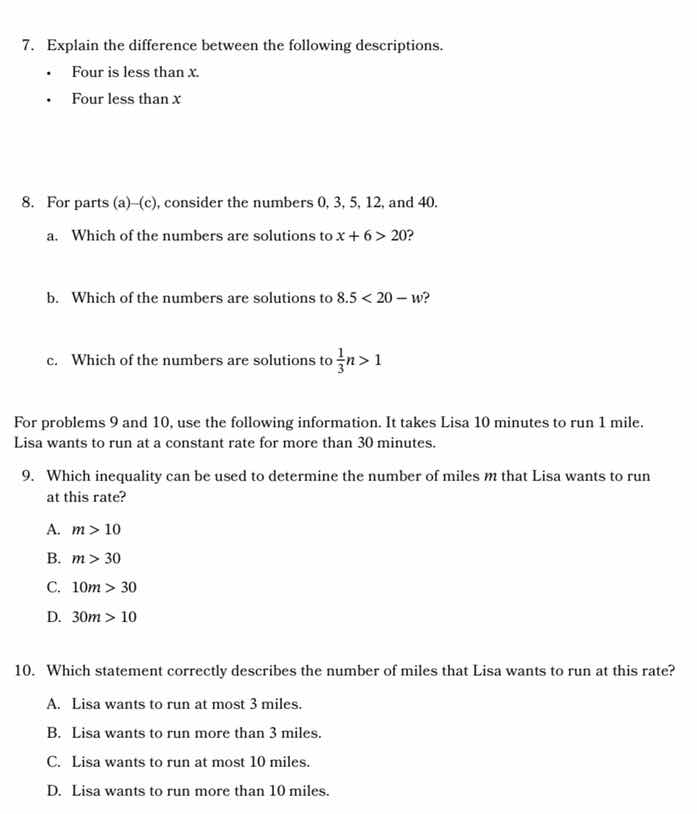
- explain the difference between the following descriptions.
- four is less than ( x ).
- four less than ( x )
- for parts (a)–(c), consider the numbers 0, 3, 5, 12, and 40.
a. which of the numbers are solutions to ( x + 6 > 20 )?
b. which of the numbers are solutions to ( 8.5 < 20 - w )?
c. which of the numbers are solutions to ( \frac{1}{3}n > 1 )
for problems 9 and 10, use the following information. it takes lisa 10 minutes to run 1 mile. lisa wants to run at a constant rate for more than 30 minutes.
- which inequality can be used to determine the number of miles ( m ) that lisa wants to run at this rate?
a. ( m > 10 )
b. ( m > 30 )
c. ( 10m > 30 )
d. ( 30m > 10 )
- which statement correctly describes the number of miles that lisa wants to run at this rate?
a. lisa wants to run at most 3 miles.
b. lisa wants to run more than 3 miles.
c. lisa wants to run at most 10 miles.
d. lisa wants to run more than 10 miles.
Question 7
- "Four is less than \( x \)" is an inequality statement comparing 4 and \( x \), written as \( 4 < x \). It describes a relationship where 4 has a smaller value than \( x \).
- "Four less than \( x \)" is a phrase indicating a subtraction operation. It means we take \( x \) and subtract 4 from it, written as \( x - 4 \). It is an algebraic expression, not an inequality like the first description.
Step 1: Solve the inequality \( x + 6 > 20 \)
Subtract 6 from both sides of the inequality:
\( x + 6 - 6 > 20 - 6 \)
\( x > 14 \)
Step 2: Check which numbers satisfy \( x > 14 \)
Given numbers: 0, 3, 5, 12, 40.
- 0: \( 0
ot> 14 \)
- 3: \( 3
ot> 14 \)
- 5: \( 5
ot> 14 \)
- 12: \( 12
ot> 14 \)
- 40: \( 40 > 14 \)
Step 1: Solve the inequality \( 8.5 < 20 - w \)
Subtract 20 from both sides:
\( 8.5 - 20 < -w \)
\( -11.5 < -w \)
Multiply both sides by -1 (reverse the inequality):
\( 11.5 > w \) or \( w < 11.5 \)
Step 2: Check which numbers satisfy \( w < 11.5 \)
Given numbers: 0, 3, 5, 12, 40.
- 0: \( 0 < 11.5 \) (true)
- 3: \( 3 < 11.5 \) (true)
- 5: \( 5 < 11.5 \) (true)
- 12: \( 12
ot< 11.5 \) (false)
- 40: \( 40
ot< 11.5 \) (false)

Snap & solve any problem in the app
Get step-by-step solutions on Sovi AI
Photo-based solutions with guided steps
Explore more problems and detailed explanations
- "Four is less than \( x \)" is the inequality \( 4 < x \) (comparing 4 and \( x \)).
- "Four less than \( x \)" is the expression \( x - 4 \) (subtracting 4 from \( x \)).