QUESTION IMAGE
Question
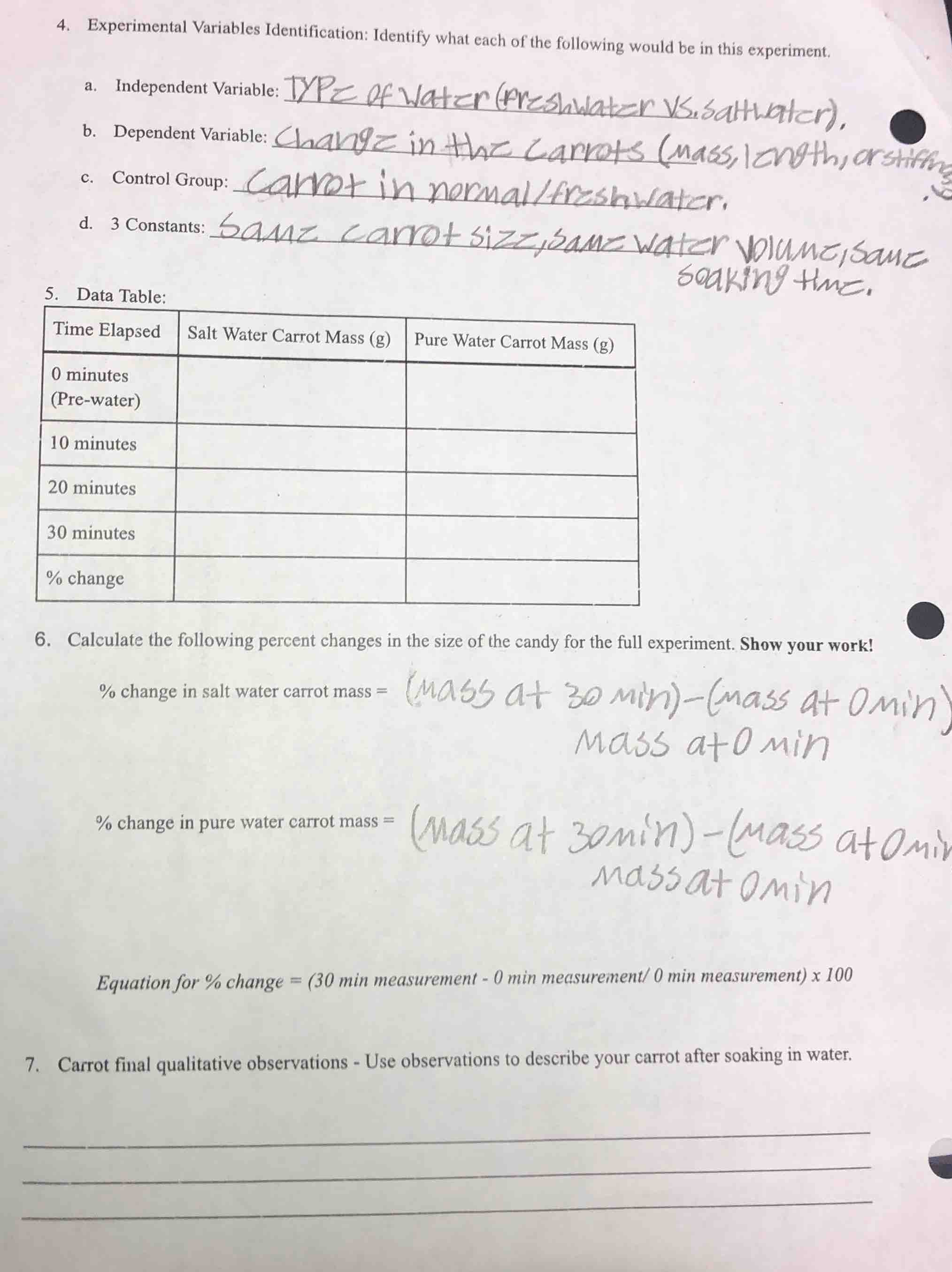
- experimental variables identification: identify what each of the following would be in this experiment.
a. independent variable: type of water (freshwater vs. saltwater)
b. dependent variable: change in the carrots (mass, length, or stiffness)
c. control group: carrot in normal/freshwater
d. 3 constants: same carrot size, same water volume, same soaking time
- data table:
\
- calculate the following percent changes in the size of the candy for the full experiment. show your work!
\\% change in salt water carrot mass = \frac{\text{mass at 30 min} - \text{mass at 0 min}}{\text{mass at 0 min}}
\\% change in pure water carrot mass = \frac{\text{mass at 30 min} - \text{mass at 0 min}}{\text{mass at 0 min}}
equation for \\% change = (30 min measurement - 0 min measurement / 0 min measurement) x 100
- carrot final qualitative observations - use observations to describe your carrot after soaking in water.
🆕 New Concept Discovered: Osmosis in Plant Cells
Water moves to balance solute concentrations
Step 1: Understand Osmosis in Plant Cells
Osmosis is the movement of water across a semipermeable membrane from an area of lower solute concentration (hypotonic) to an area of higher solute concentration (hypertonic).
- Salt Water (Hypertonic Environment): The concentration of salt outside the carrot cells is higher than inside the cells. Water leaves the carrot cells to balance this concentration, causing the cells to shrink (plasmolysis). This makes the carrot lose mass and become limp or flexible.
- Pure Water (Hypotonic Environment): The concentration of solutes inside the carrot cells is higher than in the pure water outside. Water enters the carrot cells by osmosis, causing them to swell and press against the rigid cell wall (turgor pressure). This makes the carrot gain mass and become stiff or firm.
Step 2: Describe the Salt Water Carrot
Because water moved out of the carrot's cells into the salty environment:
- The carrot loses water weight, making it feel lighter or smaller.
- The loss of internal water pressure (turgor pressure) makes the carrot feel soft, limp, bendable, or rubbery.
Step 3: Describe the Pure Water Carrot
Because water moved into the carrot's cells from the pure water environment:
- The carrot absorbs water, making it feel heavier, slightly swollen, or larger.
- The increase in internal water pressure (turgor pressure) makes the carrot feel very stiff, firm, crisp, or rigid.

Snap & solve any problem in the app
Get step-by-step solutions on Sovi AI
Photo-based solutions with guided steps
Explore more problems and detailed explanations
- Salt Water Carrot: After soaking in salt water, the carrot became limp, flexible, and soft to the touch because water left its cells via osmosis.
- Pure Water Carrot: After soaking in pure water, the carrot became very stiff, firm, and crisp because water entered its cells, increasing turgor pressure.