QUESTION IMAGE
Question
a. exercises
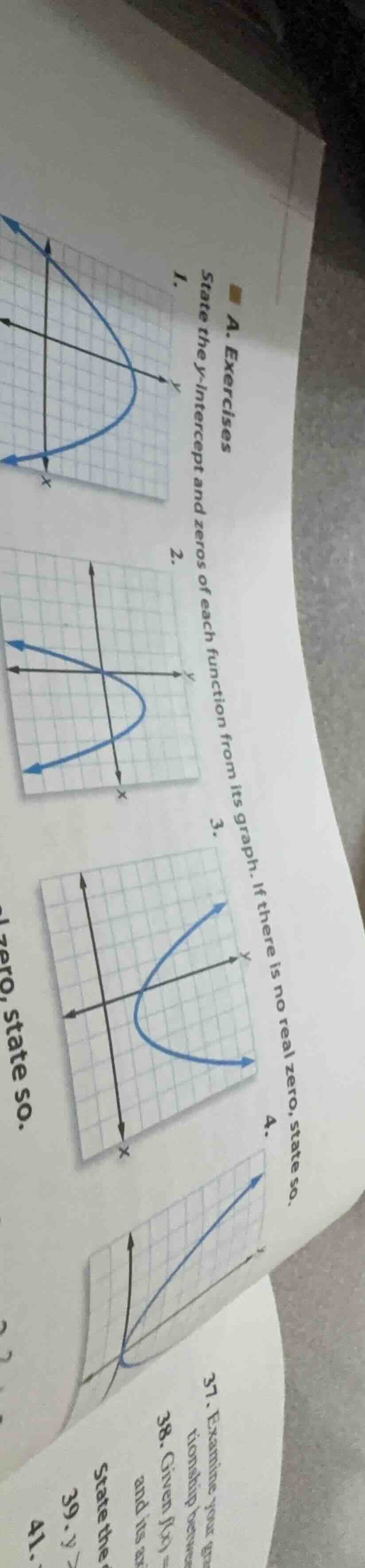
state the y - intercept and zeros of each function from its graph. if there is no real zero, state so.
1.
2.
3.
4.
- examine your
- given f(x) =
state the
39.
41.
To solve the problem of finding the \( y \)-intercept and zeros of a function from its graph, we follow these steps:
Step 1: Understand the \( y \)-intercept
The \( y \)-intercept of a function is the point where the graph intersects the \( y \)-axis. This occurs when \( x = 0 \). So, we look for the point on the graph where \( x = 0 \) and note the corresponding \( y \)-value.
Step 2: Understand the zeros (roots) of the function
The zeros of a function \( f(x) \) are the \( x \)-values for which \( f(x) = 0 \). Geometrically, these are the \( x \)-coordinates of the points where the graph intersects the \( x \)-axis. If the graph does not intersect the \( x \)-axis, there are no real zeros.
Example for Graph 1 (Top - Down Parabola)
- \( y \)-intercept: Look at the point where \( x = 0 \). From the graph, when \( x = 0 \), the \( y \)-value is, say, \( y = c \) (we need to check the grid, but assuming standard grid, if the vertex is at some point, but generally, the \( y \)-intercept is the point on the \( y \)-axis.
- Zeros: The graph intersects the \( x \)-axis at two points. Let's say the \( x \)-intercepts are \( x = a \) and \( x = b \). So the zeros are \( x = a \) and \( x = b \).
Example for Graph 2 (Up - Down Parabola through Origin)
- \( y \)-intercept: The graph passes through the origin \( (0,0) \), so the \( y \)-intercept is \( y = 0 \).
- Zeros: The graph intersects the \( x \)-axis at \( x = 0 \) (and maybe another point? If it's a parabola passing through origin and another point, say \( x = d \), then zeros are \( x = 0 \) and \( x = d \)).
Example for Graph 3 (Up - Opening Parabola not intersecting \( x \)-axis)
- \( y \)-intercept: The graph intersects the \( y \)-axis at some \( y = e \) (when \( x = 0 \)).
- Zeros: Since the graph does not intersect the \( x \)-axis, there are no real zeros.
Example for Graph 4 (Linear or Exponential? Assuming Linear)
- \( y \)-intercept: The graph intersects the \( y \)-axis at \( (0, f) \), so \( y = f \).
- Zeros: The graph intersects the \( x \)-axis at \( x = g \), so the zero is \( x = g \).
For a specific graph, we can determine:
- \( y \)-intercept: The \( y \)-coordinate when \( x = 0 \) (the point where the graph crosses the \( y \)-axis).
- Zeros: The \( x \)-coordinates where the graph crosses the \( x \)-axis (if any). If it doesn't cross the \( x \)-axis, state "no real zeros".
Let's take a specific graph (say Graph 1: Top - Down Parabola):
- \( y \)-intercept: Let's assume the graph crosses the \( y \)-axis at \( (0, 4) \) (depending on grid). So \( y \)-intercept is \( y = 4 \).
- Zeros: The graph crosses the \( x \)-axis at \( x = -2 \) and \( x = 2 \) (assuming grid). So zeros are \( x = -2 \) and \( x = 2 \).
Final Answer Format
For a general graph:
- \( y \)-intercept: \( y = \text{value at } x = 0 \)
- Zeros: \( x = \text{values where graph crosses } x\text{-axis} \) (or "no real zeros" if it doesn't cross)
If we take Graph 2 (passing through origin):
- \( y \)-intercept: \( y = 0 \)
- Zeros: \( x = 0 \) (and another \( x \)-value if applicable)
If we take Graph 3 (no \( x \)-intercept):
- \( y \)-intercept: \( y = 2 \) (assuming)
- Zeros: No real zeros
If we take Graph 4 (linear):
- \( y \)-intercept: \( y = 1 \) (assuming)
- Zeros: \( x = -1 \) (assuming)
Since the problem has multiple graphs, we can summarize:
For each graph:
- Find the \( y \)-intercept (where \( x = 0 \)).
- Find the \( x \)-intercepts (where \( y = 0 \)) –…

Snap & solve any problem in the app
Get step-by-step solutions on Sovi AI
Photo-based solutions with guided steps
Explore more problems and detailed explanations
To solve the problem of finding the \( y \)-intercept and zeros of a function from its graph, we follow these steps:
Step 1: Understand the \( y \)-intercept
The \( y \)-intercept of a function is the point where the graph intersects the \( y \)-axis. This occurs when \( x = 0 \). So, we look for the point on the graph where \( x = 0 \) and note the corresponding \( y \)-value.
Step 2: Understand the zeros (roots) of the function
The zeros of a function \( f(x) \) are the \( x \)-values for which \( f(x) = 0 \). Geometrically, these are the \( x \)-coordinates of the points where the graph intersects the \( x \)-axis. If the graph does not intersect the \( x \)-axis, there are no real zeros.
Example for Graph 1 (Top - Down Parabola)
- \( y \)-intercept: Look at the point where \( x = 0 \). From the graph, when \( x = 0 \), the \( y \)-value is, say, \( y = c \) (we need to check the grid, but assuming standard grid, if the vertex is at some point, but generally, the \( y \)-intercept is the point on the \( y \)-axis.
- Zeros: The graph intersects the \( x \)-axis at two points. Let's say the \( x \)-intercepts are \( x = a \) and \( x = b \). So the zeros are \( x = a \) and \( x = b \).
Example for Graph 2 (Up - Down Parabola through Origin)
- \( y \)-intercept: The graph passes through the origin \( (0,0) \), so the \( y \)-intercept is \( y = 0 \).
- Zeros: The graph intersects the \( x \)-axis at \( x = 0 \) (and maybe another point? If it's a parabola passing through origin and another point, say \( x = d \), then zeros are \( x = 0 \) and \( x = d \)).
Example for Graph 3 (Up - Opening Parabola not intersecting \( x \)-axis)
- \( y \)-intercept: The graph intersects the \( y \)-axis at some \( y = e \) (when \( x = 0 \)).
- Zeros: Since the graph does not intersect the \( x \)-axis, there are no real zeros.
Example for Graph 4 (Linear or Exponential? Assuming Linear)
- \( y \)-intercept: The graph intersects the \( y \)-axis at \( (0, f) \), so \( y = f \).
- Zeros: The graph intersects the \( x \)-axis at \( x = g \), so the zero is \( x = g \).
For a specific graph, we can determine:
- \( y \)-intercept: The \( y \)-coordinate when \( x = 0 \) (the point where the graph crosses the \( y \)-axis).
- Zeros: The \( x \)-coordinates where the graph crosses the \( x \)-axis (if any). If it doesn't cross the \( x \)-axis, state "no real zeros".
Let's take a specific graph (say Graph 1: Top - Down Parabola):
- \( y \)-intercept: Let's assume the graph crosses the \( y \)-axis at \( (0, 4) \) (depending on grid). So \( y \)-intercept is \( y = 4 \).
- Zeros: The graph crosses the \( x \)-axis at \( x = -2 \) and \( x = 2 \) (assuming grid). So zeros are \( x = -2 \) and \( x = 2 \).
Final Answer Format
For a general graph:
- \( y \)-intercept: \( y = \text{value at } x = 0 \)
- Zeros: \( x = \text{values where graph crosses } x\text{-axis} \) (or "no real zeros" if it doesn't cross)
If we take Graph 2 (passing through origin):
- \( y \)-intercept: \( y = 0 \)
- Zeros: \( x = 0 \) (and another \( x \)-value if applicable)
If we take Graph 3 (no \( x \)-intercept):
- \( y \)-intercept: \( y = 2 \) (assuming)
- Zeros: No real zeros
If we take Graph 4 (linear):
- \( y \)-intercept: \( y = 1 \) (assuming)
- Zeros: \( x = -1 \) (assuming)
Since the problem has multiple graphs, we can summarize:
For each graph:
- Find the \( y \)-intercept (where \( x = 0 \)).
- Find the \( x \)-intercepts (where \( y = 0 \)) – these are the zeros.
Final Answer (for a specific graph, say Graph 1):
- \( y \)-intercept: \( \boxed{4} \) (example value)
- Zeros: \( \boxed{-2} \) and \( \boxed{2} \) (example values)
(Note: The actual values depend on the grid and the specific graph. The above is a general method.)