QUESTION IMAGE
Question
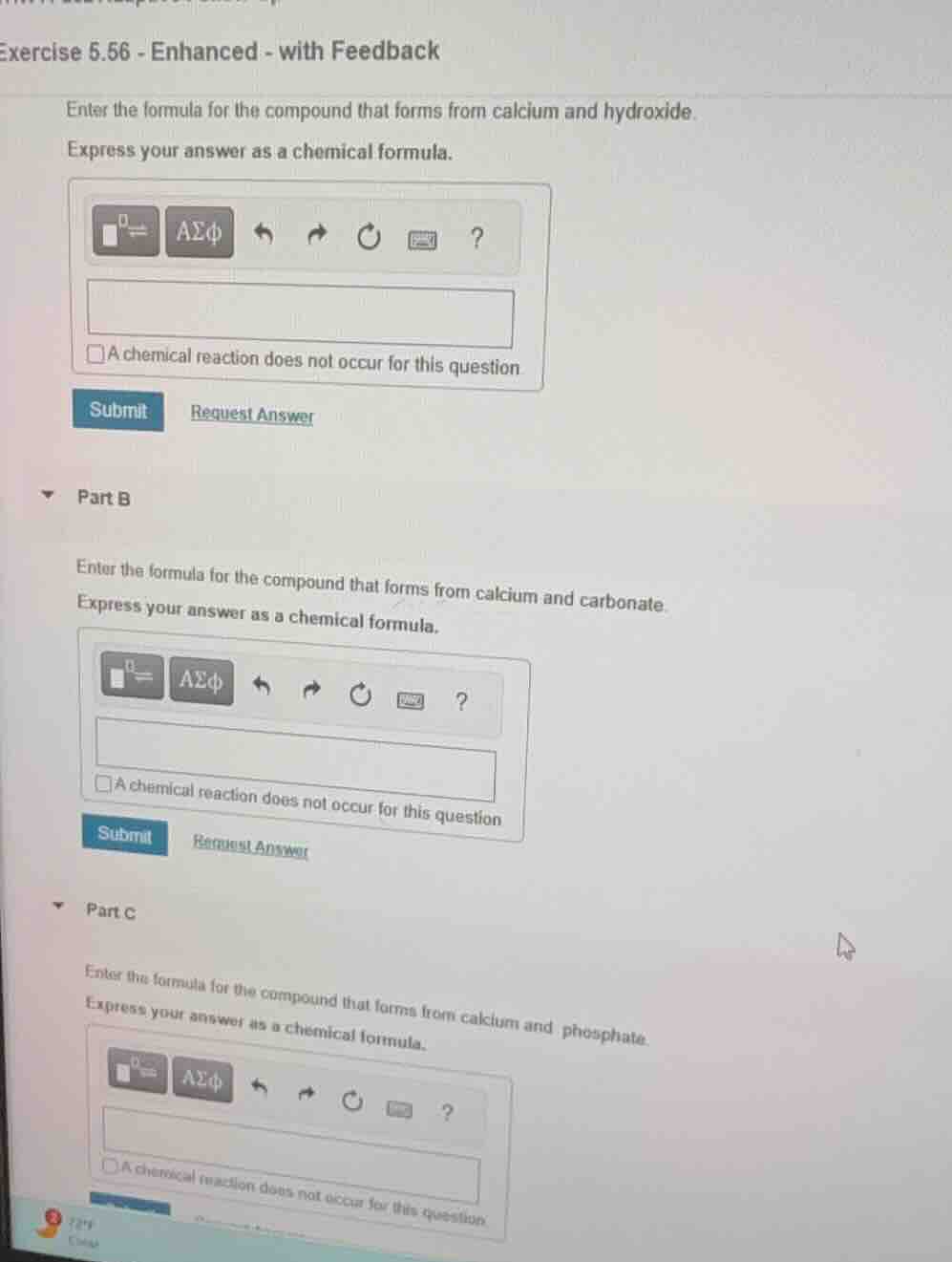
exercise 5.56 - enhanced - with feedback
enter the formula for the compound that forms from calcium and hydroxide.
express your answer as a chemical formula.
part b
enter the formula for the compound that forms from calcium and carbonate.
express your answer as a chemical formula.
part c
enter the formula for the compound that forms from calcium and phosphate.
express your answer as a chemical formula.
Identify the ions for Part A
Determine the charges of calcium and hydroxide.
- Calcium is a Group 2 metal: \(\text{Ca}^{2+}\).
- Hydroxide is a polyatomic ion: \(\text{OH}^-\).
Balance the charges for Part A
Combine the ions to form a neutral compound.
- Two \(\text{OH}^-\) ions balance one \(\text{Ca}^{2+}\) ion.
- The formula is \(\text{Ca(OH)}_2\).
Identify the ions for Part B
Determine the charges of calcium and carbonate.
- Calcium is \(\text{Ca}^{2+}\).
- Carbonate is a polyatomic ion: \(\text{CO}_3^{2-}\).
Balance the charges for Part B
Combine the ions to form a neutral compound.
- One \(\text{CO}_3^{2-}\) ion balances one \(\text{Ca}^{2+}\) ion.
- The formula is \(\text{CaCO}_3\).
Balance the charges for Part C
Determine charges and combine calcium and phosphate.
- Calcium is \(\text{Ca}^{2+}\).
- Phosphate is \(\text{PO}_4^{3-}\).
- To balance, use three \(\text{Ca}^{2+}\) and two \(\text{PO}_4^{3-}\).
- The formula is \(\text{Ca}_3(\text{PO}_4)_2\).

Snap & solve any problem in the app
Get step-by-step solutions on Sovi AI
Photo-based solutions with guided steps
Explore more problems and detailed explanations
Part A
\(\text{Ca(OH)}_2\)
Part B
\(\text{CaCO}_3\)
Part C
\(\text{Ca}_3(\text{PO}_4)_2\)