QUESTION IMAGE
Question
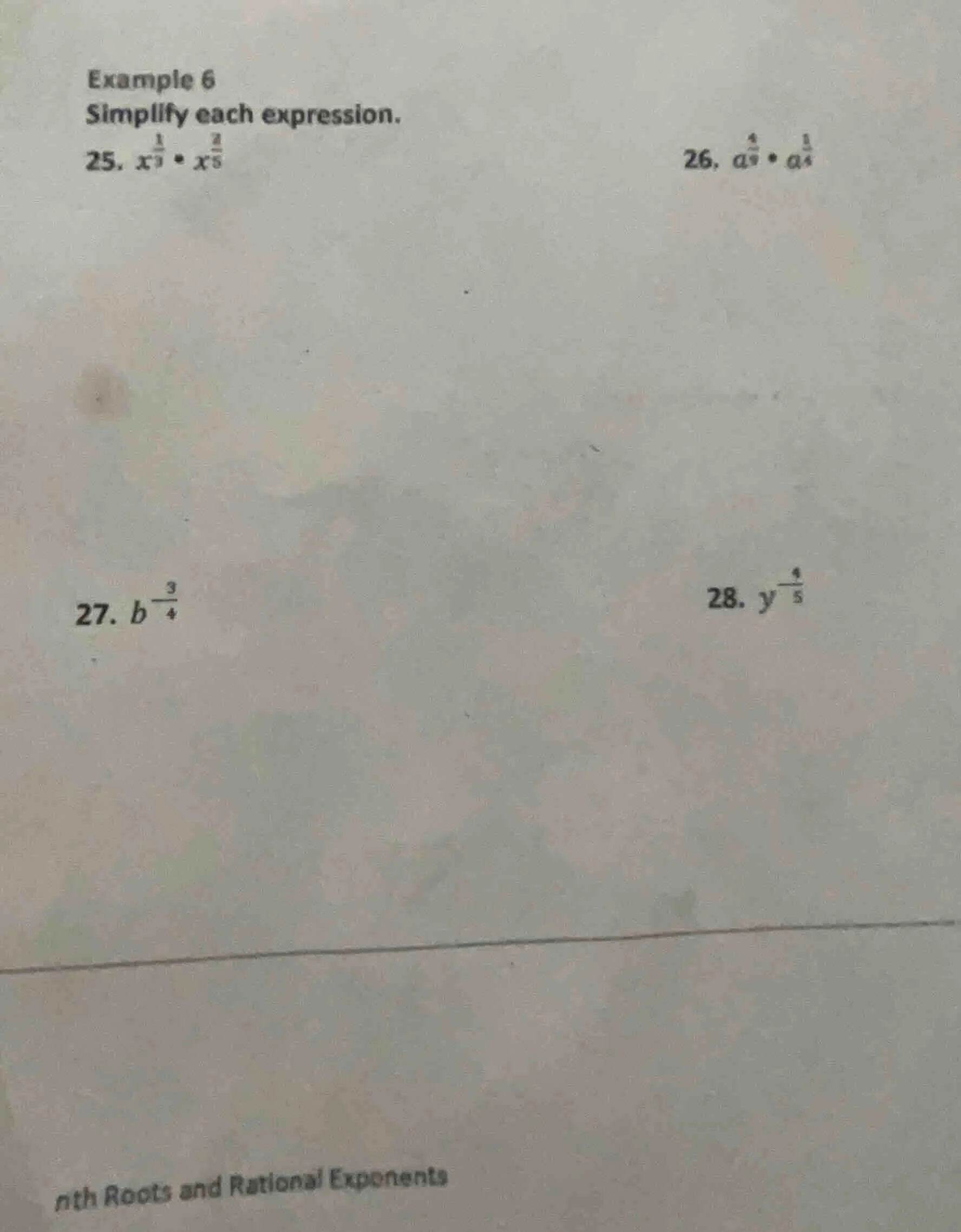
example 6
simplify each expression.
- $x^{\frac{1}{3}} \cdot x^{\frac{2}{5}}$
- $a^{\frac{4}{9}} \cdot a^{\frac{1}{4}}$
- $b^{-\frac{3}{4}}$
- $y^{-\frac{4}{5}}$
nth roots and rational exponents
Problem 25: Simplify \( x^{\frac{1}{3}} \cdot x^{\frac{2}{5}} \)
Step 1: Apply exponent product rule
When multiplying exponents with the same base, we add the exponents: \( a^m \cdot a^n = a^{m + n} \). Here, \( a = x \), \( m = \frac{1}{3} \), and \( n = \frac{2}{5} \).
\( x^{\frac{1}{3}} \cdot x^{\frac{2}{5}} = x^{\frac{1}{3} + \frac{2}{5}} \)
Step 2: Add the fractions
Find a common denominator for \( \frac{1}{3} \) and \( \frac{2}{5} \), which is 15. Convert the fractions: \( \frac{1}{3} = \frac{5}{15} \) and \( \frac{2}{5} = \frac{6}{15} \). Then add: \( \frac{5}{15} + \frac{6}{15} = \frac{11}{15} \).
\( x^{\frac{1}{3} + \frac{2}{5}} = x^{\frac{11}{15}} \)
Step 1: Apply exponent product rule
Using \( a^m \cdot a^n = a^{m + n} \) with \( a = a \), \( m = \frac{4}{9} \), \( n = \frac{1}{4} \).
\( a^{\frac{4}{9}} \cdot a^{\frac{1}{4}} = a^{\frac{4}{9} + \frac{1}{4}} \)
Step 2: Add the fractions
Common denominator of 9 and 4 is 36. \( \frac{4}{9} = \frac{16}{36} \), \( \frac{1}{4} = \frac{9}{36} \). Sum: \( \frac{16}{36} + \frac{9}{36} = \frac{25}{36} \).
\( a^{\frac{4}{9} + \frac{1}{4}} = a^{\frac{25}{36}} \)
Step 1: Apply negative exponent rule
The rule for negative exponents is \( a^{-n} = \frac{1}{a^n} \) (where \( a
eq 0 \) and \( n \) is a real number). Here, \( a = b \) and \( n = \frac{3}{4} \).
\( b^{-\frac{3}{4}} = \frac{1}{b^{\frac{3}{4}}} \)

Snap & solve any problem in the app
Get step-by-step solutions on Sovi AI
Photo-based solutions with guided steps
Explore more problems and detailed explanations
\( x^{\frac{11}{15}} \)