QUESTION IMAGE
Question
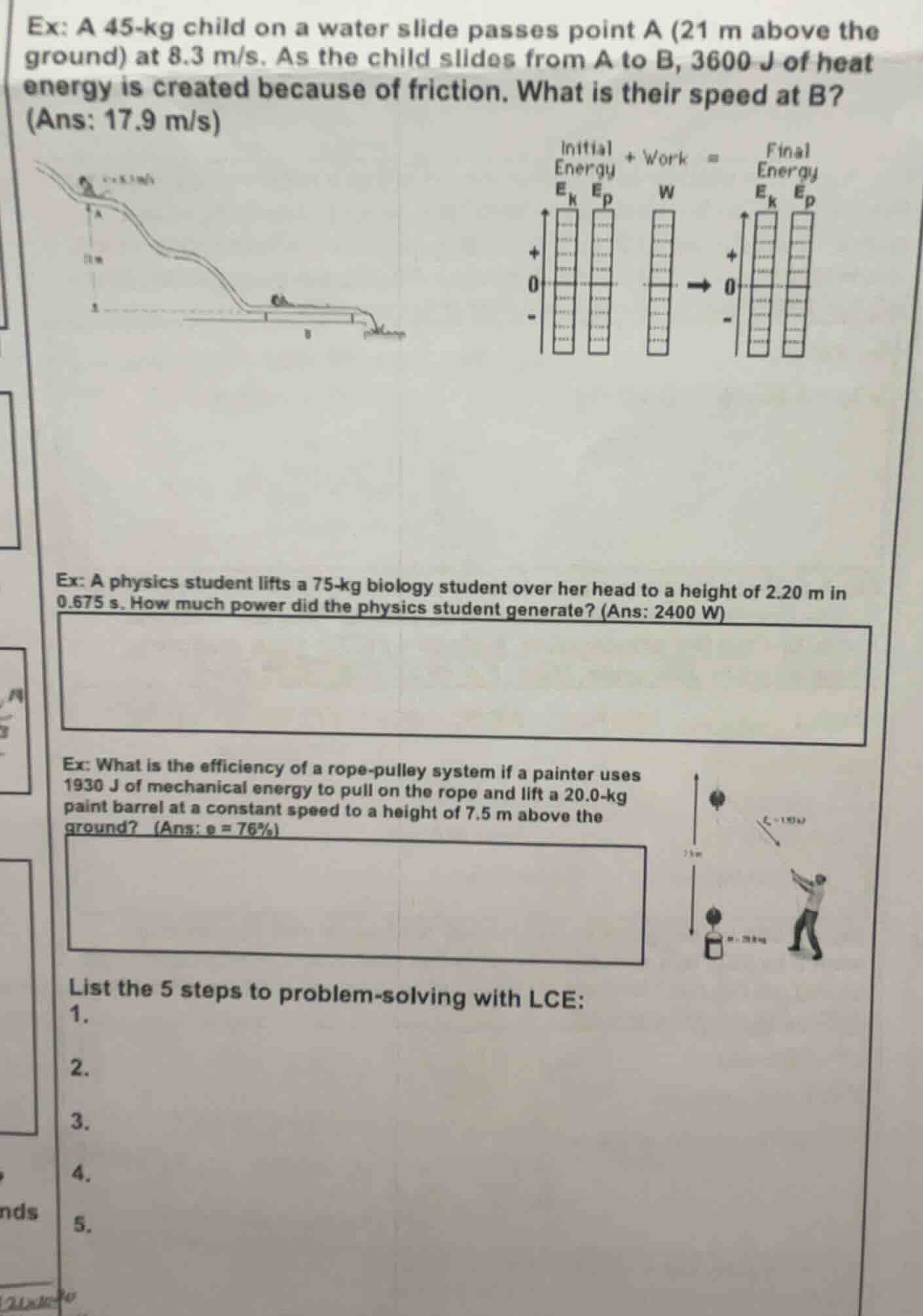
ex: a 45-kg child on a water slide passes point a (21 m above the ground) at 8.3 m/s. as the child slides from a to b, 3600 j of heat energy is created because of friction. what is their speed at b? (ans: 17.9 m/s)
ex: a physics student lifts a 75-kg biology student over her head to a height of 2.20 m in 0.675 s. how much power did the physics student generate? (ans: 2400 w)
ex: what is the efficiency of a rope-pulley system if a painter uses 1930 j of mechanical energy to pull on the rope and lift a 20.0-kg paint barrel at a constant speed to a height of 7.5 m above the ground? (ans: e = 76%)
list the 5 steps to problem-solving with lce:
1.
2.
3.
4.
5.
Analyze the water slide energy conservation
Using the Conservation of Energy knowledge point
Calculate the power generated by lifting
Using the Mechanical Power knowledge point
Determine the efficiency of the pulley system
To find the efficiency \(\eta\), we compare the useful gravitational potential energy gained by the paint barrel to the total mechanical energy input.
Define the 5 steps to problem-solving with LCE
LCE stands for LOL diagrams (or Energy Bar Charts) representing the Law of Conservation of Energy. The standard 5-step systematic approach is:
- Define the system and choose the initial and final states.
- Draw the LOL diagram (initial energy bar chart, system schema circle, and final energy bar chart).
- Write the qualitative energy equation based on the bar charts.
- Substitute quantitative formulas for each energy type and solve for the unknown variable.
- Evaluate the answer for reasonable units, signs, and physical magnitude.

Snap & solve any problem in the app
Get step-by-step solutions on Sovi AI
Photo-based solutions with guided steps
Explore more problems and detailed explanations
Question 1
The speed of the child at point B is \(17.9\text{ m/s}\).
Question 2
The power generated by the physics student is \(2400\text{ W}\).
Question 3
The efficiency of the rope-pulley system is \(76\%\).
Question 4
The 5 steps to problem-solving with LCE (Law of Conservation of Energy) are:
- Define the system and identify the initial and final states.
- Draw the LOL diagram (initial energy bar chart, system boundary circle, and final energy bar chart).
- Write the qualitative energy equation representing the conservation of energy for the system.
- Substitute quantitative formulas and solve mathematically for the target variable.
- Evaluate the final answer for correct units, sign, and physical reasonableness.