QUESTION IMAGE
Question
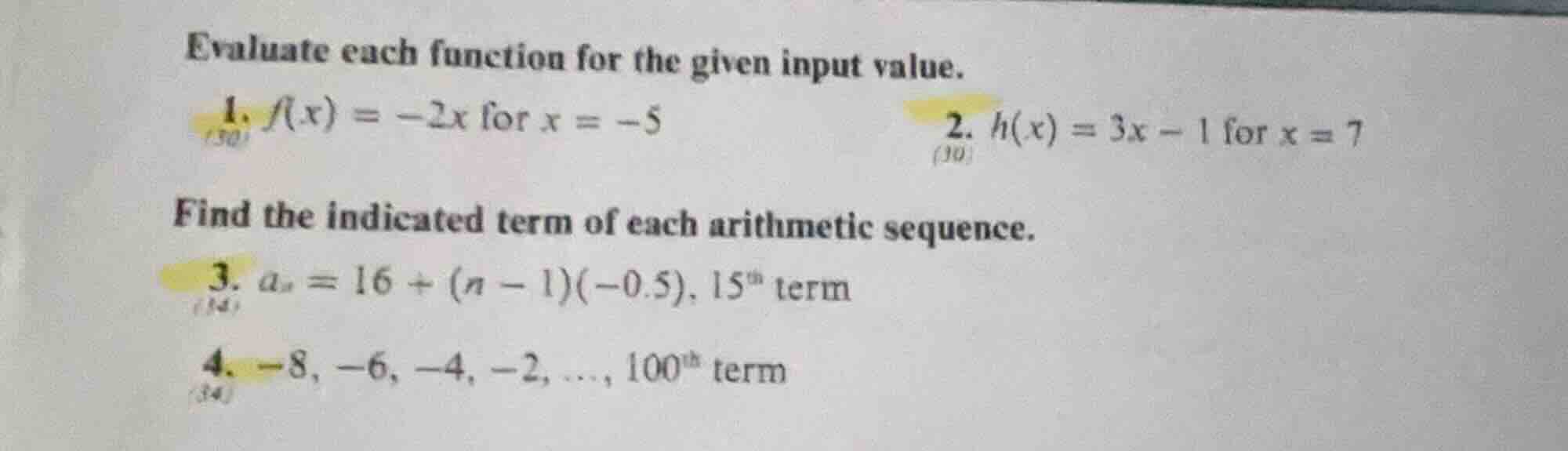
evaluate each function for the given input value.
- $f(x) = -2x$ for $x = -5$
- $h(x) = 3x - 1$ for $x = 7$
find the indicated term of each arithmetic sequence.
- $a_n = 16 + (n - 1)(-0.5)$, $15^{\text{th}}$ term
- $-8, -6, -4, -2, \dots$, $100^{\text{th}}$ term
Problem 1: Evaluate \( f(x) = -2x \) for \( x = -5 \)
Step 1: Substitute \( x = -5 \) into \( f(x) \)
We have the function \( f(x) = -2x \). To find \( f(-5) \), we replace \( x \) with \( -5 \) in the function. So we get \( f(-5) = -2 \times (-5) \).
Step 2: Simplify the expression
Multiplying two negative numbers gives a positive result. So \( -2 \times (-5) = 10 \).
Step 1: Substitute \( x = 7 \) into \( h(x) \)
The function is \( h(x) = 3x - 1 \). Substituting \( x = 7 \), we have \( h(7) = 3\times7 - 1 \).
Step 2: Simplify the expression
First, calculate \( 3\times7 = 21 \). Then subtract 1 from 21: \( 21 - 1 = 20 \).
Step 1: Recall the formula for the \( n^{\text{th}} \) term of an arithmetic sequence
The formula for the \( n^{\text{th}} \) term of an arithmetic sequence is \( a_n = a_1 + (n - 1)d \), where \( a_1 \) is the first term and \( d \) is the common difference. In our given formula \( a_n = 16 + (n - 1)(-0.5) \), to find the \( 15^{\text{th}} \) term, we substitute \( n = 15 \) into the formula. So we get \( a_{15} = 16 + (15 - 1)(-0.5) \).
Step 2: Simplify the expression inside the parentheses
First, calculate \( 15 - 1 = 14 \). Then our expression becomes \( a_{15} = 16 + 14\times(-0.5) \).
Step 3: Calculate the product and then the sum
Calculate \( 14\times(-0.5) = -7 \). Then add this to 16: \( 16 + (-7) = 16 - 7 = 9 \).

Snap & solve any problem in the app
Get step-by-step solutions on Sovi AI
Photo-based solutions with guided steps
Explore more problems and detailed explanations
\( 10 \)