QUESTION IMAGE
Question
essay questions
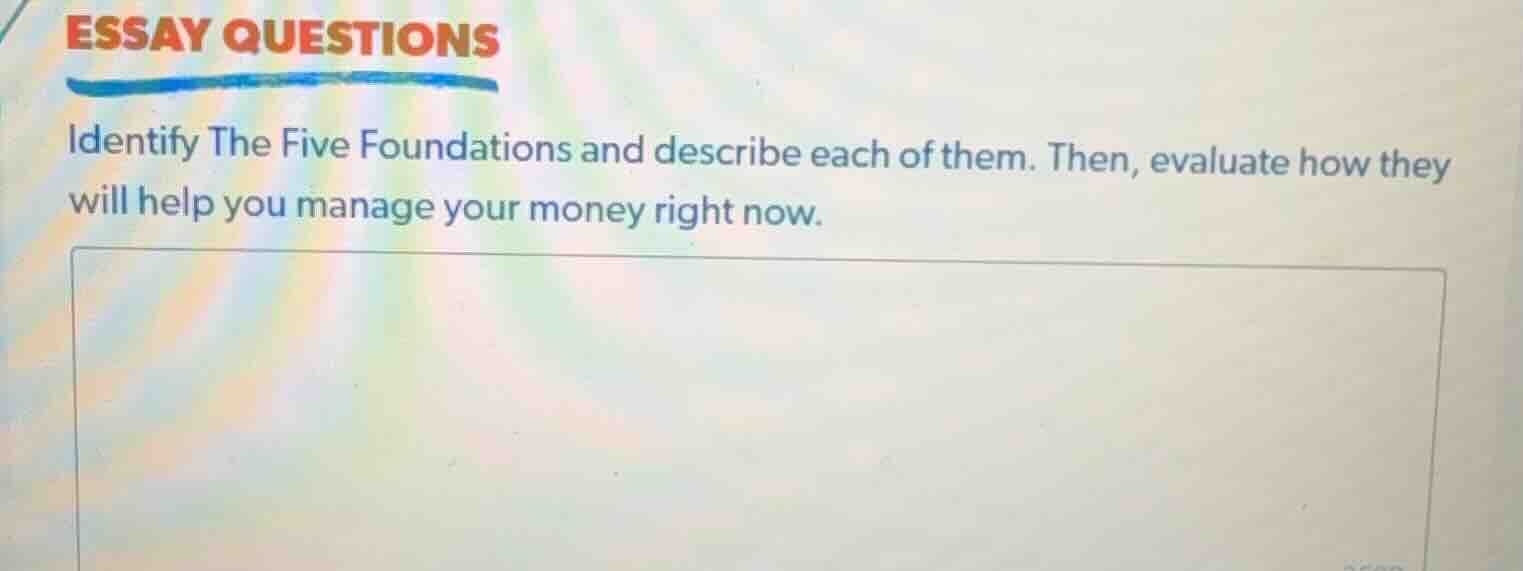
identify the five foundations and describe each of them. then, evaluate how they will help you manage your money right now.
The five foundations of personal finance (commonly in financial education) are: 1. Save a starter emergency fund of $500 - $1,000 to cover unexpected small expenses. 2. Get out of debt using the debt snowball method (paying smallest debts first while making minimum payments on others). 3. Save a fully funded emergency fund (3 - 6 months of living expenses) for major crises. 4. Pay cash for your car to avoid auto loans and interest. 5. Pay cash for college to avoid student loan debt.
To manage money now: The starter emergency fund prevents relying on credit for small emergencies. Getting out of debt frees up income. A small emergency fund stops dipping into savings for daily needs. Avoiding car loans means no monthly payments, and saving for college (or education) reduces future debt stress. Each foundation builds financial stability step - by - step, from short - term security to long - term planning.

Snap & solve any problem in the app
Get step-by-step solutions on Sovi AI
Photo-based solutions with guided steps
Explore more problems and detailed explanations
The five foundations of personal finance (for money management) are:
- Starter Emergency Fund: Save $500 - $1,000 to cover small, unexpected expenses (e.g., car repairs, medical bills). It prevents relying on credit for such costs.
- Debt Freedom (Debt Snowball): Pay off debts starting with the smallest balance (while making minimum payments on others). This eliminates debt - related stress and frees up income.
- Fully Funded Emergency Fund: Save 3 - 6 months of living expenses. It provides a safety net for major crises (e.g., job loss, major illness) without going into debt.
- Pay Cash for a Car: Avoid auto loans and their associated interest, reducing monthly financial obligations.
- Pay Cash for College: Avoid student loan debt, ensuring future financial flexibility.
For current money management:
- The starter emergency fund stops me from using credit cards for unexpected small costs, protecting my credit score and avoiding interest.
- Working on debt freedom (if I have debt) would free up money for savings or essential spending.
- Even a small emergency fund means I don't have to dip into long - term savings for daily unexpected needs.
- Paying cash for a car (if I need a vehicle) means no monthly loan payments, so I can allocate that money to savings or debt repayment.
- Saving for college (or education) now means I won't start my adult life with student loan debt, giving me more control over my financial future.