QUESTION IMAGE
Question
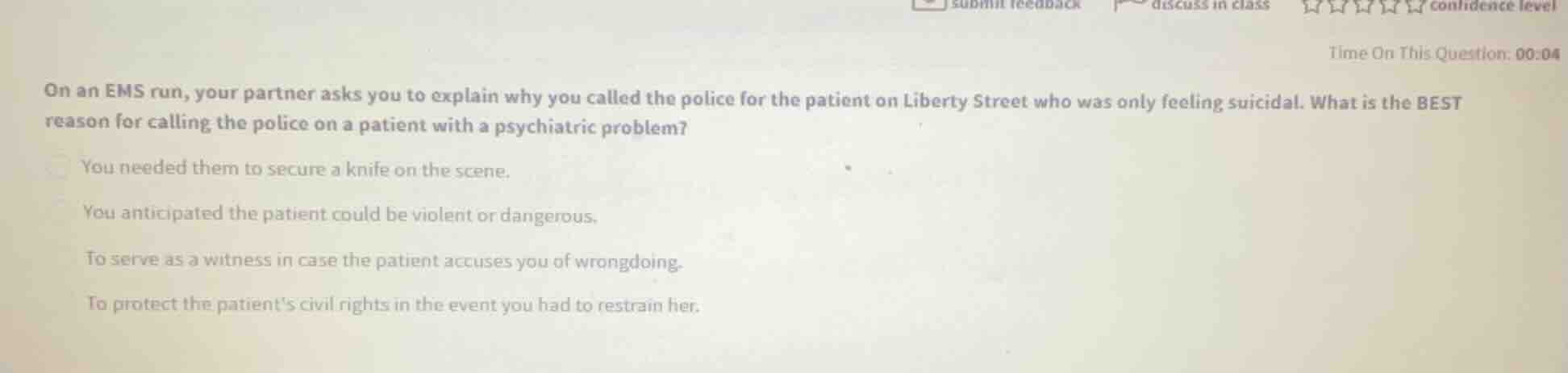
on an ems run, your partner asks you to explain why you called the police for the patient on liberty street who was only feeling suicidal. what is the best reason for calling the police on a patient with a psychiatric problem?
you needed them to secure a knife on the scene.
you anticipated the patient could be violent or dangerous.
to serve as a witness in case the patient accuses you of wrongdoing.
to protect the patients civil rights in the event you had to restrain her.
Analyze the clinical scenario
The scenario describes an EMS call for a patient experiencing suicidal ideation ("only feeling suicidal"). The core question asks for the best reason to involve law enforcement (the police) for a patient with a psychiatric emergency of this nature.
Evaluate the options based on EMS protocols
Using the Suicidal Ideation Assessment and Patient Restraint Protocols knowledge points:
- Option 1 ("You needed them to secure a knife on the scene"): This is too specific to a single hypothetical weapon not mentioned in the prompt.
- Option 2 ("You anticipated the patient could be violent or dangerous"): While scene safety is paramount, a patient who is "only feeling suicidal" is not automatically assumed to be violent toward others without specific indicators.
- Option 3 ("To serve as a witness in case the patient accuses you of wrongdoing"): This is a defensive practice but not the primary clinical or legal reason for involving law enforcement.
- Option 4 ("To protect the patient's civil rights in the event you had to restrain her"): In many jurisdictions, EMS personnel do not have the legal authority to deprive a patient of their liberty or initiate an involuntary transport/restraint without a law enforcement officer placing the patient on an involuntary psychiatric hold (protective custody). Law enforcement involvement ensures that the patient's constitutional and civil rights are protected under due process when involuntary restraint or transport is required for their own safety.
Select the best option
Therefore, protecting the patient's civil rights during involuntary restraint or transport is the most legally and ethically sound primary reason among the choices provided.

Snap & solve any problem in the app
Get step-by-step solutions on Sovi AI
Photo-based solutions with guided steps
Explore more problems and detailed explanations
- You needed them to secure a knife on the scene.
- You anticipated the patient could be violent or dangerous.
- To serve as a witness in case the patient accuses you of wrongdoing.
- To protect the patient's civil rights in the event you had to restrain her. (Correct answer)