QUESTION IMAGE
Question
effects of the great depression: a primary sources analysis activity
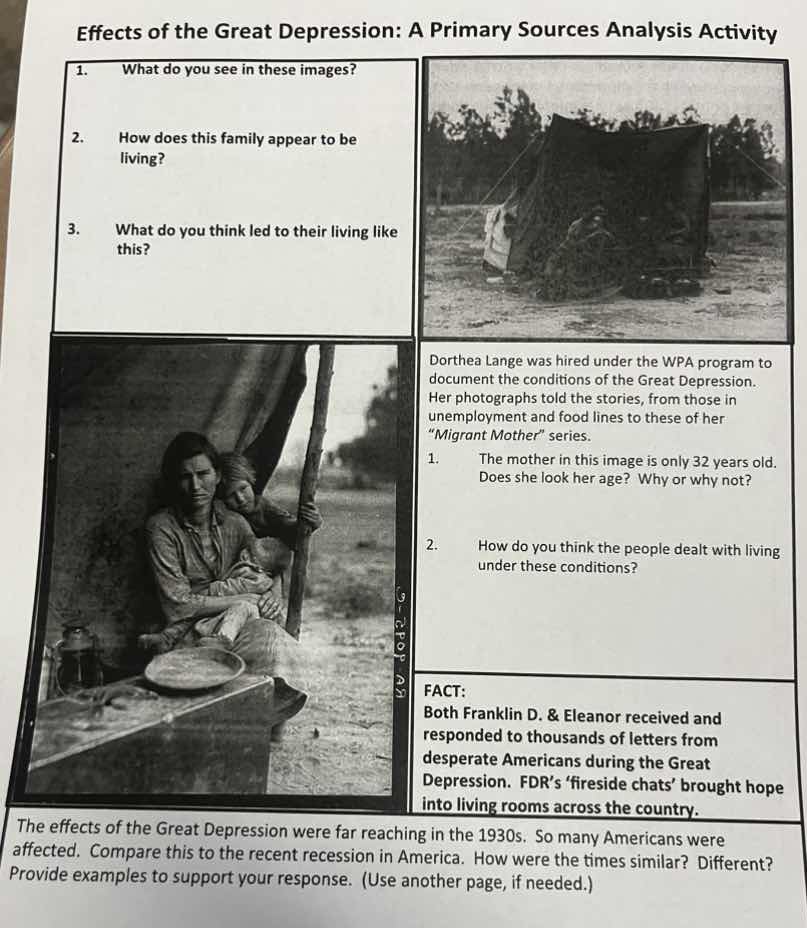
- what do you see in these images?
- how does this family appear to be living?
- what do you think led to their living like this?
dorothea lange was hired under the wpa program to document the conditions of the great depression. her photographs told the stories, from those in unemployment and food lines to these of her “migrant mother” series.
- the mother in this image is only 32 years old. does she look her age? why or why not?
- how do you think the people dealt with living under these conditions?
fact:
both franklin d. & eleanor received and responded to thousands of letters from desperate americans during the great depression. fdr’s ‘fireside chats’ brought hope into living rooms across the country.
the effects of the great depression were far reaching in the 1930s. so many americans were affected. compare this to the recent recession in america. how were the times similar? different? provide examples to support your response. (use another page, if needed.)
Top Image Questions
- The images show makeshift, ramshackle shelter (a tent-like structure) and a destitute family in a sparse, outdoor setting, typical of Great Depression-era poverty.
- The family appears to be living in extreme poverty, in temporary, inadequate shelter with no permanent housing or basic comforts.
- Their living situation was caused by the Great Depression: widespread unemployment, bank failures, loss of savings and property, and the Dust Bowl displacing rural families.
Dorothea Lange "Migrant Mother" Questions
- She does not look her age (32). The constant stress of poverty, hunger, caring for children without resources, and harsh living conditions have aged her prematurely, showing in her tired, gaunt face and weathered appearance.
- People likely coped by relying on community support, sharing scarce resources, seeking aid from government relief programs (like the WPA that hired Lange), taking odd jobs for small pay, and drawing on family bonds to survive.
Great Depression vs. Recent Recession Comparison
- Similarities: Both saw widespread job loss, financial insecurity, and a sharp drop in economic activity. For example, the 2008 recession had mass layoffs in housing and finance; the Great Depression had nationwide unemployment peaking at ~25%. Both also led to increased reliance on government assistance (food stamps in 2008, bread lines in the 1930s).
- Differences: The Great Depression was far more severe and long-lasting (over a decade vs. a few years for most recent recessions). Modern safety nets (unemployment insurance, Social Security, Medicaid) did not exist in the 1930s, so suffering was more extreme. The 2008 recession was driven by financial market collapse, while the Great Depression stemmed from stock market crash, bank failures, and agricultural collapse (Dust Bowl).

Snap & solve any problem in the app
Get step-by-step solutions on Sovi AI
Photo-based solutions with guided steps
Explore more problems and detailed explanations
Top Image Answers
- Makeshift tent shelter and a destitute family in a barren outdoor area.
- In extreme poverty, in temporary, inadequate shelter with no stable housing.
- The Great Depression: unemployment, loss of savings/property, and rural displacement from the Dust Bowl.
Dorothea Lange "Migrant Mother" Answers
- No, she does not look 32. Chronic stress, hunger, and harsh living conditions have aged her prematurely.
- They coped by relying on community/family support, government relief programs, and taking low-paying odd jobs.
Great Depression vs. Recent Recession Answers
- Similarities: Widespread job loss, financial insecurity, increased reliance on government aid. Example: 2008 recession layoffs in housing/finance mirrored 1930s nationwide unemployment; food stamp use in 2008 mirrored 1930s bread lines.
- Differences: The Great Depression was far more severe and long-lasting; modern safety nets (unemployment insurance, Social Security) did not exist in the 1930s, worsening suffering. The 2008 recession was driven by financial market collapse, while the Great Depression included agricultural collapse from the Dust Bowl.