QUESTION IMAGE
Question
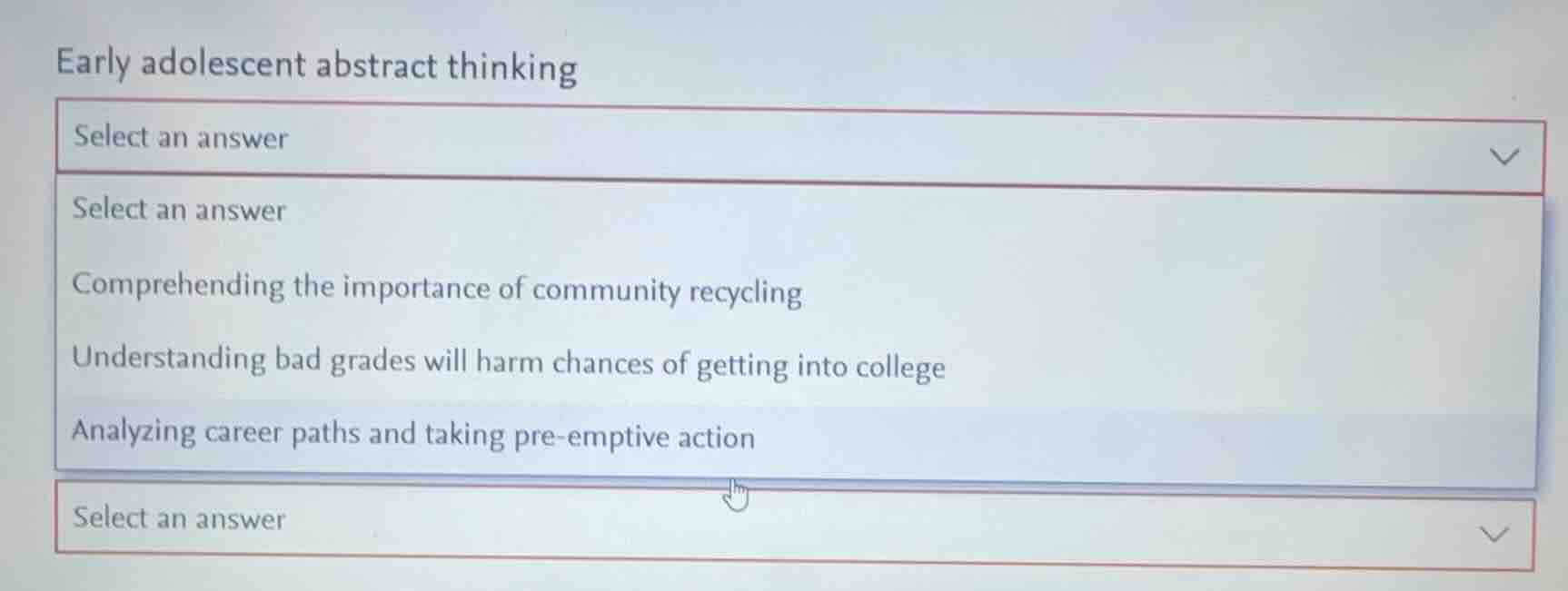
early adolescent abstract thinking
select an answer
comprehending the importance of community recycling
understanding bad grades will harm chances of getting into college
analyzing career paths and taking pre-emptive action
🆕 New Concept Discovered: Cognitive Development in Adolescence
Thinking beyond concrete, immediate experiences.
Step 1: Define early adolescent abstract thinking
During early adolescence (typically ages 11 to 14), cognitive development transitions from concrete operational thought to formal operational thought (Piaget's stages).
- Concrete thinking focuses on immediate, physical, and highly personal realities (e.g., "If I get bad grades, I won't get into college").
- Abstract thinking allows individuals to think about broader concepts, systemic issues, and ideas that are not immediately visible or personally experienced (such as global issues, philosophy, or community-wide systems).
Step 2: Evaluate the options
- "Comprehending the importance of community recycling": This requires looking beyond one's immediate personal routine to understand a broader, systemic societal concept (how individual actions impact a community and the environment). This is a classic example of early abstract thinking.
- "Understanding bad grades will harm chances of getting into college": This is a relatively direct, cause-and-effect relationship that is highly personal and concrete for a student.
- "Analyzing career paths and taking pre-emptive action": This involves long-term, systematic planning and future-oriented decision-making, which is a more advanced cognitive skill typical of late adolescence or emerging adulthood rather than early adolescence.

Snap & solve any problem in the app
Get step-by-step solutions on Sovi AI
Photo-based solutions with guided steps
Explore more problems and detailed explanations
Comprehending the importance of community recycling