QUESTION IMAGE
Question
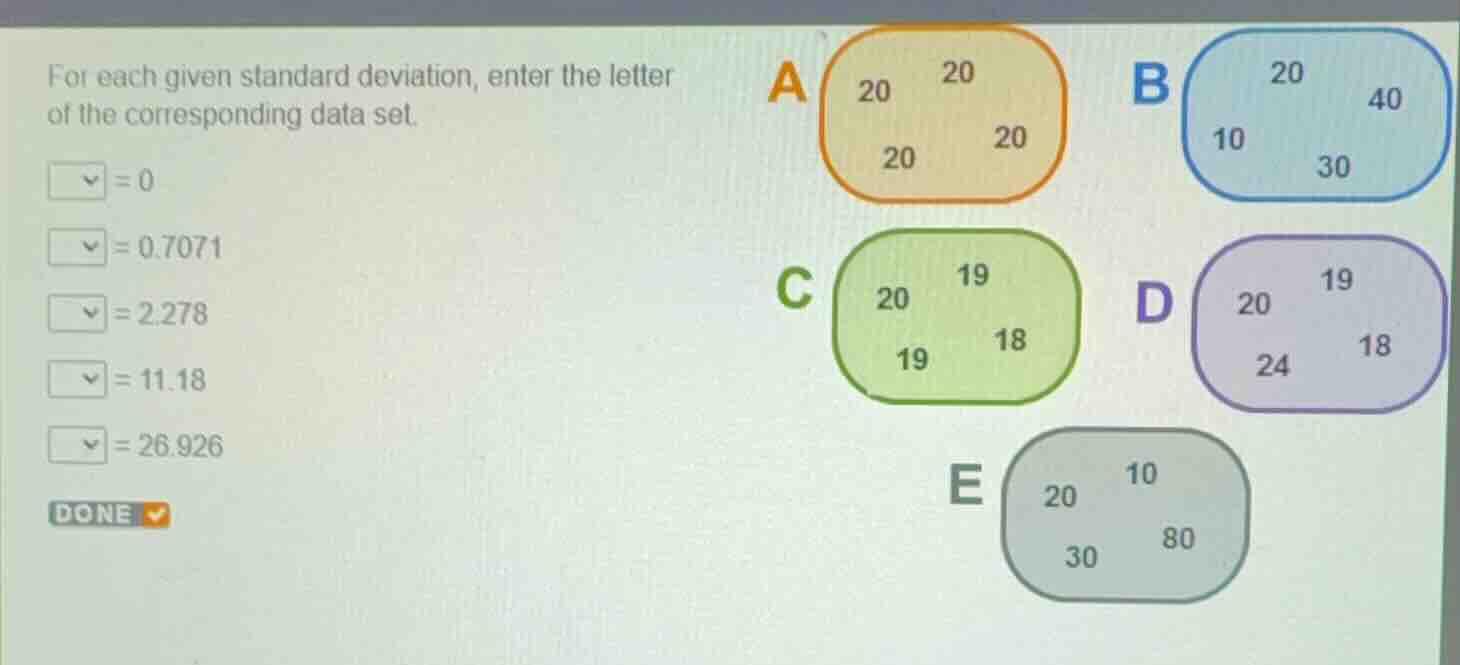
for each given standard deviation, enter the letter of the corresponding data set.
\\(\square = 0\\)
\\(\square = 0.7071\\)
\\(\square = 2.278\\)
\\(\square = 11.18\\)
\\(\square = 26.926\\)
data sets:
a: \\(\\{20, 20, 20, 20\\}\\)
b: \\(\\{10, 20, 30, 40\\}\\)
c: \\(\\{18, 19, 19, 20\\}\\)
d: \\(\\{18, 19, 20, 24\\}\\)
e: \\(\\{10, 20, 30, 80\\}\\)
Analyze data set A
Using the Measures of Spread knowledge point
- Data set A contains: \(\{20, 20, 20, 20, 20\}\).
- All values are identical, so there is no variation.
- Thus, the standard deviation is exactly \(0\).
Analyze data set C
Using the Sample Standard Deviation Formula knowledge point
- Data set C contains: \(\{18, 19, 19, 20\}\).
- Mean \(\mu = \frac{18 + 19 + 19 + 20}{4} = 19\).
- Deviations from mean: \(-1, 0, 0, 1\).
- Squared deviations: \(1, 0, 0, 1\).
- Sample variance \(s^2 = \frac{1 + 0 + 0 + 1}{4 - 1} = \frac{2}{3} \approx 0.6667\).
- Sample standard deviation \(s = \sqrt{\frac{2}{3}} \approx 0.8165\).
- Population variance \(\sigma^2 = \frac{2}{4} = 0.5\).
- Population standard deviation \(\sigma = \sqrt{0.5} \approx 0.7071\).
- This matches the given value \(0.7071\).
Analyze data set D
Using the Sample Standard Deviation Formula knowledge point
- Data set D contains: \(\{18, 19, 20, 24\}\).
- Mean \(\mu = \frac{18 + 19 + 20 + 24}{4} = 20.25\).
- Squared deviations: \((18-20.25)^2 = 5.0625\), \((19-20.25)^2 = 1.5625\), \((20-20.25)^2 = 0.0625\), \((24-20.25)^2 = 14.0625\).
- Sum of squared deviations \(= 20.75\).
- Population variance \(\sigma^2 = \frac{20.75}{4} = 5.1875\).
- Population standard deviation \(\sigma = \sqrt{5.1875} \approx 2.278\).
- This matches the given value \(2.278\).
Analyze data set B
Using the Sample Standard Deviation Formula knowledge point
- Data set B contains: \(\{10, 20, 20, 30, 40\}\).
- Mean \(\mu = \frac{10 + 20 + 20 + 30 + 40}{5} = 24\).
- Squared deviations: \((10-24)^2 = 196\), \((20-24)^2 = 16\), \((20-24)^2 = 16\), \((30-24)^2 = 36\), \((40-24)^2 = 256\).
- Sum of squared deviations \(= 520\).
- Population variance \(\sigma^2 = \frac{520}{5} = 104\).
- Population standard deviation \(\sigma = \sqrt{104} \approx 10.198\).
- Sample variance \(s^2 = \frac{520}{4} = 130\).
- Sample standard deviation \(s = \sqrt{130} \approx 11.18\).
- This matches the given value \(11.18\).
Analyze data set E
Using the Sample Standard Deviation Formula knowledge point
- Data set E contains: \(\{10, 20, 30, 80\}\).
- Mean \(\mu = \frac{10 + 20 + 30 + 80}{4} = 35\).
- Squared deviations: \((10-35)^2 = 625\), \((20-35)^2 = 225\), \((30-35)^2 = 25\), \((80-35)^2 = 2025\).
- Sum of squared deviations \(= 2900\).
- Population variance \(\sigma^2 = \frac{2900}{4} = 725\).
- Population standard deviation \(\sigma = \sqrt{725} \approx 26.926\).
- This matches the given value \(26.926\).

Snap & solve any problem in the app
Get step-by-step solutions on Sovi AI
Photo-based solutions with guided steps
Explore more problems and detailed explanations
| Standard Deviation | Data Set |
|---|---|
| \(0.7071\) | C |
| \(2.278\) | D |
| \(11.18\) | B |
| \(26.926\) | E |