QUESTION IMAGE
Question
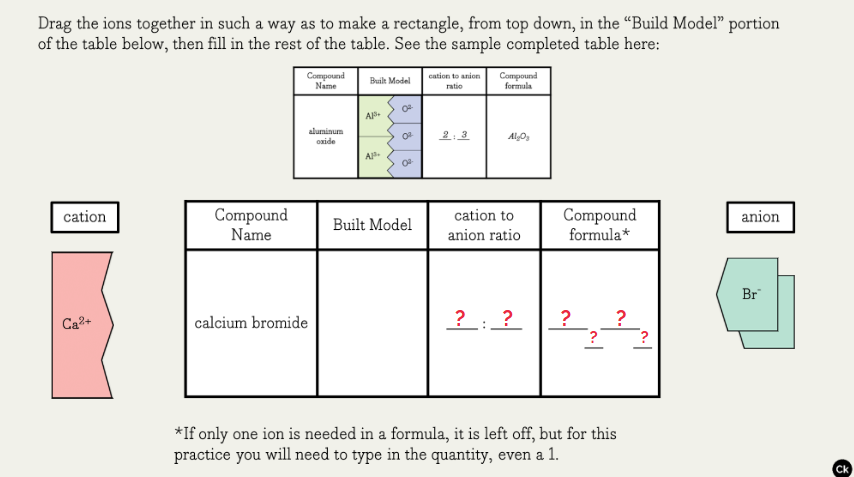
drag the ions together in such a way as to make a rectangle, from top down, in the \build model\ portion of the table below, then fill in the rest of the table. see the sample completed table here:
\
\
& 2 : 3 & \text{al}_2\text{o}_3 \\\\
\hline
\end{tabular}
\
*if only one ion is needed in a formula, it is left off, but for this practice you will need to type in the quantity, even a 1.
⚡ Using what you learned: formation of ionic and covalent bonds
Step 1: Identify the charges of the ions
The cation is calcium, which has a \(2+\) charge:
The anion is bromide, which has a \(1-\) charge:
Step 2: Balance the charges to find the ratio
To form a neutral ionic compound, the total positive charge must equal the total negative charge.
- One \(\text{Ca}^{2+}\) ion provides a charge of \(+2\).
- Each \(\text{Br}^-\) ion provides a charge of \(-1\).
To balance the \(+2\) charge, we need two \(\text{Br}^-\) ions:
Thus, the ratio of cation to anion is:
Step 3: Write the compound formula
Using the ratio of \(1\) calcium ion to \(2\) bromide ions, and following the instruction to write the quantity even if it is \(1\), the formula is:

Snap & solve any problem in the app
Get step-by-step solutions on Sovi AI
Photo-based solutions with guided steps
Explore more problems and detailed explanations
- cation to anion ratio:
1 : 2 - Compound formula:
Ca1Br2