QUESTION IMAGE
Question
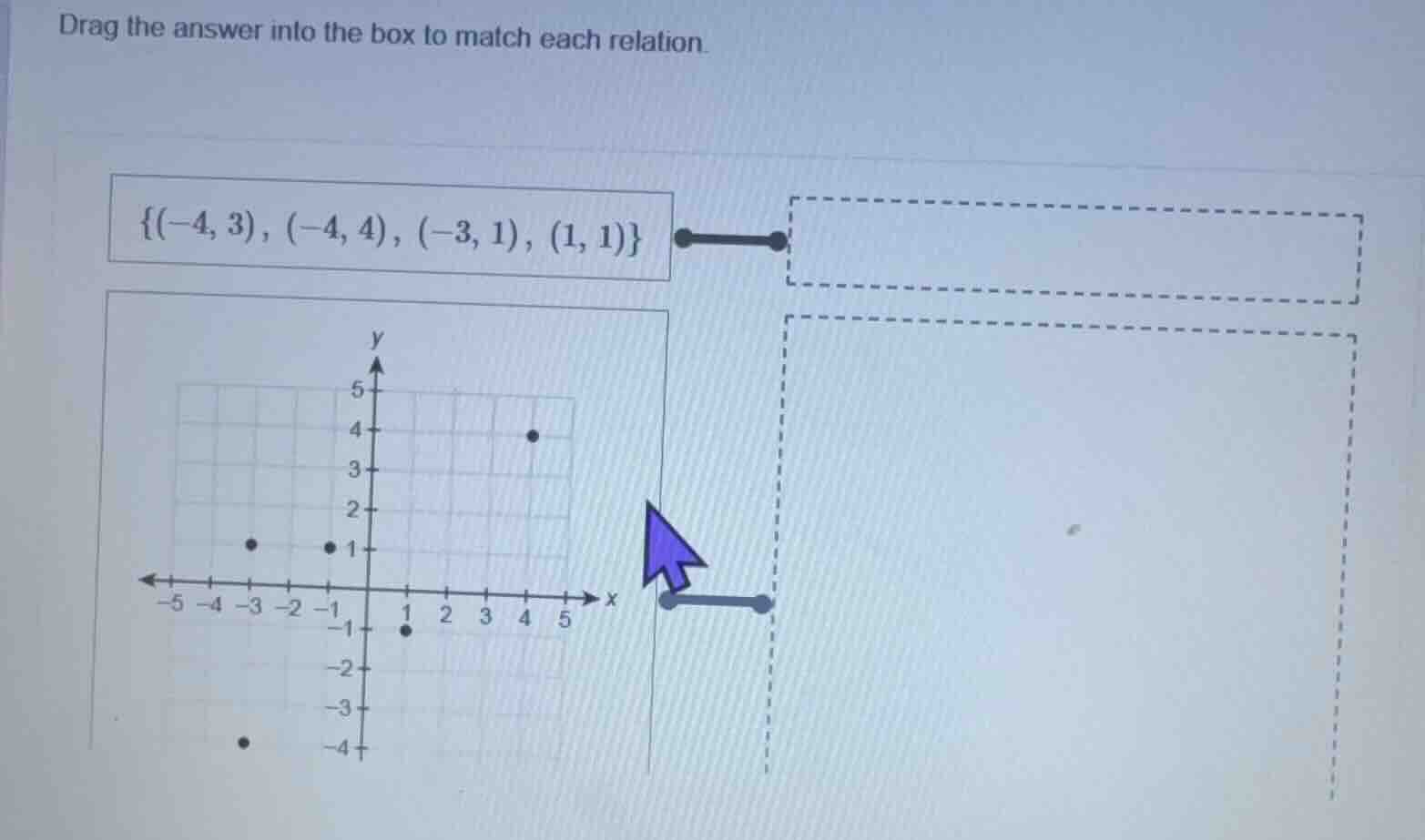
drag the answer into the box to match each relation. {(-4, 3), (-4, 4), (-3, 1), (1, 1)} graph of a coordinate plane with points plotted at (-3,1), (-1,1), (1,-1), (4,4), (-4,-4)
Step1: Identify coordinates from graph
First, we list the coordinates of the points on the graph. From the graph:
- At \( x = -4 \), \( y = -4 \) (point \((-4, -4)\))
- At \( x = -3 \), \( y = 1 \) (point \((-3, 1)\))
- At \( x = -1 \), \( y = 1 \) (point \((-1, 1)\))
- At \( x = 1 \), \( y = -1 \) (point \((1, -1)\))
- At \( x = 4 \), \( y = 4 \) (point \((4, 4)\))
Wait, no, let's re - examine. Wait the given relation is \(\{(-4, 3), (-4, 4), (-3, 1), (1, 1)\}\). Wait maybe I misread the graph. Wait the graph has points: Let's check the x - coordinates and y - coordinates again.
Wait the first relation is \(\{(-4, 3), (-4, 4), (-3, 1), (1, 1)\}\). Now let's check the graph. The graph has a point at \( x=-4,y = - 4\)? No, maybe I made a mistake. Wait the other side (the graph) has points: Let's list all the dots:
- One dot at \( (-4, -4) \) (x=-4, y=-4)
- One at \( (-3, 1) \) (x=-3, y = 1)
- One at \( (-1, 1) \) (x=-1, y = 1)
- One at \( (1, -1) \) (x = 1, y=-1)
- One at \( (4, 4) \) (x = 4, y = 4)
Wait, no, the relation given is \(\{(-4, 3), (-4, 4), (-3, 1), (1, 1)\}\). Wait maybe the graph is not the one we are matching? Wait, no, the problem is to match the relation \(\{(-4, 3), (-4, 4), (-3, 1), (1, 1)\}\) with the correct description (like function or not, but maybe the other box is for the graph's relation). Wait, no, the key is to check the x - values (domains) of the relation \(\{(-4, 3), (-4, 4), (-3, 1), (1, 1)\}\). The x - value \(-4\) is paired with two y - values (\(3\) and \(4\)), so it's not a function. Now let's check the graph's points. Wait maybe the graph's relation is different. Wait, perhaps the first relation \(\{(-4, 3), (-4, 4), (-3, 1), (1, 1)\}\) has a repeated x - value (\(-4\)) so it's a relation that's not a function, and we need to match it with the appropriate description. But maybe the other box is for the graph's relation. Wait, maybe the problem is to identify that the relation \(\{(-4, 3), (-4, 4), (-3, 1), (1, 1)\}\) is not a function (since \(x=-4\) has two \(y\) - values), and the graph's relation: let's list the graph's points. From the graph:
Points are: \((-4, -4)\), \((-3, 1)\), \((-1, 1)\), \((1, -1)\), \((4, 4)\)
Wait, no, maybe I misread the graph. Let's look again. The y - axis is vertical, x - axis horizontal. The dots:
- At \(x=-4\), \(y = - 4\) (so \((-4, -4)\))
- At \(x=-3\), \(y = 1\) (so \((-3, 1)\))
- At \(x=-1\), \(y = 1\) (so \((-1, 1)\))
- At \(x = 1\), \(y=-1\) (so \((1, -1)\))
- At \(x = 4\), \(y = 4\) (so \((4, 4)\))
Now the given relation is \(\{(-4, 3), (-4, 4), (-3, 1), (1, 1)\}\). Let's check the x - values: \(-4\), \(-4\), \(-3\), \(1\). The y - values: \(3\), \(4\), \(1\), \(1\). So for \(x=-4\), there are two \(y\) - values (\(3\) and \(4\)), so it's a relation, not a function (since a function requires each \(x\) to have at most one \(y\)).
Now, if we are to match the relation \(\{(-4, 3), (-4, 4), (-3, 1), (1, 1)\}\) with the appropriate category (like not a function), but maybe the other box is for the graph's relation. Wait, perhaps the problem is to see that the relation \(\{(-4, 3), (-4, 4), (-3, 1), (1, 1)\}\) has a repeated \(x\) - value (\(-4\)) so it's not a function, and the graph's relation: let's check the graph's \(x\) - values: \(-4\), \(-3\), \(-1\), \(1\), \(4\) (all unique), so the graph's relation is a function (since each \(x\) has one \(y\)). But the given relation has \(x=-4\) twice, so it's not a function. So we need to match the relation \(\{(-4, 3), (-4, 4), (-3, 1), (1, 1)\}\) with the description "not a function" (or the appropri…

Snap & solve any problem in the app
Get step-by-step solutions on Sovi AI
Photo-based solutions with guided steps
Explore more problems and detailed explanations
The relation \(\{(-4, 3), (-4, 4), (-3, 1), (1, 1)\}\) is not a function (matches with the box indicating non - function, based on the fact that \(x=-4\) has two corresponding \(y\) - values).