QUESTION IMAGE
Question
dna replication (2 of 2): synthesis of the leading and lagging strands (bioflix tutorial)
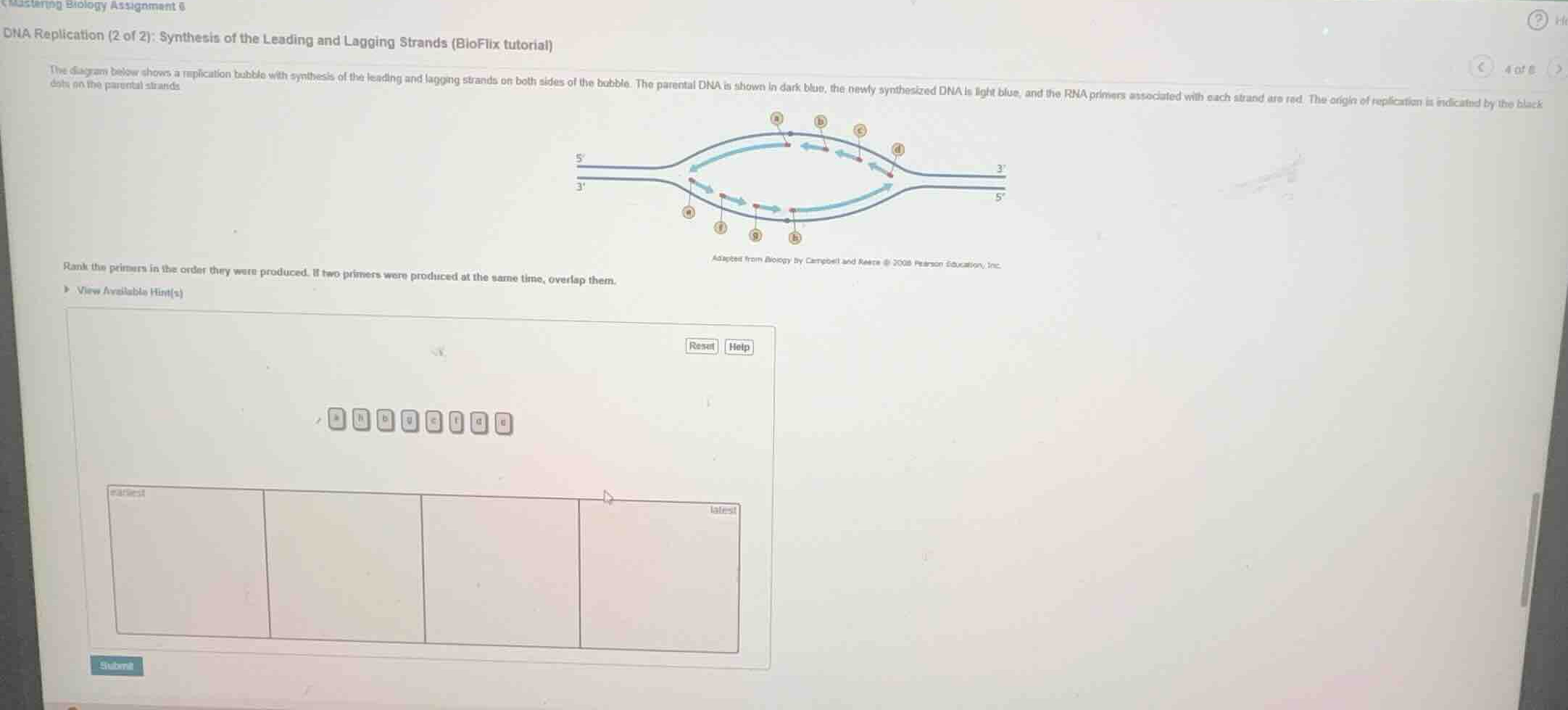
the diagram below shows a replication bubble with synthesis of the leading and lagging strands on both sides of the bubble. the parental dna is shown in dark blue, the newly synthesized dna is light blue, and the rna primers associated with each strand are red. the origin of replication is indicated by the black dots on the parental strands.
rank the primers in the order they were produced. if two primers were produced at the same time, overlap them.
Identify the origin and strand polarities
The origin of replication is marked by the black dots on the parental strands in the middle of the replication bubble.
The top parental strand runs \(5'\) to \(3'\) from left to right.
The bottom parental strand runs \(3'\) to \(5'\) from left to right.
Using Antiparallel Strands, newly synthesized strands must run antiparallel to their template strands.
Determine leading and lagging strand directions
Replication forks move outward in both directions from the central origin.
For the left fork (moving left):
- The top template is \(5'\) to \(3'\) (left-to-right), so moving left goes toward its \(5'\) end. The new strand synthesized leftward on this template runs \(3'\) to \(5'\) (lagging strand).
- The bottom template is \(3'\) to \(5'\) (left-to-right), so moving left goes toward its \(3'\) end. The new strand synthesized leftward runs \(5'\) to \(3'\) (leading strand).
For the right fork (moving right):
- The top template is \(5'\) to \(3'\) (left-to-right), so moving right goes toward its \(3'\) end. The new strand synthesized rightward runs \(5'\) to \(3'\) (leading strand).
- The bottom template is \(3'\) to \(5'\) (left-to-right), so moving right goes toward its \(5'\) end. The new strand synthesized rightward runs \(3'\) to \(5'\) (lagging strand).
Analyze primer placement and synthesis order
Using Leading and Lagging Strand Synthesis and Replication Fork Movement:
- Leading strands require only one primer near the origin to initiate continuous synthesis outward.
- Leftward leading strand (bottom template, left side): Primer (h) is at the origin.
- Rightward leading strand (top template, right side): Primer (a) is at the origin.
- Since these initiate replication at the origin, primers (a) and (h) are produced first (earliest).
- Lagging strands require multiple primers synthesized discontinuously as the fork opens.
- The first lagging strand primers are synthesized closest to the origin.
- Leftward lagging strand (top template, left side): Primer (b) is closer to the origin, and primer (c) is further left (closer to the fork). Thus, (b) is made before (c).
- Rightward lagging strand (bottom template, right side): Primer (g) is closer to the origin, and primer (f) is further right (closer to the fork). Thus, (g) is made before (f).
- As the forks expand equally, the first set of lagging primers (b) and (g) are produced at the same time.
- The second set of lagging primers are synthesized further out as the fork opens wider.
- These are primers (c) and (f). They are produced at the same time, after (b) and (g).
- The third set of lagging primers are furthest out near the active forks.
- These are primers (d) and (e). They are produced last (latest).
Group and rank the primers chronologically
Combining the steps, the chronological order from earliest to latest is:
- Earliest: (a) and (h) (leading strand primers at the origin)
- Second: (b) and (g) (first lagg…

Snap & solve any problem in the app
Get step-by-step solutions on Sovi AI
Photo-based solutions with guided steps
Explore more problems and detailed explanations
The correct chronological order of the primers from earliest to latest (with simultaneous primers grouped together) is:
Earliest \(
ightarrow\) Latest
- a, h
- b, g
- c, f
- d, e